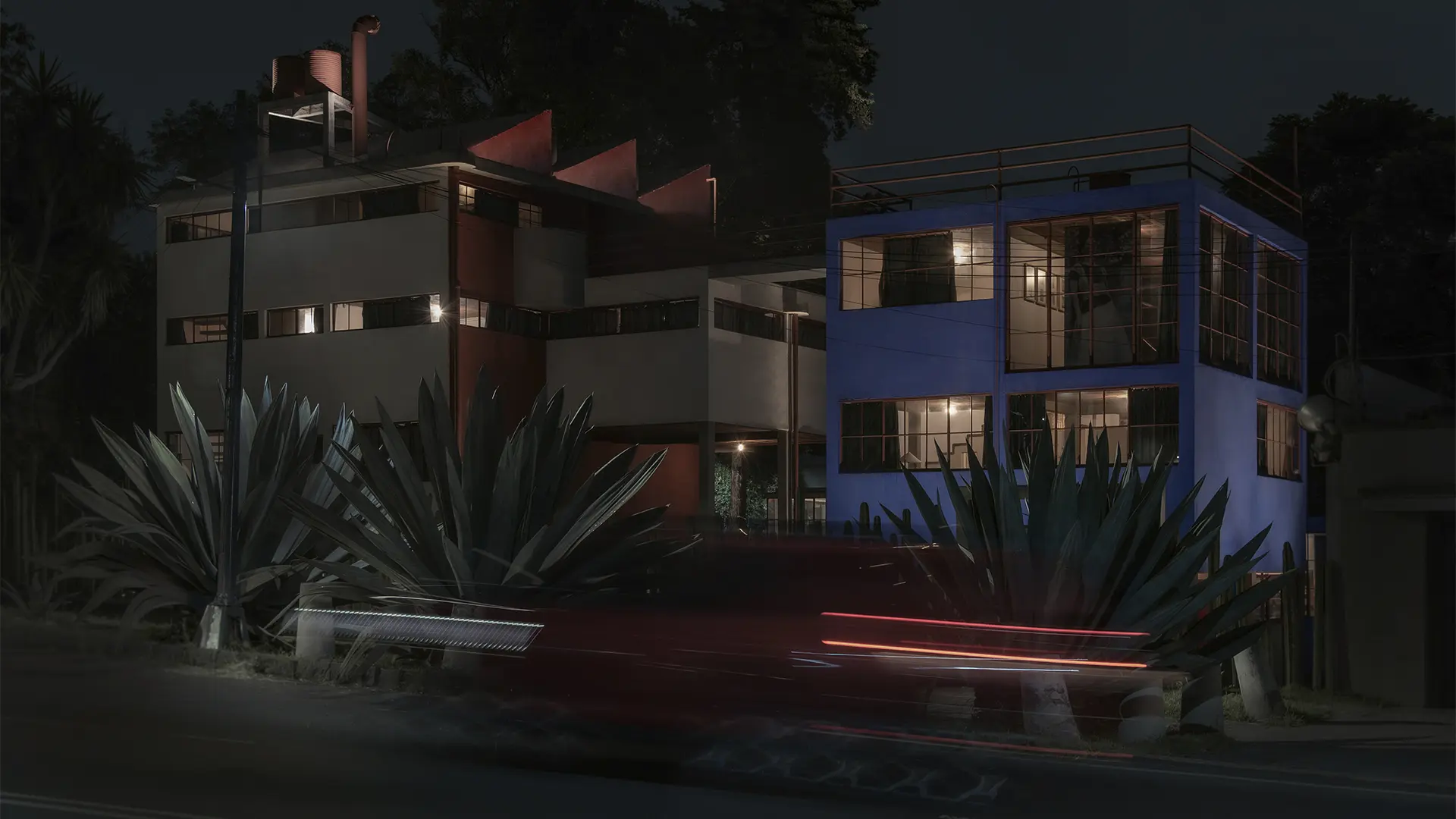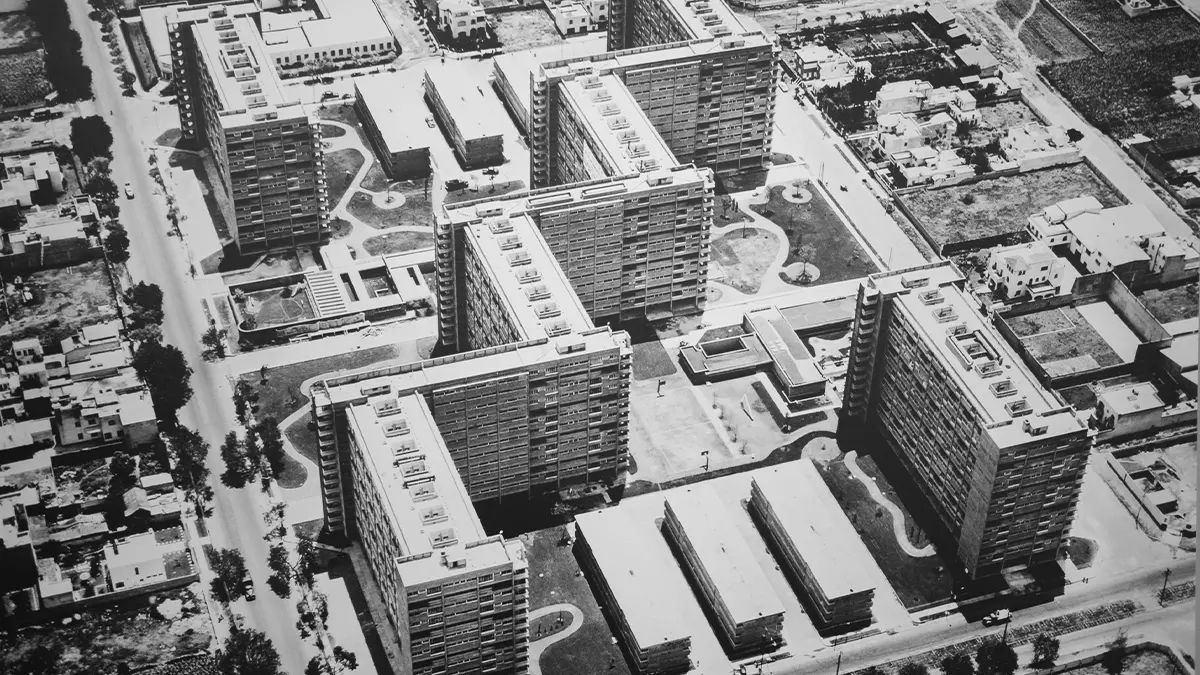

Modernist Chimeras, at the National Museum of Architecture, invites visitors to explore, through a dual perspective, the legacy of architect Mario Pani—one of Mexico’s most influential urban planners—and that of Guillermo Zamora, a pioneer of architectural photography in the country.
The central theme of Modernist Chimeras is drawn from Pani’s personal archive and examines the works that shaped the architectural landscape of Mexico City: the UNAM University City, the Presidente Alemán Urban Complex, and the Nonoalco-Tlatelolco Housing Complex. These projects also marked the beginning of coordinated urban planning. The exhibition will be on view through May 3, 2026, on the third floor of the Palacio de Bellas Artes in Mexico City.

How should we approach the exhibition “Modernist Chimeras“?
According to curator Rocío Guerrero Mondoño, the exhibition draws on documentary records of the construction of iconic buildings in Mexico City and is organized around three thematic strands: images of Mexico’s reconstruction following the Revolution, a cinematic perspective on architectural works, and the architectural portrait as a conceptual framework.
Zamora’s photographs capture the bittersweet charm of everyday life in these urban areas through images that depict the daily routines and leisure activities of their residents.
The title, which alludes to fantastical worlds and modernity, foreshadows a historical interpretation based on multiple perspectives and positions the exhibition as an exercise in critical reflection.
Thus, the exhibition does not merely present a sanitized version of the past, but seeks to acknowledge both the merits and the flaws of a project that, for better or worse, left its mark on the history of Mexico City—regardless of whether it was the result of pipe dreams or concrete historical circumstances.

Pani and its significance in the history of urban planning in Mexico City
Based on this curatorial interpretation, it is necessary to examine the figure of Mario Pani (1911–1993) and the historical conditions that shaped his urban project. Hero or villain? The exhibition does not seek to determine this.
Without a doubt, Mario Pani is an icon of Mexican architecture. He played a pivotal role in introducing European functionalism to the capital’s landscape and to national urban planning, in dialogue with a society in the process of recovery.
In The Labyrinth of Solitude, Octavio Paz interprets the Mexican Revolution as a moment in which the country was forced to confront its historical and cultural identity. This process was compounded by the rapid growth of Mexico City, a result of political, economic, and labor centralization, as well as massive rural migration.
This context paved the way for the emergence of a large-scale urban project such as Pani’s, who conceived of housing complexes as a rational response to population growth and the need to organize the city.
The Legacy of Mario Pani
Pani, who studied architecture at the École Nationale Supérieure des Beaux-Arts in Paris, was trained in the principles of functionalism, the theories of Le Corbusier, and European urban planning—ideas he sought to apply to the complex and somewhat unequal reality of Mexico.
Among his most important works are: the Miguel Alemán Housing Complex (1949), Mexico’s first major modern housing development; the Juárez Housing Complex (1950), a project emblematic of functionalist urban planning—which did not survive the 1985 earthquake—; the UNAM University City (1950–1954), where he integrated architecture, urban planning, and art into a project that is now a UNESCO World Heritage Site; and the Nonoalco-Tlatelolco Urban Complex (1960–1964), conceived as a “city within a city.”

“Modernist Chimeras ” explores the legacy of Mario Pani. Photo: INBA
Mario Pani ‘s legacy includes 136 projects, such as houses, hospitals, public buildings, schools, and urban complexes.
*Modernist Chimeras* also documents some of his projects that never came to fruition, such as an urban development plan that began at the Insurgentes Roundabout and extended to the Cuauhtémoc Roundabout along Paseo de la Reforma. It also covers Pani’s work outside the Mexican capital, such as the Yacht Club, the Los Cocos condominium, and the old Acapulco airport.
Mario Pani and Urban Planning in Mexico City
His work transformed the urban landscape of Mexico City through the use of high-density development—the intelligent concentration of a large number of people in a small area—axial layout—a system that organizes space by aligning its elements along one or more straight axes—and the incorporation of green spaces.
History shows that Pani firmly believed that architecture and urban planning could organize society; consequently, his designs prioritized urban and formal functionality over actual community life, which drew considerable criticism on the grounds that modern architecture needed to be approached from a local perspective.

Guillermo Zamora, a visual chronicler of architecture and art
The photographs by Guillermo Zamora—who also had a background as a visual artist—provide the precision and sensitivity needed to understand Pani’s futurism beyond its utopian implications. His highly cinematic images document both the aesthetic and social dimensions of the buildings, and they rewrite architectural reality by incorporating the human experience. Zamora was also a pioneer of architectural photography in Mexico.

What makes an exhibition like Modernist Chimeras lies in the fact that, in addition to celebrating these promises of modernity, it also challenges them somewhat and examines their role in today’s Mexico. Furthermore, it invites us to recognize that those chimeras are not exclusive to the past: they continue to inhabit the contemporary city and question the way we imagine and build our urban future.
To keep exploring this thread, visit contemporary Latin American architecture.