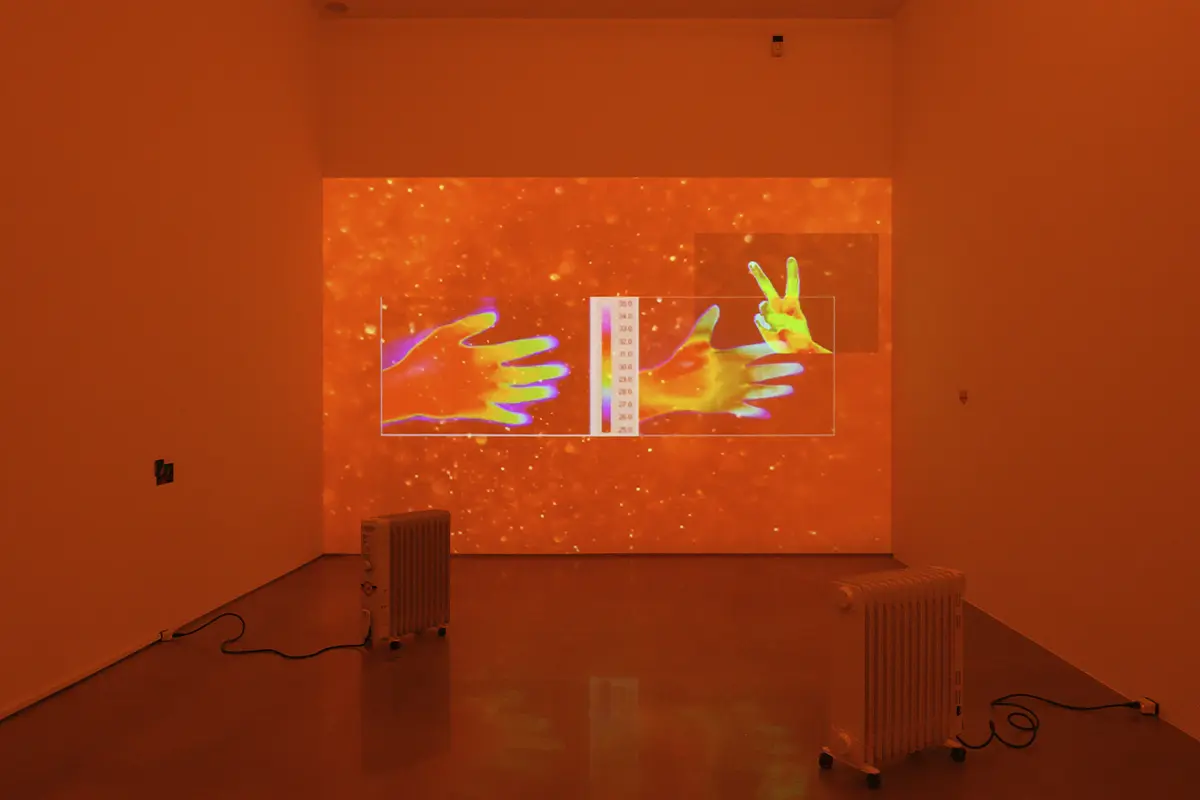

The Museo de Arte Contemporáneo de Panamá (MAC Panamá) highlights the participation of local, Central American and Spanish artists in Horizon Ablaze, the international exhibition presented at the Taichung Art Museum (TcAM) in Taiwan. The Asian exhibition brings together 33 artists from 16 countries and is the result of a collaboration between independent curator Nobuo Takamori (Japan-Taiwan), Tessa Maria Guazon, chief curator of the UP Vargas Museum (Philippines), and MAC Panamá’s curatorial team, led by chief curator Juan Canela and curator Jennifer Choy.

Latin American art on the rise
The exhibition underscores the growing recognition of Latin American art, especially Central American art, on the global stage. Through perspectives from Asia, Africa, Europe, Oceania and Latin America, Horizon Ablaze explores the concept of “heat” beyond its climatic dimension, approaching it as a cultural, historical and social experience tied to tropical territories, colonial inheritances and diverse forms of resistance and collective healing.
“The exhibition also invites reflection on climate as a cultural force capable of shaping bodies, knowledge systems, cultural heritage and healing practices”
The exhibition also invites reflection on climate as a cultural force “capable of shaping bodies, knowledge systems, cultural heritage and healing practices.
In this way, it establishes a dialogue between tropical experiences, colonial legacies and contemporary expressions of cultural, social and artistic resistance,” according to a statement.
Horizon Ablaze is part of the Taichung Art Museum’s summer program and is presented alongside The Covenant of Dadu: A Diplomacy of Things between Mountains and Seas, a research project centered on Taiwan’s history, territory and infrastructures.
The curatorial work behind Horizon Ablaze
The curatorial proposal is led by Nobuo Takamori, Tessa Maria Guazon, Juan Canela and Jennifer Choy. Takamori, a Japanese-Taiwanese curator based between Dusseldorf, Germany, and Taipei, Taiwan, is known for his research into the connections between Taiwan, Southeast Asia and the Global South. His most notable projects include Post-Actitud (2011), South Country, South of Country (2012), Is/In Land (2018), The Secret South (2020) and The Oceans and the Interpreters (2022-2023).
Tessa Maria Guazon is a Filipino curator and researcher specializing in contemporary art in public space in Asia. She currently directs the UP Vargas Museum (University of the Philippines Jorge Vargas Museum and Filipiniana Research Center), where she has advanced projects such as Fever Dream and Gardens and Homesteads, focused on exploring new forms of exhibition and social participation.

Contemporary artistic practices and international collaboration processes
Juan Canela is chief curator of the Museo de Arte Contemporáneo de Panamá (MAC Panamá) and a member of the Advisory Committee of the Instituto Cader de Arte Centroamericano at the Museo Reina Sofía. His work has unfolded across leading institutions and platforms in Latin America and Europe, with a particular interest in contemporary artistic practices and processes of international collaboration.
His recent projects include curating the Projects section of ArtBo Bogota (2024), co-curating the 23rd Paiz Art Biennial in Guatemala (2023) and serving as curatorial director of El Patio ABC in Baja California, Mexico (2023-2024). He previously served as artistic director of ZsONAMACO in Mexico City and has been linked to initiatives such as Matadero Madrid, osloBIENNALEN and BAR Project in Barcelona.

Jennifer Choy is curator at the Museo de Arte Contemporáneo de Panamá (MAC Panamá). Her research focuses on contemporary art from Central America, the Caribbean and Asia, exploring the cultural and affective ties between these regions.
Her curatorial practice addresses themes related to memory, politics of care, decolonial thought and the construction of identities in diasporic contexts.
Trained in Culture, Criticism and Curation at Central Saint Martins, University of the Arts London, she has developed curatorial and editorial projects in different spaces across the region. She was also co-director and curator of the independent space Antítesis, where she promoted initiatives devoted to artistic experimentation and the exchange of contemporary ideas.

Central America present in Horizon Ablaze
Among the artists from Panama and Central America participating in Horizon Ablaze are Panamanians Donna Conlon (1966) y Jonathan Harker (1975), internationally recognized for works that explore geopolitics and social dynamics through humor and critique. Their works are part of major international collections, including those of Tate and the Guggenheim Museum.
The exhibition presents Drinking Song (2011), a sound installation made with Panamanian beer bottles that perform the United States national anthem, a reflection on the complex historical relationship between the two countries. Also on view is Tropical Zincphony (2013), an audiovisual work that turns the sound of mangoes falling onto zinc roofs into a sensory experience tied to the tropical landscape.
Vibrations, sound, heat and collective memory
The exhibition also includes Guatemalan artist Edgar Calel (1987), one of the leading figures in Central American contemporary art. During a residency in Taichung, he developed Aq’on-Q’ojom Musical Medicine, an installation that turns stones – considered in the Maya worldview to be carriers of knowledge – into a space crossed by vibrations, sound, heat and collective memory.
Costa Rican artist Verónica Navas (1995) also participates with The Healing Power of Nature, a project exploring the relationships between nature, healing and traditional knowledge through cabuya fibers, vessels made from gourds and artisanal processes inspired by herbal recipes.

The Panamanian representation is completed by artists Andrea Santos (1991) and Ana Elena Tejera (1990), whose practices expand the country’s presence within an exhibition that brings together 33 artists from 16 nations across Asia, Africa, Europe, Oceania and Latin America.
The Ibero-American presence is complemented by Eliazar Ortiz Roa, from the Dominican Republic, and Cristina Mejías, from Spain. Through different languages and approaches, these artists explore themes linked to memory, territory, ancestral knowledge, identity and social transformations, contributing perspectives that enrich the intercultural dialogue proposed by the exhibition.
Encounter and international exchange
Alongside them, the exhibition brings together creators from Asia, Africa, Europe and Oceania, including Musquiqui Chihying, Chang Chien-Chi and Liao Jui-Fen (Taiwan), Buen Calubayan and Corinne de San Jose (Philippines), Rahima Gambo (Nigeria/United Kingdom), Penelope Cain (Australia), Ampannee Satoh (Thailand), Neli Ružić (Croatia) and Luchezar Boyadjiev (Bulgaria), among others.
The coexistence of these voices from diverse cultural contexts strengthens the global character of Horizon Ablaze, turning the event into a space of encounter and exchange where local experiences, memories and histories enter into dialogue.
At the same time, the Taichung Art Museum presents The Covenant of Dadu: A Diplomacy of Things between Mountains and Seas, an exhibition based on two years of research into art history, territory and infrastructure in Taiwan.
MAC Panamá’s participation in this project reaffirms the growing international visibility of Panamanian and Central American artists while strengthening cultural ties between Latin America and Asia. Horizon Ablaze will remain open to the public at the Taichung Art Museum through August 30, 2026.
Find more news on Latin American and Spanish representation in AW Magazine.
To keep exploring this thread, visit contemporary art from Latin America; you can also continue through contemporary Latin American artists.