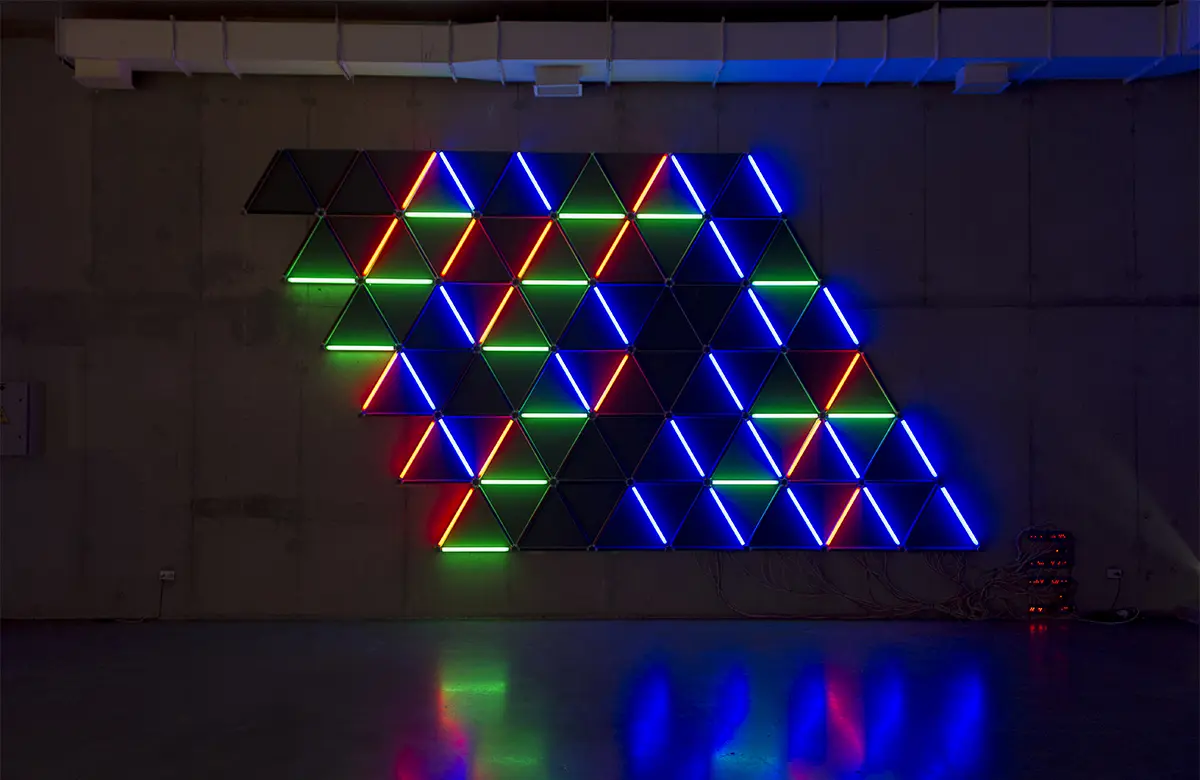

For Gonzalo Reyes-Araos, traveling and settling in other places and other times constitutes an essential dimension of a body of work characterized by displacement, detachment, and, at the same time, new forms of long-distance communication. Born in Quilpué, Chile, in 1980, the artist currently lives and works between Berlin and Chile. His career, however, extends far beyond this dual geographical affiliation: since the early 2000s, he has developed a practice marked by successive relocations, residencies, exhibitions, and international collaborations. His journey through Chile, Switzerland, Belgium, France, Germany, China, and South Korea, among other contexts, allows us to understand travel not simply as a biographical circumstance, but as an experience that permeates and structures his artistic production. We spoke with him.
I notice that the issue of immigration continues to be a major theme in contemporary art
I believe that curiosity about exploring different places can indeed be inherent to the artist. In my case, it was precisely migration that sparked a significant portion of my body of work. Let’s say that the act of migrating created new bonds and changed the ways I relate to my people, my country, and my homeland.

So did communication technology spark some of your work?
All of this was already influenced by the way I communicated—over the phone or via video call, which at the time was Skype, where the connection wasn’t very good, so it caused these glitches. And these glitches—this filter on reality—began to intrigue me.
Where was the trip that started it all?
This actually began in China. It was during an artist residency where I was forced to spend a month locked in a room, but was required to produce artwork.
Why were you locked up?
It was a motorcycle accident. I fell off. But for me, it was a lucky accident. I call it that because, since I was under a bit of pressure to produce a body of work—an exhibition—the only things I had in front of me were a computer screen and an internet connection. I was settled in, living in Switzerland. At the time, I had friends and family in Switzerland, and I had family in Chile.

How did you get started with those processes?
What I started doing was recording and photographing all the information, all the conversations I had with my family. My mother lives in the Atacama Desert in Chile, and she’d show me incredible landscapes on her tablet—the beach, sunsets, and the deserts. And I’d record all of that. I’d save it as reference material.
Was everything based on those samples?
In the countryside as well—in central Chile, which has a more Mediterranean climate—my family also showed me around the countryside, places I had visited as a child. That provided me with a significant body of material to work with.

What did you do with those images? How did they evolve into artworks?
I was perceiving everything through a screen: sounds, images, light. All communication with my family was filtered through that screen. And I began to wonder what was behind it, what made that mediation possible. That’s why I studied programming for a year—to understand what lay behind that screen, which had become the filter for all my communication with my family.
What happened when you started learning to program?
Something quite unique happened because I started studying programming. I began to understand how pixels work, how bytes work, and that also greatly inspired my work.
How does this relate to mobility?
So, mobility leads you to have a different relationship with nature, with places, and with people.

What did you start recording?
I started recording sunrises and sunsets in different parts of the world, in real time, using webcams installed in various locations around the globe. You go online and find webcams for weather monitoring, security purposes, beach views, hotel views, and so on. Back then, there were a lot of free webcams, so I started using them to create a sunrise calendar—showing when the sun was visible in those different parts of the world—while also reflecting on my own relationship with the sun.
How long has it been since you last visited Chile?
I go there pretty often. Let’s just say that, considering I’ve been… Look, I’ve been away from Chile for 20 years. Let’s just say that in the early years, it was harder for me to travel. At one point, things were going pretty well for me, and I had the chance to go once or twice a year, and that’s when my work kind of started to lose its meaning—let’s say it started to change. It started to change because I was already in touch with my people; I had physical contact with them. They didn’t miss me as much anymore.
So detachment is key in this play
Yes, my work began to evolve, and it was interesting because I eventually started to realize what personal relationships are really like across a distance—you’re not actually with the person right in front of you. They’re light impulses and sound waves that create the illusion that we’re face to face. It’s when you start to perceive a person from a distance through these stimuli—which are extensions of our bodies, extensions of our eyes and ears—that we form a different impression of that person.
Now that you mentioned that you used to work with Skype and other systems that have since been replaced, I’m not sure if it’s a challenge, but how do you handle working with digital tools that are constantly changing?
Of course they change, but the principle remains the same. I focus more on the idea—let’s say that, for me, technology is more of a philosophical source of inspiration because I don’t work with technology that much. The truth is that I use the media that are already available to people. I’m not very interested in future technologies, but rather in how the technologies that have already become part of our daily lives shape the way we understand ourselves and perceive the world.
It’s true, you use resources just like a phone. And for many artists—even contemporary ones, who are supposedly more progressive—digital media like the phone are the enemy
Sure, it’s a tool. Many people ask me, “When are you going to use AI—artificial intelligence—to create art?” And the truth is, I only recently became interested in it when I started noticing a shift in people’s attitudes and behavior toward AI. About three years ago, I created a piece called *Bitmap Poemarium*.

Was that your first foray into AI?
It was the first project I worked on that involved something like AI—it actually used machine learning, a technology that’s built into every phone, even the oldest ones. As you type, your phone’s keyboard remembers words you’ve used before. So that memory is fed by your own experience as a user. That’s interesting because I started writing by drawing inspiration from the Surrealist poets, who practiced automatic writing to reveal the subconscious.
What did that exhibition reveal?
If your phone records what you’re typing, it holds some of your information—part of your experience—which is also stored on the phone. Therefore, the phone also contains at least part of your subconscious. So I started writing using only the phone’s suggestion prompts, and it generated extremely strange texts—often incoherent—but they do use words that only you use. Places that only you visit. I called it a collection of poems because sometimes extremely poetic phrases would emerge. So much so that if a person had written it, I would have said, “Hey, this person is so sensitive; I was getting emotional over a phone. I mean, over a machine.”
What are your most representative works, and why?
There’s a work I really like called *Mother PNG*. It’s a 440-page book containing all the code the computer needs to read in order to render an image of my mother. The images of her are screenshots I took while we were talking on Skype. The work reflects what I was telling you earlier—that the relationship with another person is transformed and stored as code. I was telling you that when I talked to my family from a distance on Skype, there was all this interference—the glitches—and it was interesting to understand why the glitches occurred.
What are you currently working on that’s set to be released in the coming months?
I’m preparing two group exhibitions coming up at the end of the month in Berlin. One here in Berlin at the end of the month, and the other is also in Berlin, in early September. On September 30, I have a solo exhibition in Chile, at the gallery, and it’s my first solo show in Chile in over 20 years. I’m also preparing for the launch of a book called *Cielos Forasteros*. The first launch took place in Brussels last November.
Discover more avant-garde works in AW Magazine.