
“Under no circumstances will I move that tree,” Gonzalo Lebrija warns his friend, the Guadalajara-based cartoonist Jis. We’re in the artist’s studio, where, cigarette in hand, he begins to welcome guests to an open house. Meanwhile, he shows Jis the changes he wants to make to the space: a new wall over there, some tables here, but preserving the original walls of this old house where his studio is located.

Time, chance, and the way we perceive them run through Gonzalo Lebrija’s work. Through photography, video, painting, and sculpture, he transforms everyday gestures—flying a paper airplane, gazing at a landscape—into questions about freedom, social structures, and the possibility of freezing a moment in time. His work has been exhibited at the Jumex Museum, the Tamayo Museum, and the Palm Springs Art Museum; among his recent projects are *Dormir*, at Travesía Cuatro in Mexico City and Guadalajara, and *Finisterre*, in collaboration with Jorge Méndez Blake, at the gallery’s Madrid location.
Layers of Light
“I like to sit and look at the paintings I create here. Some come together very quickly, and others take me a very long time to complete—not because of technical complexity, but because of the decisions I make about the layers. For me, rather than paintings, it’s like adding layers of light to the landscape: they’re glazes,” she reflects as we look at some of her most recent, triangular paintings.

“The studio is very important to me. This is another space for painting, printing, and contemplation; the sculptures and everything else are made elsewhere,” he adds as he contemplates some of his own work. For a moment, he loses himself in thought. I take the opportunity to take a sip from the bottle of water his team offered me and think to myself that, yes, maybe I should have accepted the beer.
“All my life, my parents thought I had some kind of mental disability, because I’d just stare at something and say, ‘I’m fine, I’m not thinking about anything—I’m just looking at the clouds or a tree,’” he confesses with a smile. Over time, that contemplative—almost obsessive—practice led him to create art. “I embraced that nature, stayed true to it, and my work in art has always reflected that,” he says. “I’ve always been guided by that intuition in what I do, but I like to be rational…”
From the Movies to the First Surgeries
His work draws from various mediums. “The first thing that interested me was film. While I was there, I realized that my ideas were heading in a different direction and that it was very difficult to make the kind of films I was looking for. Naturally, I turned toward the art world.” In fact, many of his early pieces originated in an audiovisual format: “I made very few films. A documentary about a mental hospital, for example, and a very surrealist short film, in the style of Buñuel and Jodorowsky. I was on that quest.”

Back then, Lebrija would regularly go to a theater where they showed a different movie every day. “I went practically every day. That’s where I saw Pasolini, Antonioni… All of that was an influence and my first exposure to art,” he acknowledges.
It was in the 1990s that he began to discover contemporary art, and through various mentors, he found a path that opened up a whole new horizon for him. “We started out as a group, rather than as individual artists. We were all experimenting on our own, but then we came together. There were Jose Dávila, Jorge Méndez Blake, and Francisco Ugarte, among others.”
Together, they worked on the idea of creating their first installations. Some of his colleagues had backgrounds in architecture (he studied Communication Sciences), and the group began to explore that approach to intervening in spaces. Their early works were site-specific installations—pieces that couldn’t even be sold. The goal was to begin developing a visual language.

The Sacredness of a Paper Airplane
And from that experimentation came the triangles—shapes associated with airplanes, but not the kind we might imagine: “In 2001, I organized a paper airplane contest on the top floor of the Guadalajara Condominium. I invited the building’s lawyers to participate to see who could throw their paper airplane the farthest. I’ve always felt a strong connection to the paper airplane. To me, it’s the most beautiful toy there is: it’s the cheapest, the simplest—anyone can make one—it’s fragile, and it flies. It has so many connotations. I actually started working with them because every day I’d run into lawyers in the building’s elevator carrying stacks of papers. I thought, ‘I have to do something with this.’”
That playful object became an iconic element of his work, and his geometric figures follow that path. Lebrija began to explore the idea of paper and its vulnerability on other levels: from the absurdity of a paper airplane, he moved on to other things, “even the sacred,” he confesses. “For me, unfolding a paper airplane has something mystical about it. You strip it of its function, and an image appears. They are very vertical images, with geometric axes that have a kind of sacred quality. I was interested in taking something so simple in that direction.”
And no, he’s not talking about a religious perspective: “It’s in the sense of emotional appreciation—absolutely not religious, because I’m an atheist. Then I thought about how interesting it was to draw with paper, using the light and shadow created by the folds. And I asked myself why not take it to something even more sacred: gold,” he admits. “I started with the design and the folding of the paper to take it into three dimensions and make it out of wood. They’re wooden altarpieces covered with gold leaf, in the Baroque style, but very minimalist. They’re also quite heretical: they look like sacred works, but they have to do with unfolding a paper airplane.”
A Car at the End of an Era
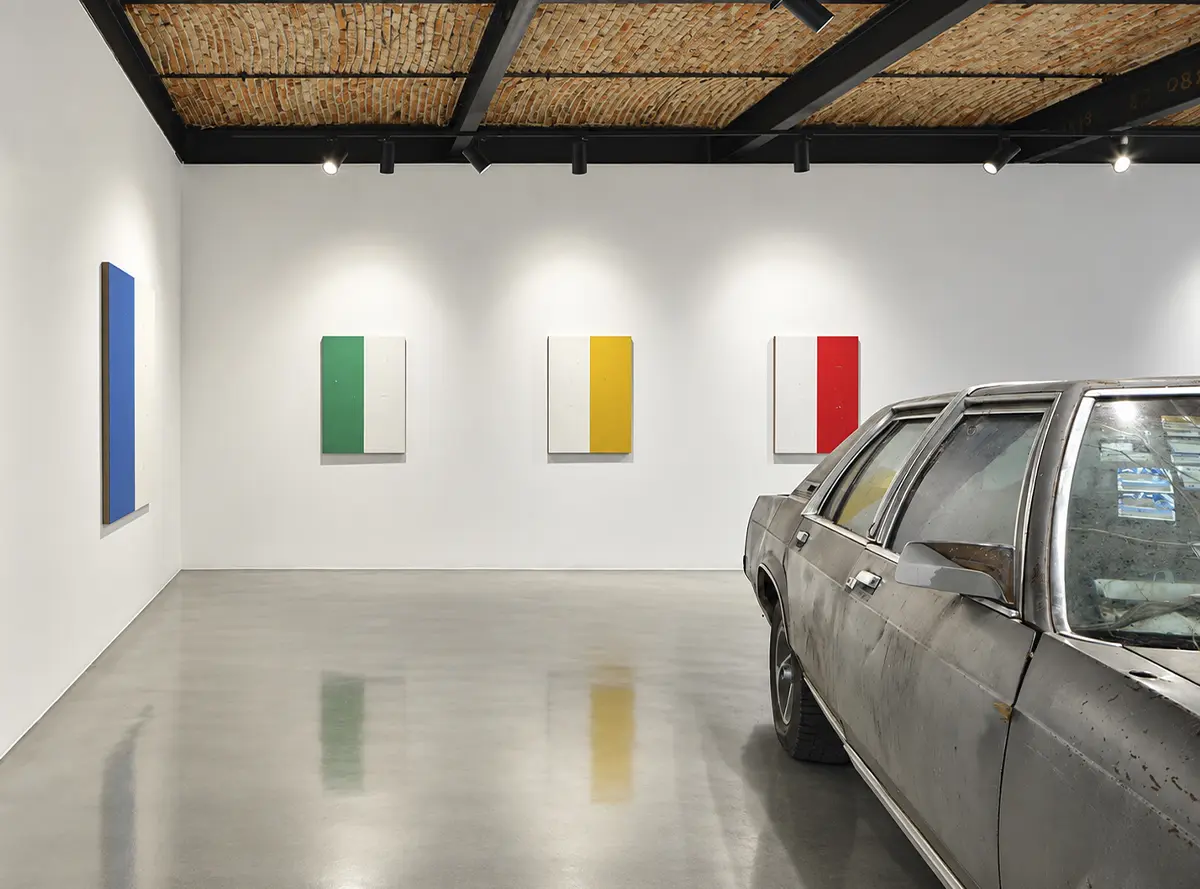
One of his most iconic pieces appears on the cover of an album by the American artist Post Malone. “I shot the first version of that piece in 2008, when I drove a car into the water and used a high-speed camera, with the idea of capturing the moment the car hit the water,” he recalls.

First came the photograph. After taking it, Lebrija decided to create a sculpture. He made three; one of them is in a hotel in Las Vegas. When asked how he feels about that piece in a setting like that, he replies: “It’s very strange, but I like it. I feel like it works. It’s a Galaxie 500, and I think it fits in really well.”
For him, those cars belong to a very interesting era of design—the era of the American Dream—when eight-cylinder cars were a symbol of freedom. “You’d step on the gas, and the tires would screech,” he says. The car also holds an important place in the memory of his generation, although he acknowledges that priorities have changed: “Now the phone is much more important than the car. I think that was the shift: from the car to the phone.”
In that image of the car upside down, falling into the water and reflected in it, Lebrija sees something of that transformation. “To me, the piece speaks to the end of an era. It’s a very nostalgic image.”

Although his pieces have traveled to various countries, much of his work maintains a very local connection to the workshops and crafts of Guadalajara. “Yes, I’ve worked with many artisans: carpenters, blacksmiths, welders. Especially here in Jalisco; it’s been a very local connection, with Guadalajara. I’ve created almost all of my work here,” he says.
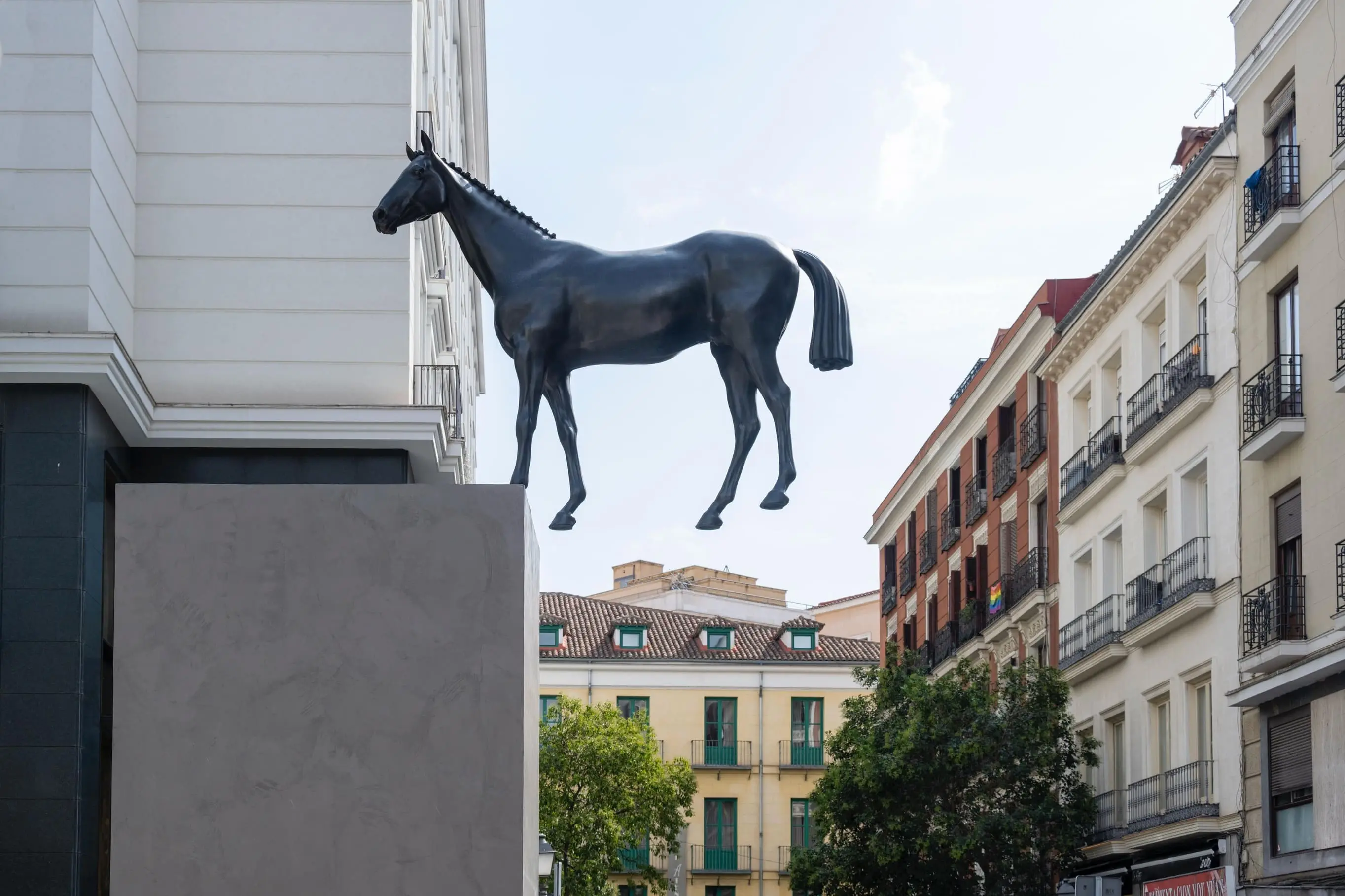
He has also worked with foundries in Spain, where he has just installed one of his most recent works in a public square: *El rumor de la discordia*(The Murmur of Discord), a suspended horse supported by a hand. The piece, which was unveiled on October 15, is a life-size version of a sculpture that already existed in a smaller format.
Just as we were about to say goodbye, he got a call that he decided not to answer. I took advantage of the pause to save the recording of our conversation. As I did so, I noticed that the location pin showed us to be at a church.
“So this house—your studio—used to be a church?” I ask him.
He tells me no, that he has no idea.
“So why does it look like that, then?”
—I have no idea.
I tell him, jokingly, that maybe it’s a sign from above for having admitted I was an atheist. He just smiles. We say goodbye.
Learn more about the works of Ibero-American artists in AW Magazine.