
By Gustavo Egusquiza
Twenty years after it was first announced, the largest of the Guggenheim museums is opening on Saadiyat Island. Argentine artist Julio Le Parc and Mexican artist Rafael Lozano-Hemmer are among the Ibero-American artists featured in a collection whose complete list has not yet been made public.

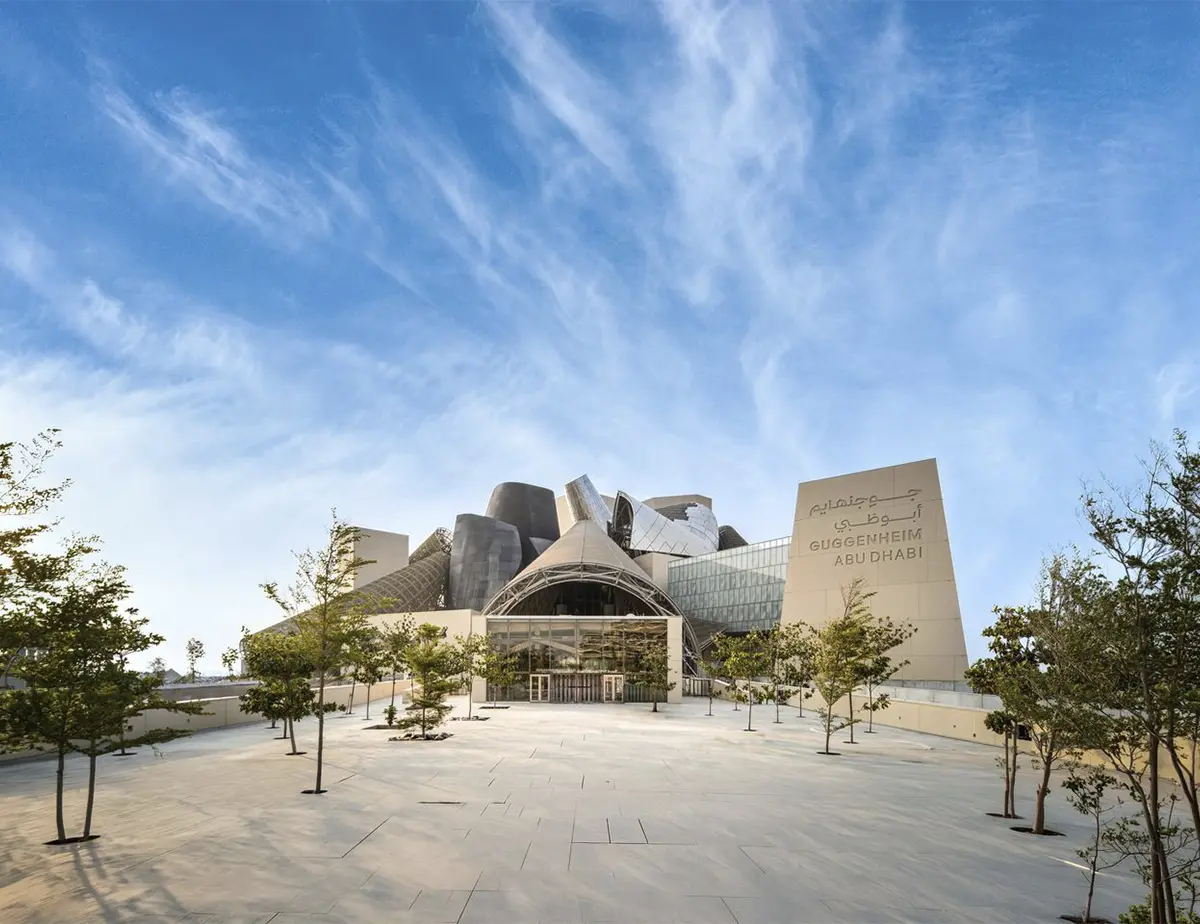
On December 11, 2026, one year and six days after Frank Gehry’s death, the largest museum designed by the architect will open its doors. The Guggenheim Abu Dhabi was announced in 2006 and has been delayed several times. It now finally joins New York, Venice, and Bilbao as the fourth location of the Solomon R. Guggenheim Foundation, and it does so with a clear purpose: to tell the story of art from 1960 to the present without making the West the center of the narrative.
The date was confirmed in July by the Abu Dhabi Department of Culture and Tourism (DCT) itself, a partner in the project and its funding source. Tickets have been on sale since September for 70 dirhams, about 16 euros. The museum will open less than three weeks after the first edition of the Frieze Abu Dhabi art fair, which takes place November 19–22. With these two events back-to-back, the emirate ends the year as a must-visit destination on the international art calendar.
Ten cones facing the ocean
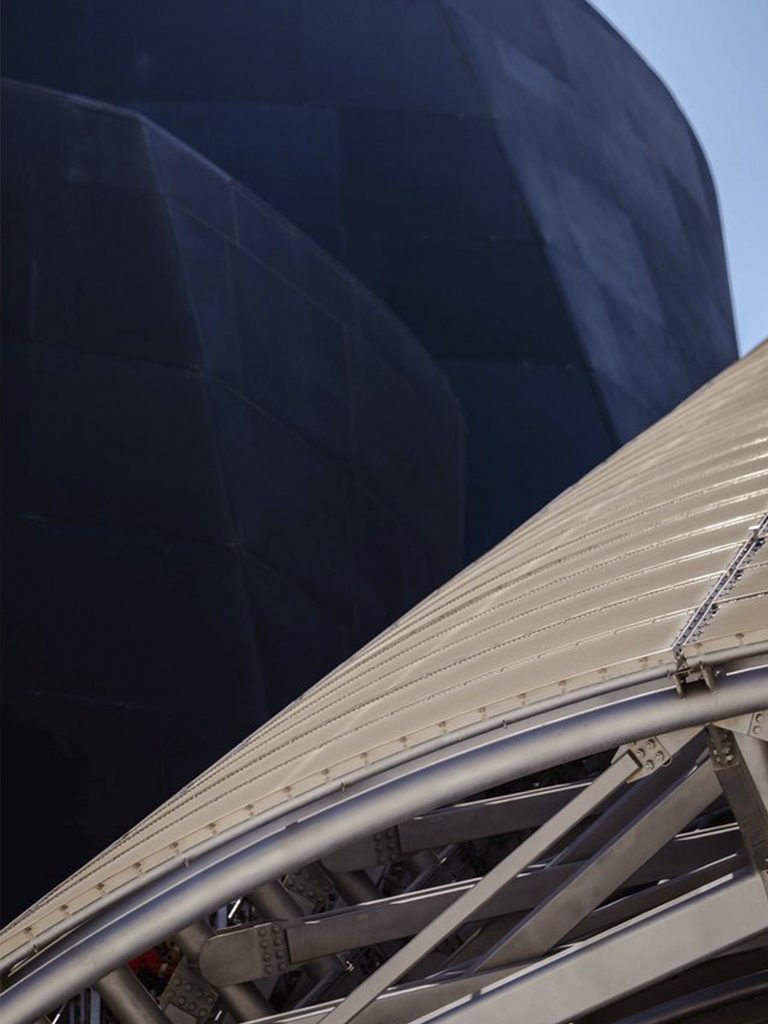
Anyone familiar with the Guggenheim in Bilbao will recognize Gehry’s style, even if not the shapes. There were titanium curves; here there are ten cones that reach a height of 88 meters. Nine are covered in stainless steel mesh, and the tenth is clad in onyx and glass. They are not merely decorative: they ventilate the building and provide natural shade, just like the traditional wind towers of the Gulf.

The figures give you an idea of its size: 80,000 square meters of floor space, 30 galleries connected by a central atrium, 11,600 square meters of indoor exhibition space, and another 23,000 square meters of outdoor exhibition space. The building is located right where Saadiyat Island meets the sea, just a short walk from Jean Nouvel’s Louvre Abu Dhabi, the Zayed National Museum, the Natural History Museum, and teamLab Phenomena. Few places in the world bring together so many museums in such a small space.
A collection in no particular chronological order
The museum has been acquiring artworks since 2009. The collection belongs to Abu Dhabi and includes paintings, sculptures, installations, photography, video, and new media. According to local media, it now comprises more than 970 works by 429 artists from over 70 countries, with a particular focus on West Asia, North Africa, and South Asia.
The tour does not follow a linear timeline. The galleries are organized around major themes in art since 1960—Abstraction, Popular Culture, Earth, Language, and Narrative—and each visitor chooses their own path. Pollock, Rothko, Warhol, and Basquiat will share space in the collection with Hassan Sharif, the father of Emirati conceptual art, as well as Monir Shahroudy Farmanfarmaian, Samia Halaby, El Anatsui, and Yayoi Kusama.
Also on display will be *My Red Homeland* (2003), Anish Kapoor’s 25-metric-ton installation of red wax, which was previously exhibited on the island in 2017. Valerie Hillings, who has been working on the project since its early years, will head the new venue.
“The museum’s collection is uniquely local and global, focused on the region but featuring works from every continent,” Mariët Westermann, director and CEO of the Guggenheim Foundation.

A museum with a Latin American flair
What role will Ibero-American art play in this context? The museum has not yet released the list of artists or works that will be featured in its opening exhibition. However, the two exhibitions it previously organized using pieces from its collection—both held at the Manarat Al Saadiyat Center—give us two solid clues.
The first is Julio Le Parc (Mendoza, 1928). The Argentine master of kinetic art, winner of the Grand Prize for Painting at the 1966 Venice Biennale, participated in *The Creative Act: Performance, Process, Presence* (2017). He was featured in the section dedicated to the experimental pioneers of the 1960s, alongside Niki de Saint Phalle, Jean Tinguely, Günther Uecker, and Rasheed Araeen. His inclusion aligns with one of the museum’s central ideas: that abstraction and light were languages shared among Paris, Buenos Aires, Düsseldorf, and Tehran.
The second is Rafael Lozano-Hemmer ( Mexico City, 1967). The Mexican-Canadian artist was featured in *Seeing Through Light* (2014–2015), the collection’s first exhibition, as part of the section on works that use technology to activate light. Around the same time, he transformed the capital’s waterfront promenade into an artwork, *Pulse Corniche*: a dome of light beams that moved to the rhythm of passersby’s heartbeats.
From Bilbao to Abu Dhabi
There is also a Spanish connection that isn’t found in the exhibition halls, but rather in the museum’s origins. The Abu Dhabi museum is a direct descendant of the Guggenheim Bilbao: the same architect and the same commitment to a building capable of transforming a region. Nearly three decades after the so-called “Bilbao effect,” Gehry comes full circle on the shores of the Gulf.
The DCT has announced that in the coming months it will provide more details about the collection and the works commissioned for the opening. Then we will be able to see just how significant Latin American and Spanish artists truly are in a museum that, in the words of Mohamed Khalifa Al Mubarak, president of the DCT, aspires to be “a source of wonder, a hub of connection, and a place of curiosity and joy for the citizens of the Emirates and the world.”
Discover more places around the world where Latin American art thrives in AW Magazine.