
Travesía Cuatro was founded in 2003 by Silvia Ortiz and Inés López Quesada in Madrid. With locations in Guadalajara and Mexico City as well, the gallery has developed a program that brings together artists from Latin America, Spain, and other parts of the world. We spoke with Claudia Llanza, director of the organization’s branch in Mexico City, during the recent Estación Material event in Guadalajara. The conversation between Jorge Méndez Blake and Jorge Eduardo Eielson, the ties between Mexico and Spain, and the Guadalajara art scene were some of the topics covered in this brief discussion.

What does participating in events like Material still mean for the gallery?
We continue to participate in various international art fairs because it’s a very dynamic environment where you meet new people and reconnect with artists, collectors, curators, and fellow gallery owners. Estación Material is a place very dear to our hearts because Travesía Cuatro has had a gallery here in Guadalajara for the past 13 years. In fact, we’re presenting a project by a Guadalajara-based artist, Jorge Méndez Blake. So, it’s a great excuse to reconnect with people and strengthen relationships.
Their first location in Mexico was Guadalajara, even before they opened in Mexico City. What did you notice about this artistic ecosystem?
We thought it was a very vibrant scene, surprisingly lively, with many fascinating artists. It was also a generation that was very close-knit and showed great solidarity with one another and with other generations. I think that was it: we found it truly magical that such a scene existed.

What is the project by Jorge Méndez Blake that is being featured in this issue?
It is a project that engages in a dialogue with—or even pays tribute to—another artist and poet, Jorge Eduardo Eielson, who passed away in 2006.
Who was Jorge Eduardo Eielson?
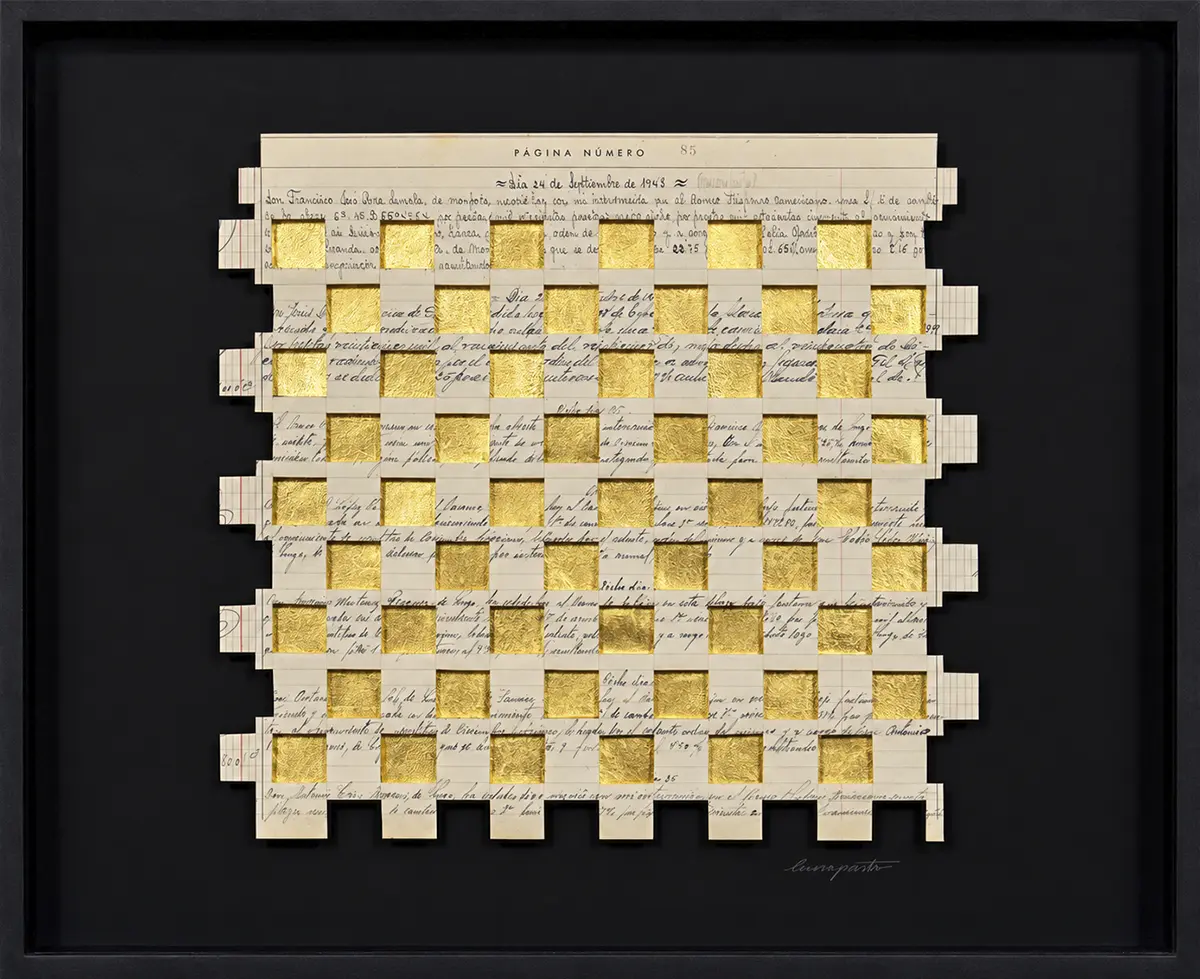
He was a Peruvian artist. He was born in 1924 in Lima, but ended up spending much of his life between Paris and Rome. He was greatly influenced by artists such as Lucio Fontana, Burri, and Cy Twombly, as well as by Arte Povera. He had started out as a poet and became a visual artist, incorporating these concepts into his painting. For example, the quipus—these Inca Andean knots that were a system of language transformed into an object, into something visual.

That ties in very well with the work of Jorge Méndez Blake, who was already a fan of Eielson and has created this new series of paintings featuring a poem at the center. The poem isn’t visible because it’s sort of buried within the painting: it’s called *Librería enterrada* and is by Eielson. Another of the works is based on one of his poems, *Ars poetica*. It’s a pictorial tradition that Méndez Blake has been exploring for several years, but these paintings were created specifically for this occasion.
How do you feel the relationship between Spain and Latin America has evolved in terms of exchanges between artists and galleries?
As for the contemporary art scene, I think there has been a lot of activity and a lot of interaction in recent years. For example, some very important collections have been established in Madrid and other parts of Spain, and that has led to closer ties with galleries and museums.
“Actually, I don’t consider myself a painter. They are paintings, but I see them as an extension of my work. For me, art is a language,” Gonzalo Lebrija.
In the case of Travesía Cuatro, which began operating in Mexico more than 20 years ago, it has served as a bridge in many ways. Now, in Madrid, a great many people from Mexico—but also from other parts of Latin America—come to the gallery. The program is very focused on Latin American artists. Something that was rarer 20 years ago now makes perfect sense.

Was Latin American art perceived as something exotic 20 years ago?
Yes, of course, 20 years ago and even longer than that, yes.
What is your presence in Mexico City?
We’ve had a gallery in Roma Norte since 2019; it’s been seven years now. Our approach here is the same as it has been here and in Madrid: to host exhibitions by artists in our program, who are Latin American, Spanish, and also international. Currently, we’re working with an artist from Zimbabwe, a Korean artist, several artists from the United States, two British artists, a Bolivian artist, a Colombian artist, two Argentine artists, and six Mexican artists.
Is this a program that focuses not on nationalities, but on the art that interests them?
Yes, they create art that interests us.
Returning to the dialogue between Méndez Blake and Eielson, was it the artist’s initiative or a proposal from the gallery?
It was a proposal from the gallery to the artist. We work with both of them; in Eielson’s case, with his legacy, since he has already passed away. We proposed this dialogue to Méndez Blake because we know it makes sense within his body of work and that he would obviously like it. That’s what we hope. Eielson died in 2006—20 years ago now.

What exhibitions are part of your program for this fall?
In Mexico City, we have an exhibition by a Spanish artist named Asunción Molinos Gordo.
For the rest of the fall, we’ll be hosting an exhibition by an artist from Sonora, Miguel Fernández de Castro. In fact, we already presented one of his works here at the Project Room in Guadalajara a few months ago. Now we’ll be hosting his first solo exhibition at the gallery in late October.

Finally, what defines Travesía Cuatro as a gallery?
Projects that inspire us, artists who inspire us. Artists who express a way of thinking or a way of life in different ways: through humor, criticism, painting, or sculpture. These are forms of expression and communication that stir something within us.
Discover more reviews and interviews from the leading trade shows and exhibitions in Mexico and Latin America in AW Magazine.