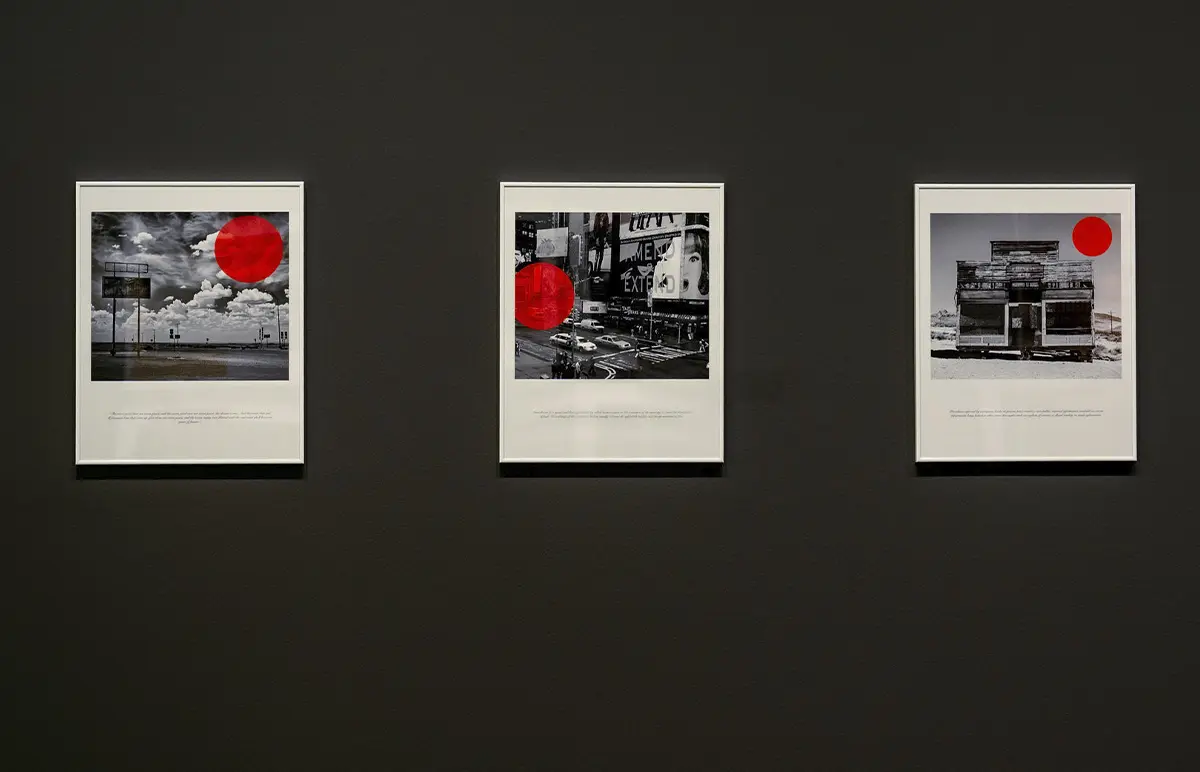

The works of Barcelona-based artist Max de Esteban do not seek to provide answers, but rather to prompt reflections based on what we see depicted in his pieces: Who controls the technologies that shape our daily lives? What role do financial capital, artificial intelligence, and biotechnology play in shaping the future?
These concerns run through so many stories. So many questions, the new exhibition that the Foto Colectania Foundation in Barcelona is dedicating to the visual artist, which will be open to the public through September 20, 2026.

The Human Condition According to Max de Esteban
Recognized for “questioning the human condition under the structures of contemporary capitalism”—in his own words—De Esteban has built a vast artistic career around the world. His work has been exhibited at institutions such as the Kunstpalast in Düsseldorf, the Jeu de Paume in Paris, the MUNTREF in Buenos Aires, the Museum of Fine Arts in Houston, the Staatliche Museen zu Berlin–Museum für Fotografie, the CGAC in Santiago de Compostela, the Red Brick Art Museum in Beijing, and the MACBA in Barcelona. He has also participated in events such as BienalSur (2025), the 16th Cuenca Biennial (2023), the Yokohama Triennial (2020), the 13th Cairo Biennial, and the 13th Havana Biennial (2019), as well as Fotofest (2016).

His work has been published in five monographs, including *Estética de la Extinción* (Turner), *Twenty Red Lights* (Virreina/La Fábrica), and *Propositions* (La Fábrica), and is included in major international collections.
So many stories. So many questions
The current exhibition, presented in his native Barcelona, brings together more than fifty works—including photographs, videos, and installations—that serve as a map of the invisible forces that govern our present. Rather than condemning technological development, the artist examines the structures that underpin it and the way in which these redistribute power, transform our relationship with the world, and narrow the scope from which we imagine that future that is always on its way.
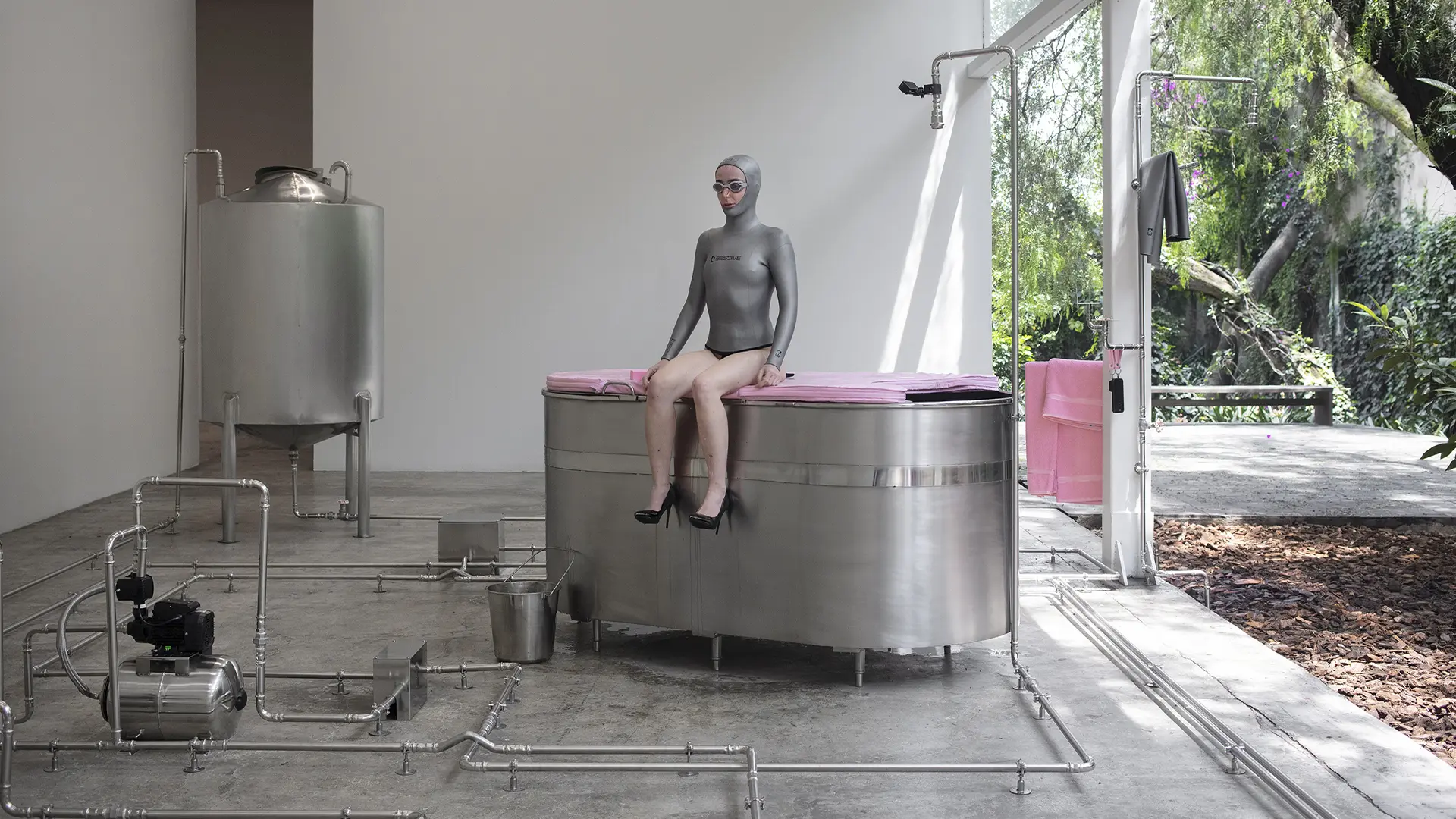
The works are part of *Aesthetics of Extinction: Infrastructures of Contemporary Capitalism*, a project that De Esteban has been developing for over a decade and in which he shifts the focus from technological objects to the invisible networks that sustain contemporary life. Rather than focusing on the devices themselves, the artist turns his attention to the economic, political, and scientific structures that determine how we inhabit the world.
What is most striking is that these scenarios—associated with control, surveillance, or power—are depicted in a rather understated manner, making beauty a means of reflecting on what normally goes unnoticed. Without a doubt, this is a series that is very consistent with an artist whose work is known for questioning our own humanity under the oppression of machines, and for presenting the subject as something aesthetic rather than terrifying.

20 Red Lights and the Apparent Neutrality of Power
Among his most significant works is *20 Red Lights* ( 2017), a series that draws attention to the settings where digital capitalism operates: data centers, corporate buildings, and technological spaces whose apparent neutrality conceals their true function: to control the flow of the economy.
At times, the spaces evoke the sterile aesthetic of the TV series *Severance*, where corporate architecture becomes a metaphor for human control. The photographs possess an unsettling serenity; they are silent landscapes that reveal “how true power rarely needs to make itself visible,” as the artist himself has explained in various interviews.
In *20 Red Lights*, financial infrastructures cease to be ethereal concepts and take on a physical presence. Data centers, corporate headquarters, and the spaces where capital flows emerge as the true landscapes of our century. The series does not seek to explain how capitalism works, but rather to reveal what usually remains hidden—the places where decisions are made that affect our daily lives without us even noticing.

The Inspiration Behind *White Noise*
The environmental dimension appears in *White Noise* (2020). Inspired by Ovid’s*Metamorphoses*, the work imagines a planet Earth on the brink of extinction. The video gives voice to a reality mired in ecological deterioration, while the photographs recreate a moment just before the end of the world. The inclusion of so-called extremophile bacteria—organisms capable of surviving in extreme conditions—shifts the narrative from human survival to the persistence of life, reminding us of a harsh reality: the planet will likely continue without us.
The series avoids showing shocking images in order to prompt a reflection that we may not want to consider: perhaps the real crisis is not that of the planet itself, but rather that of the place humans occupy on it.

The Uncomfortable Questions
The exhibition also features *Lamb of God*, an exploration of the ethical dilemmas of biotechnology. Based on his conversations with genetic engineers, the work explores the limits of biological manipulation through experiments with human stem cells in animal embryos. De Esteban does not take sides, but he confronts the viewer with uncomfortable questions about this clear ethical debate.
The exhibition concludes with *Provisional Cartography – An Interview with My Mother* (2023), a video structured in eight chapters that serves as an intellectual map for navigating a world that is no longer the same. Through a fictional conversation with his mother (with all the Almodóvarian implications that this entails), the artist intertwines memory, existentialism, and family ties to raise questions about technology, materialism, evolution, and virtual reality.

With so many stories and so many questions, Foto Colectania is launching “Ecology of Images,” a new exhibition series that will run through 2027 and explore the role of images in the contemporary world.
Discover more contemporary art from Latin America in AW Magazine.