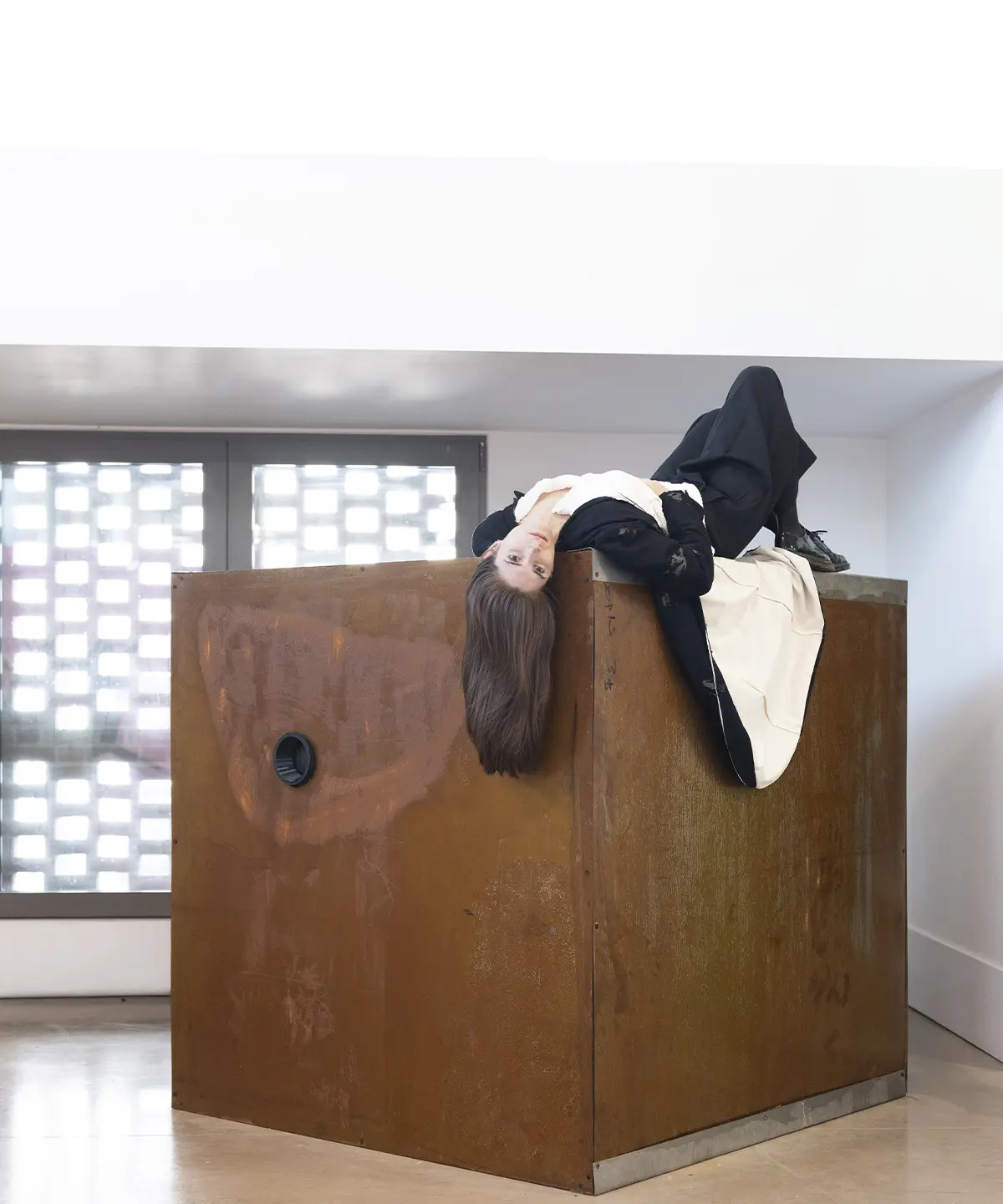

In art, anything goes—even switching disciplines. Mariajosé Fernández-Plenge is a visual artist who, after dedicating years to photography, decided to expand her practice to other mediums. The artist was born in Lima, where she studied Audiovisual Communication, and later completed the documentary photography program at the International Center of Photography in New York. In her work, Mariajosé explores sound and temporality from an intimate perspective, creating evocative pieces that invite reflection on the body, memory, and the passage of time. We spoke with the Peruvian-German artist about this.

How are you feeling at this point in your artistic and personal life?
You caught me right in Lima because I’m heading back to London on Wednesday. Everything’s super quiet here (Editor’s note: The interview took place one day before Peru’s Independence Day) and it’s a holiday. Plus, with the El Niño phenomenon, it’s winter, but it feels like summer, so everyone’s gone to the beach. I haven’t been able to do much because I’ve been in bed all this past week. I got sinusitis. I’m super allergic, and this past spring I had a really bad allergic reaction in Europe. It got worse and worse, and since I’d never had sinusitis before, I didn’t understand what was happening to me. Luckily, I’m feeling much better now. Some really great things have also been happening with my work. I’m exploring opportunities with a gallery that often takes its artists to many international art fairs. Next year they’ll be holding a group exhibition, and if everything goes well, I’ll be part of it.
Between Two Models of Art Education
You’ve studied in both New York and London. What differences did you find between the two models of art education, and which one do you think is better suited to the practice of a Latin American artist?
I think it depends on each artist’s personality and practice. Many people who entered the master’s program at the Royal College of Art felt—and this has been a hot topic this year, though I don’t know if it’s like that every year—that the system is very open-ended. If you don’t have a personal practice of going to the studio and working, it’s difficult, because they don’t hold your hand; they make you do it yourself. They assign you a studio, and from there, there are lectures you can attend or skip, workshops you can sign up for if you want, but no one takes attendance or forces you to participate. There are no grades—just pass or fail.

What has your recent experience been like at the Royal College of Art in London?
It’s been a very different experience from what I expected. Even though I’ve already done my degree show, the program has a different schedule: I still have to give a presentation and continue working in the studio before I officially graduate. What I enjoy most is having time to explore without the constant pressure of deadlines.
From Photography to Multidisciplinary Practice
How do you look back on your transition from photography to a multidisciplinary artistic practice?
I got into photography because I’ve always been a completely visual person. I thought that meant taking pictures. Every time I tried to do something more artistic, they steered me in a different direction, so I always developed my own projects on the side. I took classes, spent a summer at the University of the Arts London, and set out to find my own path. Later, I went to New York to study photography at the International Center of Photography.
I enrolled in the one-year program, which is well known for its focus on photojournalism because it was founded by Robert Capa. But two weeks after I started, I realized that I didn’t want to be a photojournalist; instead, I wanted to pursue a much more conceptual approach.

How did your artistic practice continue to evolve after photography? Was there another discipline that, at that time, you felt could answer the questions that photography could no longer address?
I was reading a book by Simone de Beauvoir about how different cultures understand that stage of life, and I discovered that textiles offered me many more possibilities for exploring those ideas than photography did. So I began combining photography and textiles, although at first I felt unsure because I didn’t have a solid background in that discipline.
Sound, Body, and Shame
How did your interest in working with sound begin?
I started thinking about art again and revisited an idea that had been on my mind for a long time, but that I had never managed to bring to fruition. I wanted to explore the body, but everything I imagined through photography made me feel that everything on that subject had already been done. I felt that it wasn’t the right medium, and I couldn’t figure out how to approach it.

So I started recording the sounds of my own body with my cell phone, simply by resting the phone against different parts of my body. I was really interested in hearing what they sounded like. Later, I met a sound producer who had a studio very close to Parsons, and he suggested I record them there to clean up the audio. The first recordings still “sounded like an iPhone,” but there was already something about them that caught my attention. They seemed very strange to me, and I was even embarrassed to listen to them. It was precisely that discomfort that made me feel I was on the right track.
Art and Discomfort
So do you think art must continue to make people uncomfortable in order to be relevant?
I don’t think all art has to be uncomfortable, but I do think it should prompt reflection.
“Art can be unsettling in various ways—for better or for worse—but it should always stir something in those who experience it and compel them to stop and think.”
How did the installation *Cuerpo* come about?
The first version grew out of an exhibition I put together in a large house. There, I presented a series of cyanotype self-portraits and revisited an earlier project, giving it a new twist: *Whimsical Cartographies*. These were large-format, 4×5 photographs of mountains in Peru and of bodies. The idea was that you couldn’t clearly distinguish what was the sky, what was a back, or what was a mountain; everything was deliberately blended together.
We had barely a month to prepare the exhibition, and they only let us use the house for a week. That meant the exhibition was open for just 24 hours, because we had to set it up and take it down in a very short time. I think it was precisely that ephemeral nature that ended up giving the work a lot of character.

Art, Time, and Consumerism
What projects are you currently working on?
I’m preparing a performance and, at the same time, developing a project that I already know will take me many years. Actually, there are seven projects that revolve around grief, but understood in a very broad sense. I’m not just talking about the death of a loved one, but about all the forms of grief we experience in life: romantic grief, professional grief, the departure of a friend from your life, and even the grief associated with the body, because the body changes and ages.
Those are the two areas I’m focusing on right now. I’m also researching consumerism. Ultimately, all my work ends up having to do with time.

Yes, I see that the theme of time and permanence comes up constantly in your work. Why has it become an artistic obsession?
Because I’m interested in thinking about how time works and how it shapes our experience. I use materials that change over the years, such as cyanotype or Corten steel, precisely so that the work continues to transform. I’m also interested in the relationship between time, memory, nostalgia, and migration: how we remember places, how those memories change, and how we, too, change along with them.
Cover photo: Kiian Shao
Discover more interviews about Latin American art in AW Magazine.