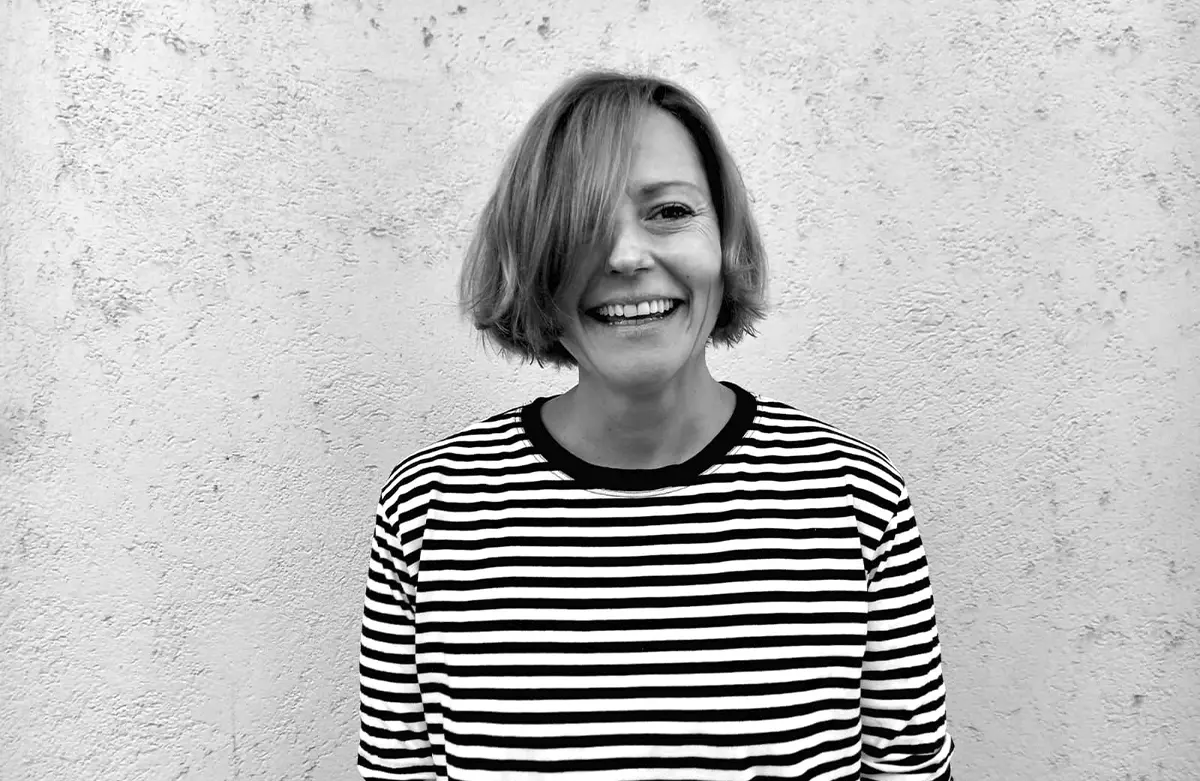

Polina Stroganova is an independent curator, art consultant, and lecturer based in Mexico City. She has directed galleries in Mexico, Germany, and the United Kingdom, and currently works in the Visual Arts department of the Goethe-Institut Mexico’s Cultural Programming division, in addition to teaching at CENTRO and the Sotheby’s Institute. Born in Moscow and a resident of Mexico since 2013, she speaks with Art Weekends about the challenges of independent curating, intuition as a research tool, the role of the curator today, and the projects she is developing between Mexico and Europe.

“I arrived exactly 13 years ago, and for me, it’s been a completely new experience,” Polina tells me. “It was a scene I wasn’t familiar with. I’d already been working in the field for several years, but with a strong focus on Europe.”
“I was aware, of course, of what was happening in the United States, but the truth is that I knew very little about Latin America and, in particular, about Mexico.”
Have you noticed any changes in Mexico’s art ecosystem over the past few years?
The ecosystem has grown exponentially. This is evident, of course, in the fact that we now have several art fairs. You only have to look at everything that happens during Art Week here in Mexico City. But there’s also a trend that I’m noticing more and more—and that I find very interesting—decentralization.
What about the art market?

We must also take into account the structural realities of the art world. Economic power lies primarily on the commercial side of the ecosystem. Galleries are the ones that provide the art, and that is where the budget lies.
Is it difficult for a curator to work on several different projects at the same time? How do you handle it?
It’s true that I almost always work on several projects at the same time. Sometimes they’re different exhibitions that I already have to start planning or that are at different stages of the process. But that idea of having to work simultaneously in several areas is very important to me.
Is it challenging?
Of course, it’s a challenge, and sometimes it’s hard work—especially in terms of organization and focus when putting together a museum exhibition. You also work with different artists at the same time on various projects, so it requires a lot of coordination and structure.
So, in addition to having a structure, do you also work intuitively as a curator?
Yes. I always work intuitively, combined with the research necessary to tackle a topic. Especially when I’m working on solo exhibitions or, for example, a dialogue between two artists—in those cases, it’s much more important to thoroughly research each artist’s proposal in order to generate an interesting dialogue. So, it really comes down to juggling several things at once: conducting the research while also allowing myself some time and space for that information to sink in. From there, I start thinking about what I want to highlight, and I enter a very specific process of selecting works.

Does the curation adapt to the venue, or does the venue adapt to the curation?
Every project is different, depending on the context in which it is presented. If it’s a gallery, there’s a very close dialogue with it. If it’s an independent space or an institution, the conditions also change. So you think about different approaches, different potential audiences, and how to approach the presentation—and, above all, the exhibition design—so that it’s accessible. Every project is unique because you have to respond to the context and try to create something tailored to it. Right now I have two exhibitions on view: one in Guadalajara, called MAÑANA, and another at Galería CAM, here in Mexico City. They are two very different projects. One is a broad exploration featuring many voices, as it brings together more than thirty artists; the other is a dialogue between two artists.
What is the most important factor you consider when deciding whether to take on a project?
It’s essential that, when I accept or start working on a project, it be something that truly convinces me—something that, from the very beginning, I feel makes sense. Afterward, that intuition is what needs to be developed, analyzed, and formalized.

What is the current state of independent curation in Mexico?
I believe that both independent and institutional curation are very important. If one approaches curation from a serious research perspective, thinking about how to structure an exhibition—the museography, the installation, the texts, and the context created to offer an interpretation of specific proposals or a theme—the truth is that a curator is indeed necessary. Someone who can bring these elements together, establish connections, and generate the content needed to foster discourse.
How can curatorial work become a way of life that influences those who practice it?
It’s an activity that constantly pushes your own boundaries and expands your way of thinking. In an ideal scenario, it also keeps you constantly questioning yourself. You can’t rest; you have to be on the lookout for opportunities and seeing what can be done. Because, obviously, there’s also a certain degree of precariousness in independent curating; that’s a fact. So, I think it’s a job that requires a lot of passion to sustain and maintain it—from this perspective of creating, proposing, and developing experimental projects.
Does being a curator involve sacrifices?
I do think it’s important that we always keep this in mind, because it really is a profession that requires a certain amount of sacrifice, as well as a great deal of dedication and love for the art. For me, it continues to be a challenge, and I think it will most likely become an even greater challenge over time.
“The role of the curator remains important. However, it is true that this title has become somewhat diluted and that the word is used too loosely. There are projects in which we cannot speak of curatorship.”
Is curating something you learn along the way, or is it something you study?
I believe that curating is something that develops over time; it’s not something you can just learn overnight. There are Curatorial Studies programs, and, of course, there’s a lot you can learn. There are also all the aspects related to protocols, logistics, and the liaising that has to be done, especially when you’re working on a large scale and with institutions. But, ultimately, it’s a craft. Or rather, I do believe you grow by putting on exhibitions. I think it’s essential to develop a feel for the space, the scale, the rhythm, the materials, and, above all, a solid eye for selecting works.
Over the years, do you think the role of the curator has changed? Beyond mere perception…
I think it’s a practice that’s constantly evolving. Of course, ten years ago, the way I brought works together, established connections, and conceived an exhibition was different from how I do it today. I also think it’s important to take risks as a curator and not fall into a comfort zone, because it’s very easy to end up working according to a set formula.
What projects are you currently working on?
I have several projects coming up, and many are already underway. The semester is starting at CENTRO, so I’ll be back teaching at the end of August. I’m also working on the selection and curation for TRÁMITEin Querétaro. I was invited to curate the exhibition and serve on the jury for the Jalisco selection process. I just finished reviewing all the submissions and have already selected the artists who will be featured in October. There’s also a project coming up in Querétaro that I’m really excited about: curating a private collection. In addition, I’m preparing another exhibition featuring artists from Berlin and Mexico, which will open in November, as well as a show at General Expenses.
How do you approach curating a private collection?
It depends. In this case, curation involves not only the works in the collection, but also references, objects, the collector’s context, significant influences, pieces that accompanied him throughout his life, and other references, such as film or music. It’s going to be a very interesting and diverse curatorial project. For me, it also represents a new endeavor, because it incorporates all these elements to generate, on the one hand, an interpretation of the collection, but above all to explore how a collection comes into being and what all the influences and references are that shape it.
Can you tell me a little about the MAÑANA exhibition?
It has been a wonderful and very challenging project, but it also addresses an important issue. I received an invitation from Galería Palma in Guadalajara to curate an exhibition. Originally, it was going to be something else, but then I started thinking that I’d like to return to this exhibition format in which there are truly many voices—a sort of salon, though not a salon understood simply as a multitude of works. That was precisely what interested me: creating a multitude of voices and artistic proposals that would allow us to consider all those possibilities.
What was the process and the setup like?
A standard size was proposed for all participants. The medium was completely open, but the pieces had to measure approximately 60 × 40 centimeters, whether in portrait or landscape orientation. This also reflected an interest in creating a more horizontal setting, where no hierarchy was established based on the size of the works. For example, to avoid having a two-by-two-meter piece next to much smaller ones. Although size does not necessarily determine the importance of a work, visually it can create hierarchies, especially in an exhibition with more than thirty pieces. For me, it was important that all the works maintain, more or less, the same format.

What was the most challenging aspect of this curatorial project?
Once the pieces arrived and I got started on the installation, I had to grapple with that multitude of ideas and ask myself, “How am I going to put all this together without it becoming too eclectic? How can these pieces work and coexist within the same space?” From there, I thought it would be interesting to create a narrative by grouping certain works that shared common elements.
What do you feel defines you as a curator?
A lot of things, I think. I really like working from a place of freedom, without being too dogmatic about a theme, a concept, or a formal approach. I also think a lot about creating an exhibition design that isn’t boring or monotonous. I like there to be a certain poetry to it and perhaps some moments that are disruptive. I’m interested in creating an open space for reflection within an exhibition, without presenting the visitor with a completely straightforward message, and I like it when an exhibition also leaves you with a sense of doubt or unease.
Find more articles on curation and art in AW Magazine.