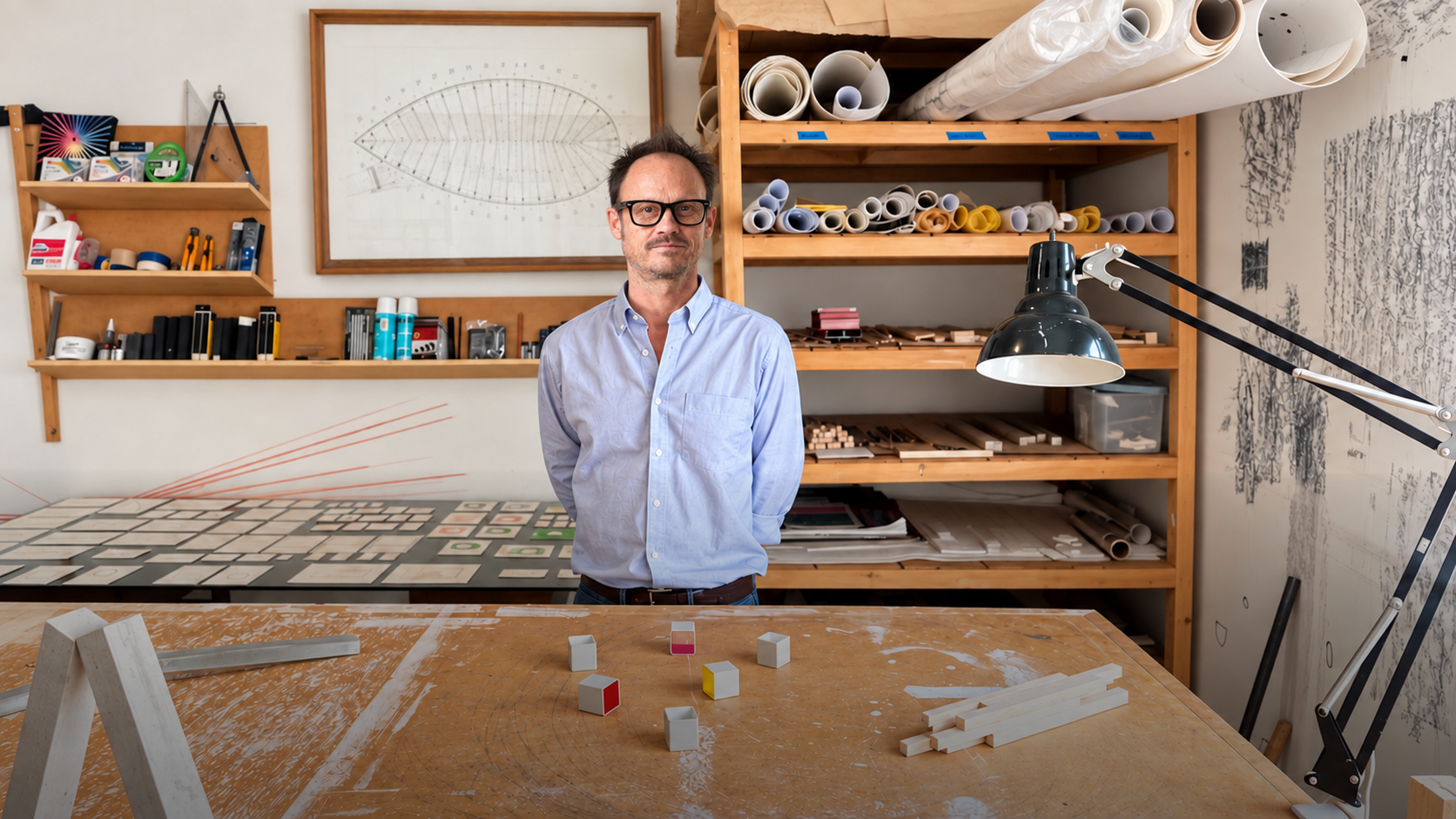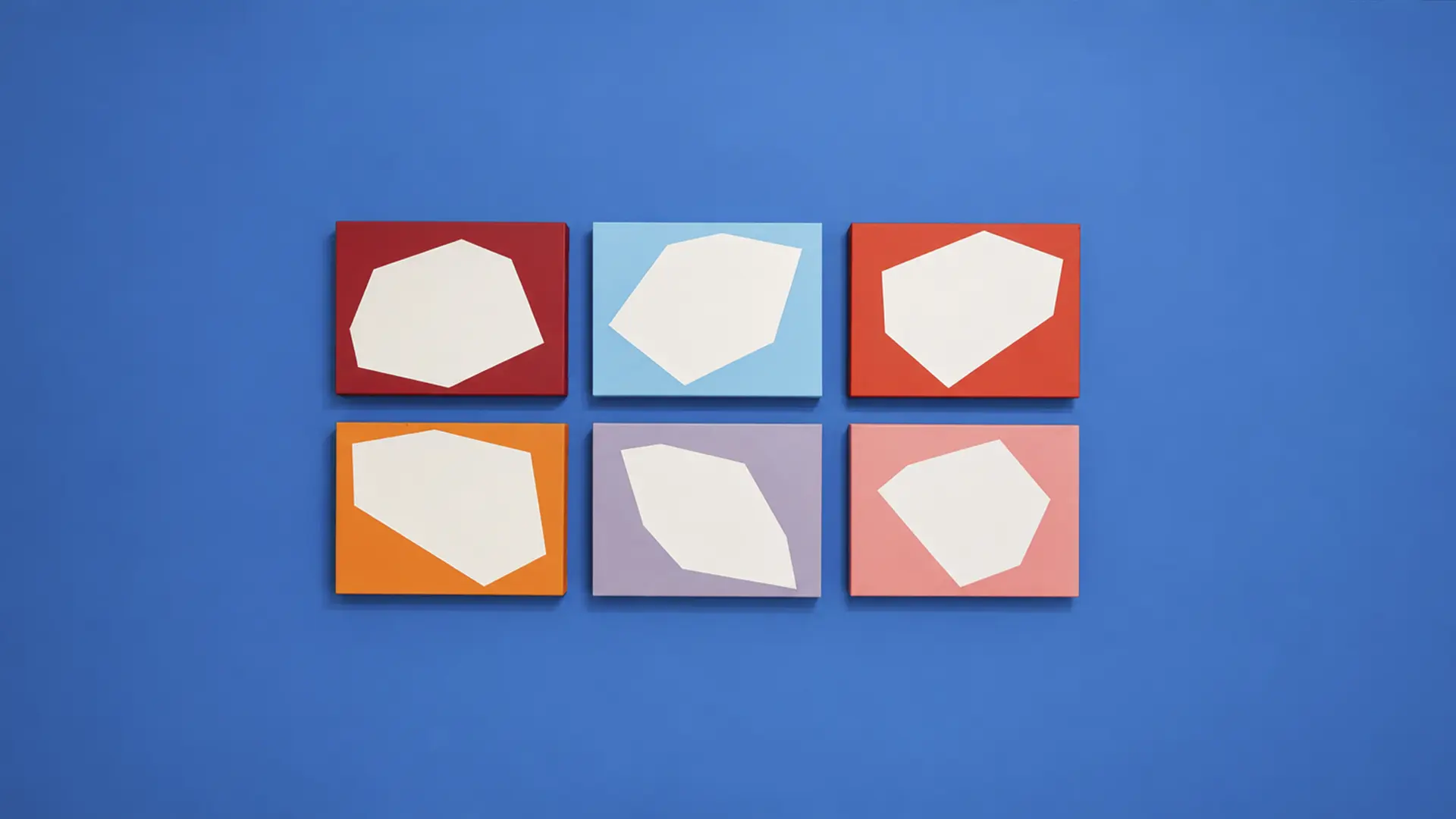

In *Momentum*, the shape retains its color but appears to change depending on the background surrounding it. That effect is the starting point for the new exhibition by Jalisco-based artist Omar Guerra M., who returns to geometry to explore how we look at art and how long we linger in front of a painting.

A visual artist, independent curator, musician, and cultural manager, Guerra is presenting the exhibition at the Aguilar Martínez Negrete Collection (CAMN) gallery, located within Estudio Parque Juan Diego in Guadalajara, curated by Raymundo Motta Llano.
“We live in an economy where time seems to have stopped being measured in hours and has instead been broken down into microseconds. Attention not only determines what we see; it also silently reorganizes the way we perceive the relationships between things,” says Omar Guerra M.
“Momentum stems from an exploration of movement, transformation, and the way we perceive what lies before us. Formally, the works establish a dialogue between geometry, color, painting, and drawing, in which different layers overlap, interrupt one another, and create new relationships,” explains the artist.

The geometric shape takes center stage in the exhibition: the pictorial surface and the space surrounding each piece form part of the same composition. “Momentum” follows in the tradition of geometric abstraction and hard-edge art, while also drawing on the expansion of painting into space explored by the Brazilian artist Hélio Oiticica.
The Geometry of Omar Guerra M.: From the Circle to the Polygon
The exhibition revolves around a geometric figure that Guerra has been exploring for several years and that reflects a consistent interest in his practice. “My work has always been focused on geometry,” he notes.
His explorations began with the circle, a shape that still occupies a central place in his work due to its connection to cycles, time, the planet, and the universe. Next came the triangle, which he associates with power and balance, but also with repetition and a metaphysical significance linked to the Trinity. These explorations were followed by others focused on the square and its rectangular variants.

His recent interest in polygons began with the hexagon. “That was my first encounter with polygons,” he explains. The shape allowed him to explore connections between geometry and organic structures, such as honeycombs. In addition to this relationship with nature, he developed an interest in their energetic and mystical associations.
He then moved on to the octagon, which symbolizes a transition between the earthly and the ethereal. The artist finds this connection in elements of religious architecture, such as certain domes and octagonal baptismal fonts.
However, the discovery of a pad of paper with a unique grid opened up new possibilities for his research. Unlike standard graph paper, its sheets featured diagonal lines in addition to vertical and horizontal ones. This structure allowed him to experiment with more edges and develop shapes that departed from geometric regularity.
“I began sketching and drawing these new polygons by hand, with greater ease and freedom,” he recalls.
The Psychology of Color at Momentum: A Moment to Reflect
Color plays a central role in this research because of the feelings it can evoke in the viewer. “When you look at red, it’s not the same as looking at yellow or blue,” explains Guerra.
The choice of colors is not based solely on intuition. Guerra explains that his research spans psychology and the history of color, with a particular focus on contrasts and concepts such as those explored by the artist and researcher Josef Albers.
In *Momentum*, the backgrounds function as a sort of limbo and shift from one piece to the next, while the central shape retains the same hue: “mushroom,” a blend of white, black, and red. Although the shape maintains its color, the variations in the background alter the way we perceive it.

From that perspective, he arrived at the tone of the central polygon. Set against the vibrant backgrounds—which can evoke different sensations—this tone aims to provide a moment of respite. The intention is that, in a subtle way, the viewer will feel comfortable and linger a little longer in front of the works.
This exploration is linked to another of his concerns: the time we devote to observing and our ability to sustain our attention in the present moment. Among the readings that fueled this reflection, he mentions a book by curator Hans Ulrich Obrist and his observations on attention.
In a world defined by high-speed internet and social media, Guerra invites us to pause and reflect on the relationships between color, form, and their surroundings.
Miles Davis in ” Momentum“: Jazz as Part of the Exhibition
Music is also part of Momentum. During the production process, Guerra noted that he had painted a good portion of the works while listening to Miles Davis. At first, he reworked one of his pieces: he reconstructed it with electronic elements and altered its duration. However, as the exhibition took shape, he felt that this version didn’t fit the narrative he was trying to convey.
He then decided to incorporate the original recording of “Blue in Green,” which serves as an additional touch of color—this time, a sonic one. For the artist, the piece creates a calm atmosphere and evokes the experience of walking through an exhibition while listening to jazz.

But his choice also stems from the freedom he finds in that genre: the ability to improvise, link notes and chords, and break away from conventional structures. This coexistence of tranquility and transgression accompanies the exhibition’s explorations of color and geometry.
Amid these fundamental changes—the persistence of the geometric shape and the music— Momentum invites us to look more closely and discover how a single figure can transform before our very eyes.
Where to Watch ” Momentum ” by Omar Guerra M. in Guadalajara
The exhibition opened on September 23, 2026, and will remain open through November 29, 2026, at Estudio Parque Juan Diego in Guadalajara, Jalisco. The exhibition is organized by the Aguilar Martínez Negrete Collection (CAMN) and curated by Raymundo Motta Llano.
Omar Guerra M. at the MexiCali Biennial: PARA/normal Borders
In addition to Momentum, Omar Guerra is among the artists featured in PARA/normal Borders, a project of the MexiCali Biennial that brings together artists from Mexico and California. The exhibition explores the border through memories, migration, identities, and the relationship between the material and the spectral.
After being shown at various venues in Mexicali and Calexico, the exhibition will travel to The Cheech Marin Center for Chicano Art & Culture in California, where it will be on view from March 13 to September 5, 2027.