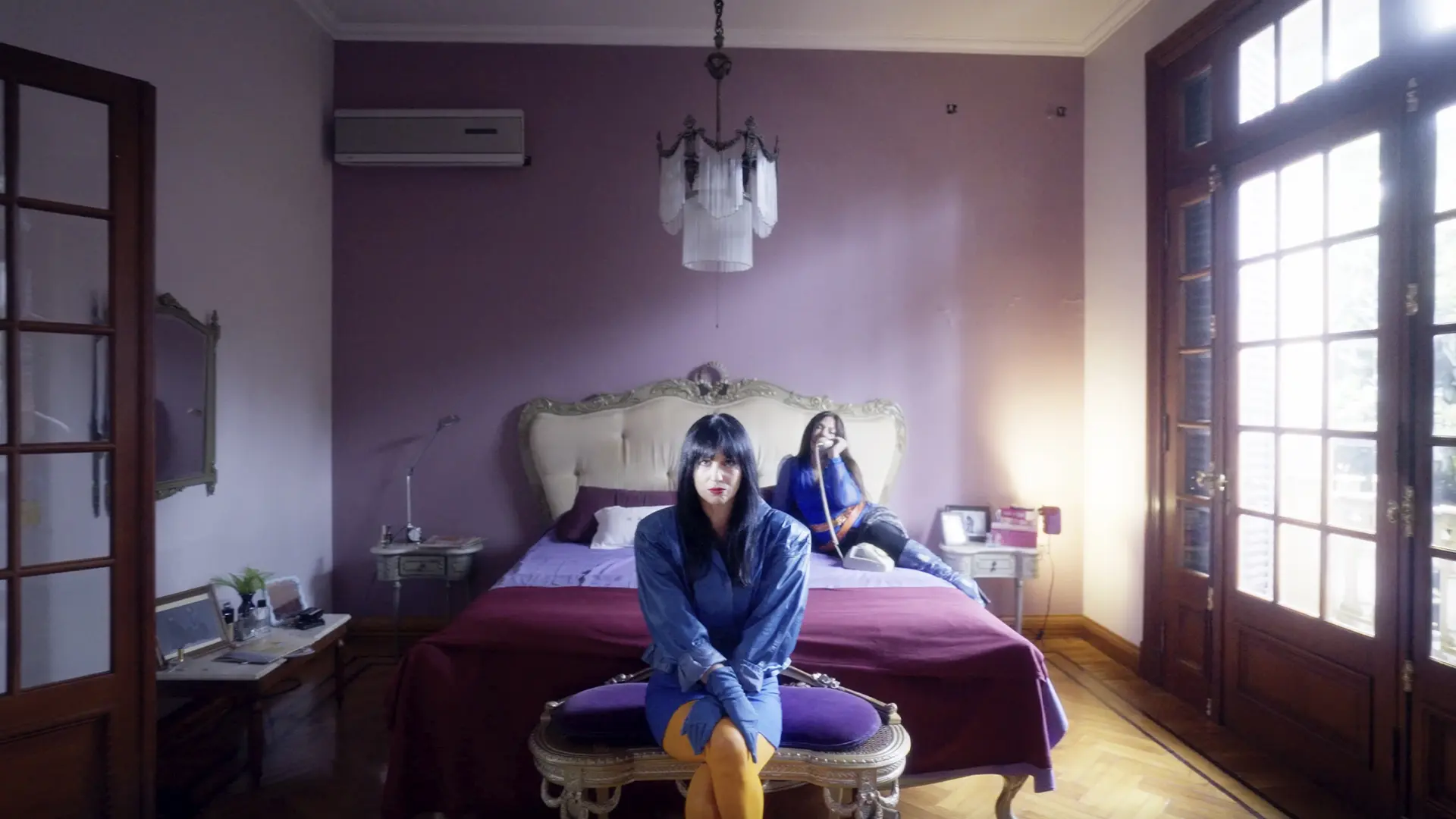

Florencia Ciliberti, also known as HANA, is an Argentine visual artist, musician, and cultural manager. Her work explores the convergence between music and contemporary art. With that in mind, she founded Otras Formas, a record label exclusively for visual artists who make music. In addition, as a sound artist, she created the HANA project (which means “flower” in Japanese) and launched a series in which artists from her label perform at art galleries and museums across Argentina, such as the Museum of Modern Art and the National Museum of Fine Arts. We spoke with her.

What is the current state of the art scene in Argentina?
Look, there are always two sides to every story. On the one hand, the political situation is very complex, and, as is often the case, culture is one of the sectors hardest hit by budget cuts. But in Argentina—particularly in Buenos Aires—artists have always been a major driving force, despite these ups and downs.
It’s a great topic for artists, not only in Latin America but all over the world.
We’re very used to this situation, so there’s a lot of self-management. As much as possible, we try to maintain spaces and collaborations as a form of resistance. I can tell you that the art scene in Argentina is very rich, despite everything.
Art always finds ways to flourish. Sometimes, in times of resistance, the most disruptive things emerge, don’t they?
I get the feeling that we’re always on shifting sands. Just when it seems like we’ve achieved some stability, it all falls apart. There are things that, given the history of humanity, one thinks will never happen again. And yet, they happen again—even when it comes to human rights. You ask yourself: How is it possible that this is coming up again, that repressive attitudes are resurfacing?

Especially in Latin America?
The art world, in all its forms, is a place of resistance. In Latin America, we can never let our guard down. I don’t know if people in Europe experience the same thing we do, but here, too, there isn’t much government support. Over there, there are foundations and resources to support research. That’s fantastic, but it doesn’t reach us.
Throughout your career, there has always been that convergence between music and art.
I’m not one to dwell on the past, but I realize that this intersection has been there since my beginnings. It wasn’t premeditated. My first album as Hana came out in 2006, and I presented it at Sonoridad Amarilla, a gallery where I also exhibited my paintings and did performance art. I never would have imagined that, twenty years later, that connection would continue to grow. I’ve always considered myself a multidisciplinary artist; for me, it was never a conflict.
Did you ever feel out of place?
Perhaps I was an unusual artist in an art world that has always been conservative. But I kept releasing albums, making music videos, and presenting exhibitions that evolved from painting to installation art. This project came about ten years ago because I began to notice that there was a lot of music created by visual artists that didn’t find a place in the art world.
So how did it all begin?
I began my research in 2015. My first step was a compilation album: I was interested in bringing together artists who, given how different their works were, probably would never have formed a collective. After that, it snowballed: I continued researching, finding material, and discovering other kinds of music. In 2017, I decided to launch, as part of my artistic practice, a record label exclusively for visual artists: Otras Formas.

You also revisited earlier stories about that intersection between art and music.
Yes, for example, Jorge de la Vega, a visual artist who released an album in 1968. He only recorded one because he died very young. He shared the stage with Toquinho and Vinicius de Moraes, but he seemed to be overshadowed by his painting. He was a visual artist with a distinguished career and was part of the New Figuration group. When he released the album, the art world thought it was fun—everything was great—but that aspect took a back seat. His story appears in the documentary I presented at Art Week.
You move effortlessly between contemporary art, experimental art, and pop art. You could open for Laurie Anderson or for Coldplay.
I love that. For me, it’s very important to take the stage and make our voices heard. Sharing the stage with both of them was a really wonderful experience. I’ve always felt comfortable with disruption. These days, I feel like there’s a push to homogenize everything, even the information we receive. The algorithm always leads you to the same thing. We need to pause and make room for what’s different.
“I’m not someone who simply goes along with a system or a market: I believe that, as an artist, it’s essential to bring out what is unique and distinctive about each individual.”
In the past, albums had a very strong visual presence: the cover art, the photos. Today, you can stream a song without even knowing what the artist looks like. Does that pose a challenge to the relationship between art and music?
Yes, I feel like something was lost. The physical object itself—its design and all the information that came with it—was really interesting. Those who can have gone back to vinyl, but let’s face it, now we listen while looking at a little cover. I don’t know how many people actually check to see who produced the album and the other credits. Maybe the music video makes up for some of that loss. Today, you listen to a song and go to YouTube to watch the video in a much more natural way than before, when you had to wait in front of MTV or one of those channels.
After exploring these intersections between music and contemporary art, what has been your biggest discovery?
The project gained significance because no one was paying attention to that music. By bringing it all together, I gained access to a wealth of material. After founding the label, I felt the need to write a book to document those stories. In addition to discovering music—even among colleagues who didn’t know that the other was also writing songs—I was interested in the political act of making those stories visible: revisiting them and reconstructing them from my perspective.

The documentary *Otras Formas* is another example of how you’ve expanded the concept to other models…
Yes, and Roberto and Eduardo Costa are featured in it. Roberto wrote more than half of Virus’s songs. Eduardo is also a great artist and wrote lyrics for songs like “Luna de miel en la mano” and “Encuentro en el río musical.” Both have exhibited in Mexico. Roberto was at El Chopo a few years ago, and Eduardo, I believe, at the Tamayo. I tell those stories, as well as that of Matías Duville, who also makes music and appears in the book, the documentary, and the compilations.
What are you working on right now?
After finishing the film, which also screened at a major festival, I felt a strong urge to express myself through song again. I started writing songs last year, released a few singles, and now I’m putting the finishing touches on the album. I think it’ll come out in November. I also see the song as a message, a statement, a countercultural gesture to speak my mind. Right now, that’s what I’m all about, and I’m in a really good place, to be honest.
I know you’ve been in touch with Galería Arróniz.
Yes, they want to launch a label; I was telling you that I have one in Argentina. They’re specifically interested in sound art. My approach is broader: if a visual artist makes a pop song, I also consider it part of their body of work. Gustavo Arróniz, the gallery owner, wants to do something disruptive in that area.
Discover more articles on contemporary art and music in AW Magazine.