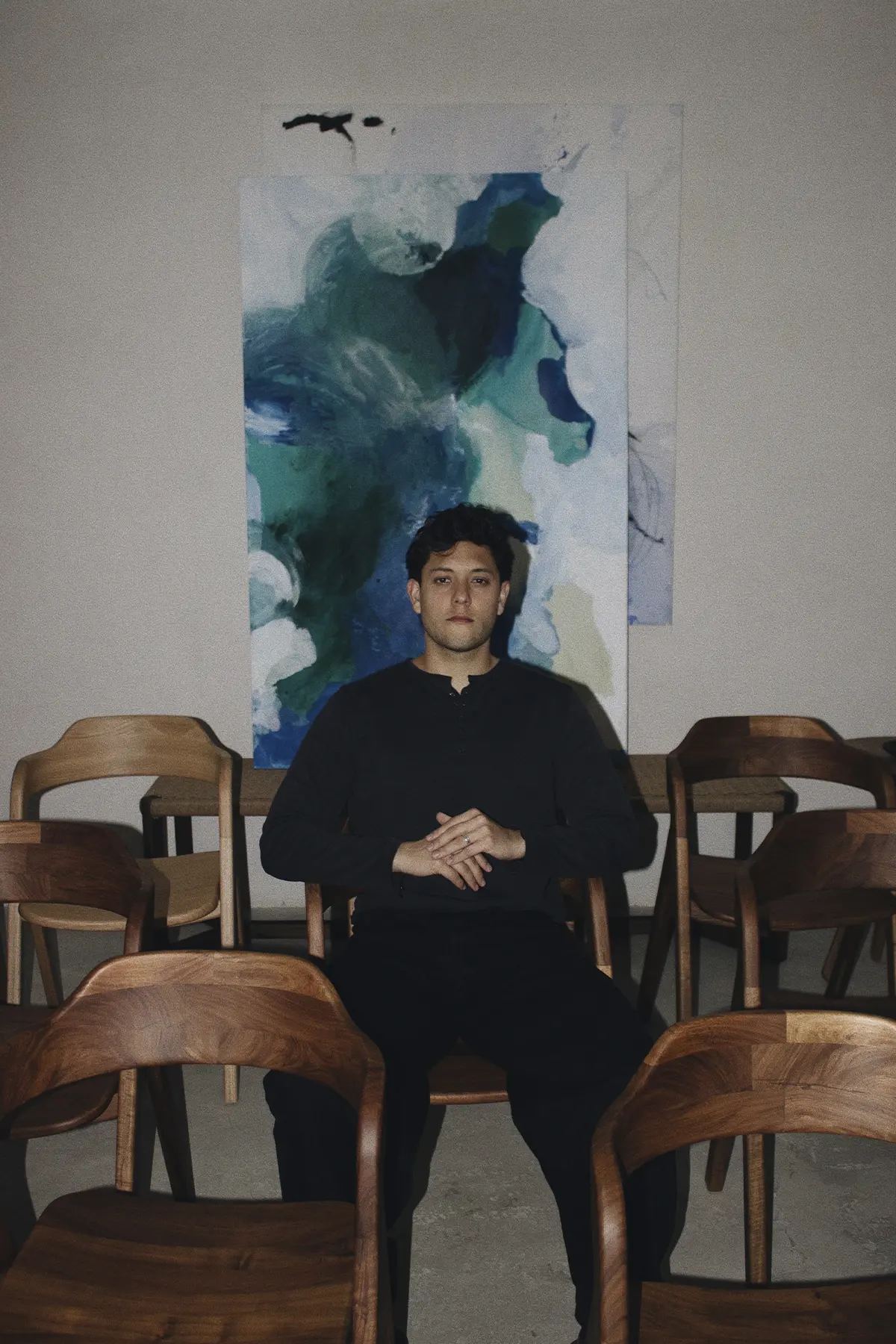

For Sebastián Ángeles, design also involves thinking about how an object accompanies us and ages with us. That quest has been a constant throughout the ten-year history of Dórica, the Mexican brand that began in an abandoned house in Coyoacán and is now celebrating its journey with a retrospective.
The anniversary coincides with the company’s second consecutive appearance at Design House, as part of Design Week. We spoke with him about his journey so far, his craft, and his growing interest in exploring the boundary between furniture and sculpture.

When you look at the brand’s earliest pieces, what do you still recognize in them, and what do you feel has changed completely?
I think what I recognize, above all, is the intention. From the very first pieces, there was a quest to create simple objects that still had something unique about them—objects that were functional, durable, and could stay with a person for a long time. What has completely changed is the way we go about creating them. At first, I designed in a much more intuitive—and, in a way, even naive—manner. Over the past ten years, we’ve learned a great deal about proportions, ergonomics, materials, and, above all, how to craft a piece well.
How did Dórica come about, and what personal or creative need led you to found it?
Dórica began in a very different way from what it is today. We started out practically as a workshop, developing projects and custom pieces for each client. Our first office was in an abandoned house in the heart of Coyoacán, and at that time, I honestly didn’t know how far the project could go. I just really wanted to design and create things. Over time, I realized that I didn’t want to just work on projects for other people, but to develop a language of my own.
The name inevitably brings to mind the Doric order and a certain sense of proportion, structure, and permanence. Why did you choose it, and what does it still mean to you?
The name came about almost naturally. We were looking for something that could have its own identity and represent the values we wanted to build. I really liked what the Doric order stood for: probably the simplest of the classical orders, but also one of the most solid. Ten years later, I think the name makes even more sense. I’m interested in designing objects that will stand the test of time, that aren’t dependent on trends, and that will retain their value over the years.

In Dórica’s work, the concepts of matter, the body, craft, and time appear constantly. How do these ideas translate into a specific piece?
For me, they begin to take shape through the way a piece relates to the body. A chair may look great, but ultimately it has to welcome you, support you, and be with you for a long time. Then there’s the material. I like it when materials retain part of their identity: when wood has grain, when metal has slight variations, when you can look closely at a piece and understand, in some way, how it was made. And finally, there’s time. I always think a piece should be able to age well, be repaired, and eventually pass from one person to another.
If you had to choose one piece that marked a turning point for Dórica, which one would it be and why?
I would probably choose the Balance Chair. Not necessarily because it represents everything we do today, but because it was a piece that began to define a much clearer design language for Dórica. I’ve always found the chair to be one of the most complex objects to design because it brings together so many elements at once: structure, ergonomics, proportion, material, and expression.
“Mies van der Rohe used to say that a chair was a very difficult object to design—he even said that a building was almost easier.”

Although the collections are different, there is a recognizable common thread among them. When did you realize that Dórica already had its own identity?
It makes me very happy that a common language is recognized among the pieces, because it also makes me think that my identity as a designer has become increasingly clear. I never established a set of rules about what Dórica should look like. However, as the collections grew, certain design choices began to recur. When we started displaying pieces from different years and collections within the same space and they coexisted naturally, I realized that a common language already existed.

What aspects of Mexican craftsmanship are you interested in preserving, and which aspects are you looking to reinterpret from a contemporary perspective?
What I’m most interested in preserving is knowledge. In Mexico, there are artisans with an extraordinary ability to work with wood, stone, metal, glass, and many other materials. There’s knowledge you can hardly learn from a computer or even in school; it comes from years of working directly with the material. But I’m also not interested in romanticizing craftsmanship or thinking that we have to produce things exactly as they were made in the past. We work with 3D modeling, CNC, 3D printing, and various technological processes when they make sense.
From your perspective, where does a piece of furniture end and where does a sculpture or work of art begin?
I’m finding it harder and harder to define that boundary. When I first started out, function played a huge role in my design process. In a sense, it dictated many of my ideas: first, there had to be a reason for the object to exist. Over the years, form has become increasingly important in my work. I’ve found forms that, simply by existing, evoke something in me, fulfill me—and I don’t necessarily need to find a function for them right away. I think allowing myself to accept that has opened up a whole new aspect of my practice. I’m very interested in that middle ground. A chair can be completely functional and at the same time have a sculptural presence. I don’t think one necessarily precludes the other.
You say that the pieces don’t seek to take center stage. In an era so defined by imagery and eye-catching objects, how do you design a subtle presence?
I don’t design with a photograph in mind or to create an instant impact. Nor am I interested in an object attracting attention simply because it’s strange, exaggerated, or colorful. I believe an object can have a powerful presence without needing to scream for attention. Sometimes a proportion, a curve, or the way two materials come together can be enough. I think a lot, for example, about a Thonet chair. It can appear today in contexts completely different from those for which it was designed, and it remains relevant. Its context does not determine its value. I’d like to think of our objects in that way: present today, but capable of becoming part of other contexts in the future. For me, there’s a kind of quiet luxury in that.

For this anniversary, they are presenting a retrospective. How was it organized, and what unexpected connections did you find between pieces created at different times?
Looking back has made me feel incredibly nostalgic. It has made me aware of great moments, of decisions that brought us this far, and even of mistakes that ultimately helped me grow. I also think about all the people who have been part of this project: some who were here for a while and then left, others who are still here, and some who, over the years, have become even more important.
In 2026, you’ll present “Prea,” Dórica’s first collection of everyday objects. Why did you decide to change your scale at this particular time?
After ten years of designing furniture, I became much more interested in the relationship we have with the small objects we use every day. The change in scale also allowed me to explore more complex and expressive forms that would likely have been very difficult to incorporate directly into furniture. In that sense, if you think about it, Prea is also a collection of small sculptures. There are very simple objects in a home with which we have a much closer relationship than we realize. We touch them, we move them around; they’re part of small daily rituals, and we often end up developing an emotional attachment to them.

After ten years, what are you interested in doing now that wouldn’t have been possible for Dórica when it first started? What’s next for the brand?
What excites me the most is that Dórica now has its own identity. We have products we’ve developed over the years, much more robust production processes, and, above all, a team that has grown into something I never imagined when we started. I see Dórica entering a phase of international growth. I’m interested in improving our logistics, strengthening our presence outside of Mexico, and eventually establishing physical retail spaces in other locations. I want our pieces to reach more cities and contexts that seemed very far off just ten years ago. I believe the next ten years aren’t just about making more products. I’m interested in broadening our understanding of design and allowing Dórica and my personal practice to evolve in parallel.
Discover more topics on art, design, and architecture in AW Magazine