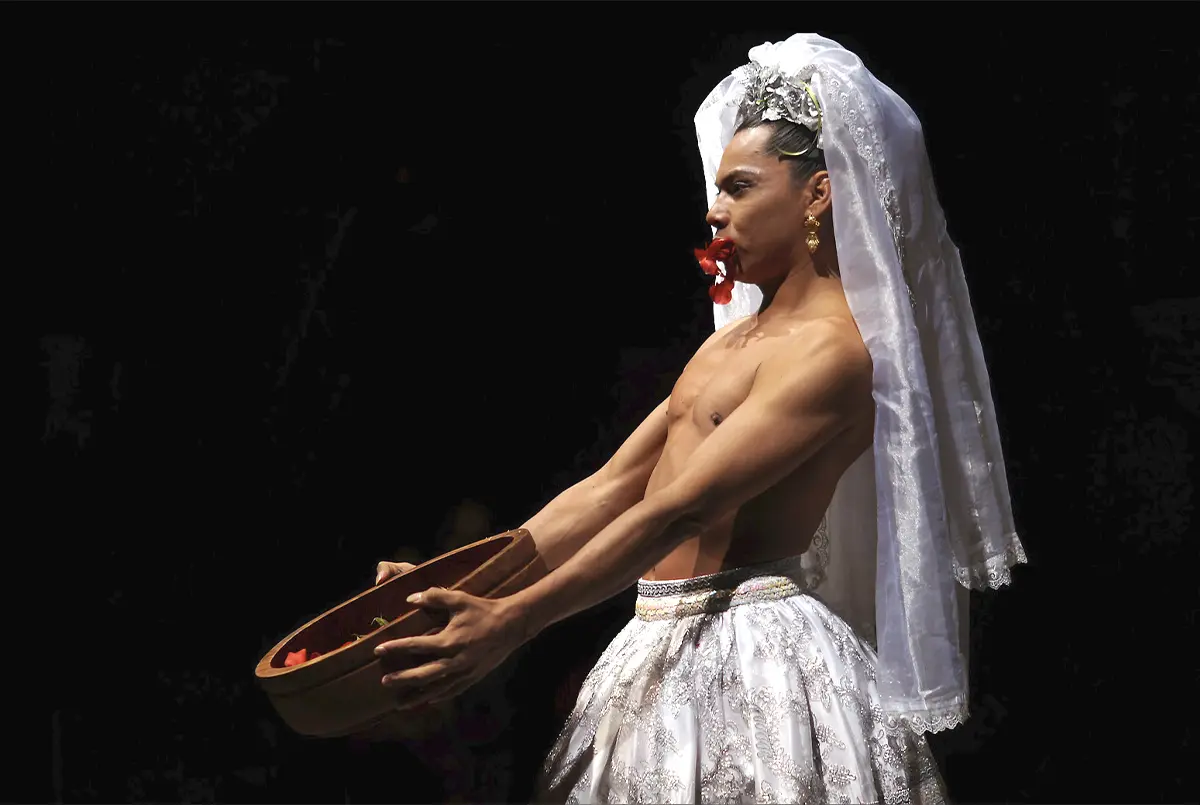

“Strangeness”: that is how succinctly Oaxacan artist and activist Lukas Avendaño describes his feelings after becoming the first Mexican to win the prestigious award from the New York Foundation for Contemporary Arts. “Yes, it’s strange because you don’t even know such a prize exists. And in that ignorance, it’s even less likely that you’d ever think you’d be awarded it one day. Plus, the nomination comes from people you don’t know, and they don’t reveal who nominated you,” he says. One of the foundation’s conditions is to keep the nominators anonymous, so that the winner does not feel indebted or obligated to repay that person in any way.

Lukas Avendaño, who identifies as muxe, has a career that transcends any single label: he is a dancer, choreographer, poet, actor, model, performance artist, and anthropologist. His work explores identity and has been presented in various countries, always driven by the need to give a voice and visibility to those who have historically been marginalized.
Identity in the Spotlight
And yes, she’s constantly in the spotlight, sometimes being asked ridiculous questions like, “So, what’s it like to be a muxe?”
For Avendaño, one of the downsides of being an artist is precisely the culture of commentary that surrounds it: “Many people assume the right to constantly comment on my appearance rather than on the award or the grant. They call you weird, abnormal, twisted…”
But fortunately, he has a protective shell—one he has forged over the years. “As an artist, I’m constantly shielded by my role as an anthropologist,” he says—two categories that, it seems, implicitly grant a person an advantage : “Oh, he’s a professional—oh, well. But when the image appears, nothing has more value than the image, which seems to be transgressing the roles of normality,” he reflects. For Avendaño, that background allows him to approach his stage works in a certain way: “It wouldn’t be the same if I hadn’t studied anthropology.”

The Difference Outside the Isthmus
When he left the Isthmus, he was very young and didn’t yet understand the unique characteristics of the region and its people. “To me, the world was like that everywhere,” he recalls. It wasn’t until he arrived in Xalapa, Veracruz, to study that he discovered that what he could do freely in his own community was viewed differently there.
To live in a dorm, he had to cut his hair and stop wearing earrings. That was one of the first conflicts that led him to adjust his behavior and build cultural capital that would allow him to engage with the city from a different perspective. “From my position of nonconformity, I could still live up to the standards of masculinity. That gave me a buffer that allowed me, on the other hand, to live freely,” he acknowledges.
“He’s gay, but he writes well; he’s a faggot, but he’s an artist; he’s weird, but he’s a professional.” Turning that “but” on its head became part of his journey. The reaction to the news of the award, however, confirmed to him that the challenge continues: alongside the congratulations came comments that belittled him.
From Dance to Performance
In fact, Avendaño came to art by chance. Her earliest role models were figures from television and film, especially Lola Beltrán and Lucha Villa—women who, in films about the Mexican Revolution, broke with traditional gender roles. “I didn’t want to be an artist; I wanted to dance in that different way.”
His training as an athlete and dancer blended with his experience as a model in the life-drawing workshop led by Swedish-born artist Per Anderson. From that experience emerged his own unique way of engaging with public space. In 2001, an invitation from the Jardín de las Esculturas marked the moment when he began to be recognized as an artist.

Beyond the Folkloric Symbol
Today, his work has gained recognition both inside and outside Mexico, and his performances have been particularly well received in Madrid.
Its growing recognition has also led to the muxe identity being viewed as a folkloric or exotic symbol, disconnected from the everyday complexities of the Isthmus. Requiem for a Stone Curlew, the first piece in which he addressed the muxe theme, dates from 2011 and was inspired by the assertions of those who, after visiting the Isthmus just once, felt entitled to establish absolute criteria of truth, “as if there were only one way to be muxe,” she explains, adding with a tone that leaves us unsure whether it is acknowledgment or irony:
“When a muxe wears the Tehuana costume, it takes on added significance, because it’s a costume that already carries prestige. Perhaps its greatest advocate was Frida Kahlo.”
Requiem for a Stone Curlew It also responded to those who claimed that muxes sought to take women’s place, compete with them, or confuse men. That is why Avendaño appears on stage without a huipil. One of her costumes was embroidered by a muxe who, upon learning what would happen during the performance, asked her if she was going to appear “naked.”
“If a muxe who doesn’t have breasts to breastfeed felt conflicted about going out without a huipil, that led me to think I could refute those so-called ‘truths’ that claimed we wanted to take women’s place or compete with them.”
By appearing without a huipil, she seeks to lay bare that duality: “It’s a way of saying, ‘Look, don’t be confused. I don’t want to confuse anyone or compete with anyone, much less with women. This is what it means to be muxe.’”

Celebrations and Everyday Life
For Lukas, the muxe festival is not merely an aesthetic expression: it is the visible result of a broader community structure. The growing media attention has also changed certain conditions. Traditionally, many muxe people supported themselves through trades associated with the community: embroiderers, cooks, bartenders, sex workers, hairstylists, makeup artists, or adornment makers. Now, with interest from media outlets and platforms like Vogue and Netflix, some have begun charging for interviews and photo shoots.
It’s a nod to Tehuana culture
Something similar happens with the aforementioned references to Frida Kahlo that some people find in his work. When Avendaño created the installation *Buscando a Bruno*, he wasn’t thinking about the painter. The association arose because of the clothing. “I’m not the one winking at Frida. Frida is winking at Tehuana culture.” The performance is a profound piece of performance art created by Avendaño to draw attention, through his work, to the disappearance of his brother, Bruno Alonso Avendaño Martínez.
After the Mexican Revolution, the project to forge a national identity brought together artists and intellectuals who found in the Isthmus of Tehuantepec part of the imagery through which the country would be represented. Frida Kahlo herself, along with Diego Rivera, Miguel Covarrubias, Sergei Eisenstein, and Tina Modotti, among others, visited the region and drew inspiration from its imagery. The murals at the National Palace and the Ministry of Public Education, as well as the depiction of a Tehuana woman on the ten-peso bill, placed this indigenous representation at the center of the national imagination.
According to Avendaño, the clothing of Zapotec women from the Isthmus possesses a scenic and theatrical quality that explains Kahlo’s fascination. In many of her photographs, she is shown wearing petticoats, ruffles, and jewelry from the region. “She is immersed in that visual aesthetic—its colors, designs, lines, shapes, and rhythms. I believe she also draws on this to create some of her works.”
Tribute or cultural appropriation?
What was once understood as a homage or tribute can now be interpreted as cultural appropriation. Avendaño recalls *Los rivales*, a painting by Diego Rivera inspired by an Isthmian celebration and auctioned off decades later for millions. This transaction leads him to wonder how a work taken out of that context gives back to the culture from which it drew its imagery.
“An artist takes up a subject, and then we think, ‘What an honor that he has looked at the indigenous peoples and brought them to the world’s attention.’ We were raised to believe that they were doing us a favor.”
When Fame Hides One’s Origins
The confusion surrounding her own works stems from this very lack of knowledge. It’s not that Avendaño drew inspiration from Frida Kahlo, but rather that many people immediately associate her with the artist because they are unaware of the history of the Isthmus, Zapotec culture, and the Tehuana costume. He explains this with a comparison: if Rosalía were to wear Wixárika clothing, some people would probably say afterward that a Wixárika artist “dressed like Rosalía.”

“The same thing would happen if Madonna or Salma Hayek were to appear in a jarocha outfit: the media image would end up overshadowing the regions where the attire originates,” the artist says.
“It’s a kind of intellectual laziness. Instead of researching, people make associations and invent things. Legitimacy is granted to those who have accumulated the most cultural, economic, or political capital, while those who are rendered invisible continue to be portrayed as copycats.”
Who should represent a community?
When I ask him about Lila Downs and whether he thinks she has carried the values of her region with her, Avendaño turns the question back on me: “It’s as if I were to ask you: Have you, as a communicator, carried the values of the place where you live and of your time?” I reply, jokingly, that “we communicators don’t have values,” but his question raises an important point: why are certain artists expected to represent a collective identity, as if their origins compelled them to speak on behalf of an entire community? He also clarifies a point: Downs isn’t originally from the Isthmus; rather, her mother is from the Mixteca region.
A Space for Remembrance
In the face of these inequalities, Avendaño has been working for 25 years to create a space dedicated to memory. The money from the prize he just won will go toward that project, although it is not the starting point: every extra income he has received over the years has become “a brick or a notebook.”
The space, located in Tehuantepec, will be named the Embajada Conservatorio de las Artes. Avendaño does not consider it his legacy, as he is, in a way, reluctant to take on that spotlight.
“The costumes I wear on stage are the result of two hundred years of craftsmanship and evolution. The music I dance to is a hundred years old, and those who wrote those scores never imagined it would become their legacy. What kind of sense of self-importance or ego would I have if I thought this would be my legacy?”
In addition, by 2027 he hopes to premiere a new piece titled *Siado’guie’*, a Zapotec expression that can be translated as “Little Flower Morning” and is used to refer to the dawn. This is how the days unfold for an artist who questions who has the right to define an identity and how it is represented to the world.
Discover more exclusive interviews about art and performance in AW Magazine.