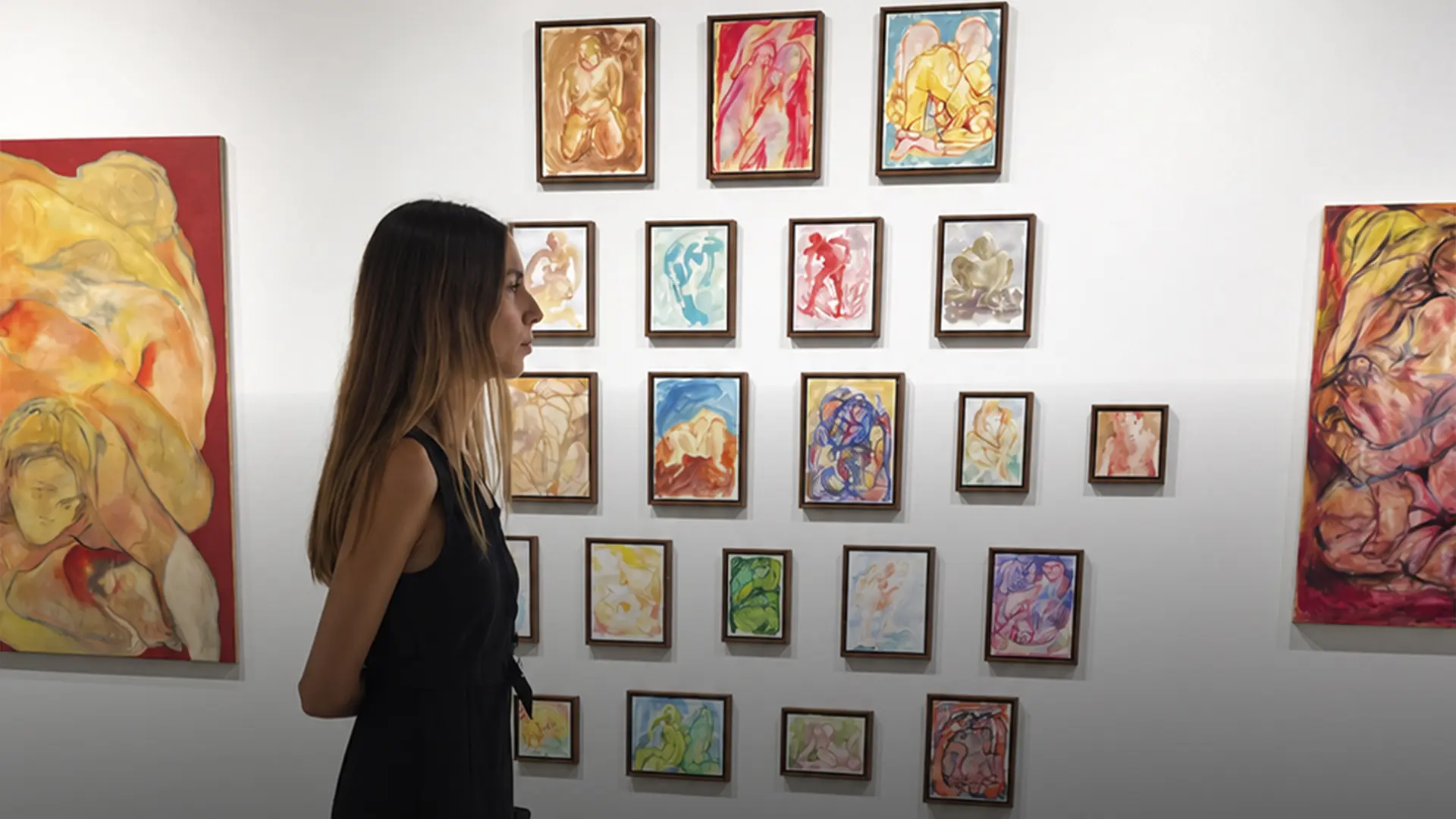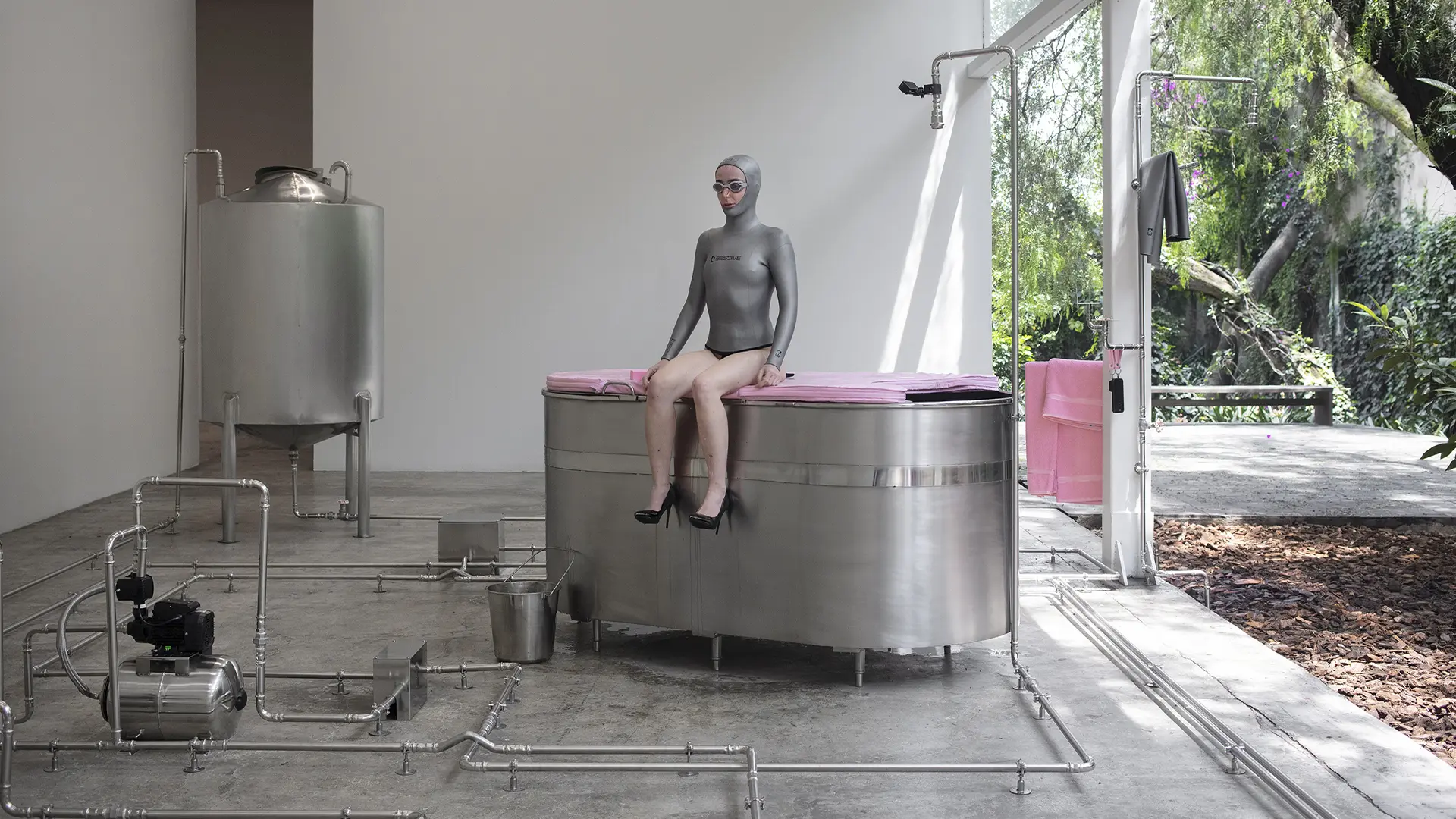

LABOR presents APNEA, the first solo exhibition by Spanish dancer and choreographer Candela Capitán at the gallery in Mexico City. Apnea means a lack of breathing, or being out of breath. Based on this concept, the performance artist transforms the space into a kind of spa set in the imminent future, where rest is no longer synonymous with stillness but becomes an experience that pushes the body to its very limits.
Through an installation activated by feminized bodies, Capitán connects breath, water, and technology to question new forms of care and well-being, which are increasingly subject to systems of measurement, training, and control. We spoke with her about this piece, the relationship between the body and the machine, and the contradictions that underlie our contemporary pursuit of “well-being.”

What is the emotion or drive behind APNEA, your first solo exhibition at LABOR?
The piece is an installation. I actually come from the world of dance—I’m a choreographer—but I’m very interested in the movement that emerged in the 1980s in New York: postmodern dance. So, I really like conceptual art and exhibitions.
I’ve been engaging with the visual arts for some time now and have held a couple of exhibitions, though mostly in venues connected to a performing arts program. I really wanted to do an exhibition in a setting devoted entirely to the visual arts and not have to view my work through the lens of movement—though that’s impossible, because I always view it through the body—but I wanted the freedom not to view it from the perspective of dance. Freediving is a sport, but to me it also sounds like a woman’s name. Within the sport, there are three types of freediving. I’m practicing static freediving. In the other disciplines, the person stays underwater for a long time, descends to the greatest possible depth, or covers the greatest distance. It’s the sport of holding one’s breath underwater.
How would you describe this play?
The work is an installation that is activated through a performance. I say it’s about a spa in the very near future. I’m always exploring how bodies today are being isolated and how social media and new technologies are causing us to optimize ourselves.

Optimization might seem like a positive thing. One of the current trends in art and performance is to resist modernity and appeal to tradition or “the way things have always been.” When you talk about a spa of the future, do you frame it positively, or not necessarily?
Actually, I usually try to pose questions rather than provide answers. The truth is, I’m part of a generation that has benefited greatly from the internet. I’m from a very small town in southern Spain, and I can’t say that social media has only negative aspects. In fact, its positive aspects are more prominent in many of my works.
But this piece, specifically, is about how, very soon, we’re going to push that limit even further. In my movement practice, there’s always an element of pushing the body to its limits. In this piece, it’s as if we’re no longer going to the spa to relax, but rather to push our bodies beyond their limits.
“Candela Capitán’s proposal is wonderful because it focuses all its energy and emphasis on understanding the body’s alarm signal related to breathing and proposes a different way of studying it, relating to it, and even using it for our own pleasure,” Chus Martínez in the curatorial text for *Apnea*.

Performance is often associated with the performing arts, although it also has a very close relationship with dance. How do you understand that relationship—first in general terms and then within the context of this exhibition?
Performance, in reality, is a matter of terminology, because “performance art” is what Marina Abramović established within the museum. In reality, it’s a question of classification and how you secure funding for your work: through a performing arts program or an arts program.
“It’s very complex. People in the art world say what I do is dance, and people in the dance world say it’s art. That can be very positive in a way, but sometimes I also have a hard time breaking into certain circles because I don’t have a label,” Candela Capitán.
The word “performance” can refer to performance art or the performing arts. It’s a problem with the word itself. But there’s a big difference between a performance that takes place in a museum, the way the body is viewed within a museum, and how it’s constructed for the stage.
Then everything can fall apart, which is what I do. When I create plays, they have a lot to do with performance and conceptual art; and when I move into a realm more closely related to conceptual art, my work must be viewed through the lens of movement.

Finally, when presenting the play in Mexico and at LABOR, do you think the Mexican audience might receive it differently than they would in Spain?
I think European aesthetics are very modern, but I feel like there’s a lot of culture here—general culture. Maybe there’s more depth here. The aesthetic and everything surrounding artworks in Europe are so strong that they’ve somewhat overshadowed the depth. I also feel that here there’s a strong focus on the female body—as if it were something quite important.
Discover more connections between art, lifestyle, and contemporary culture in AW Magazine.