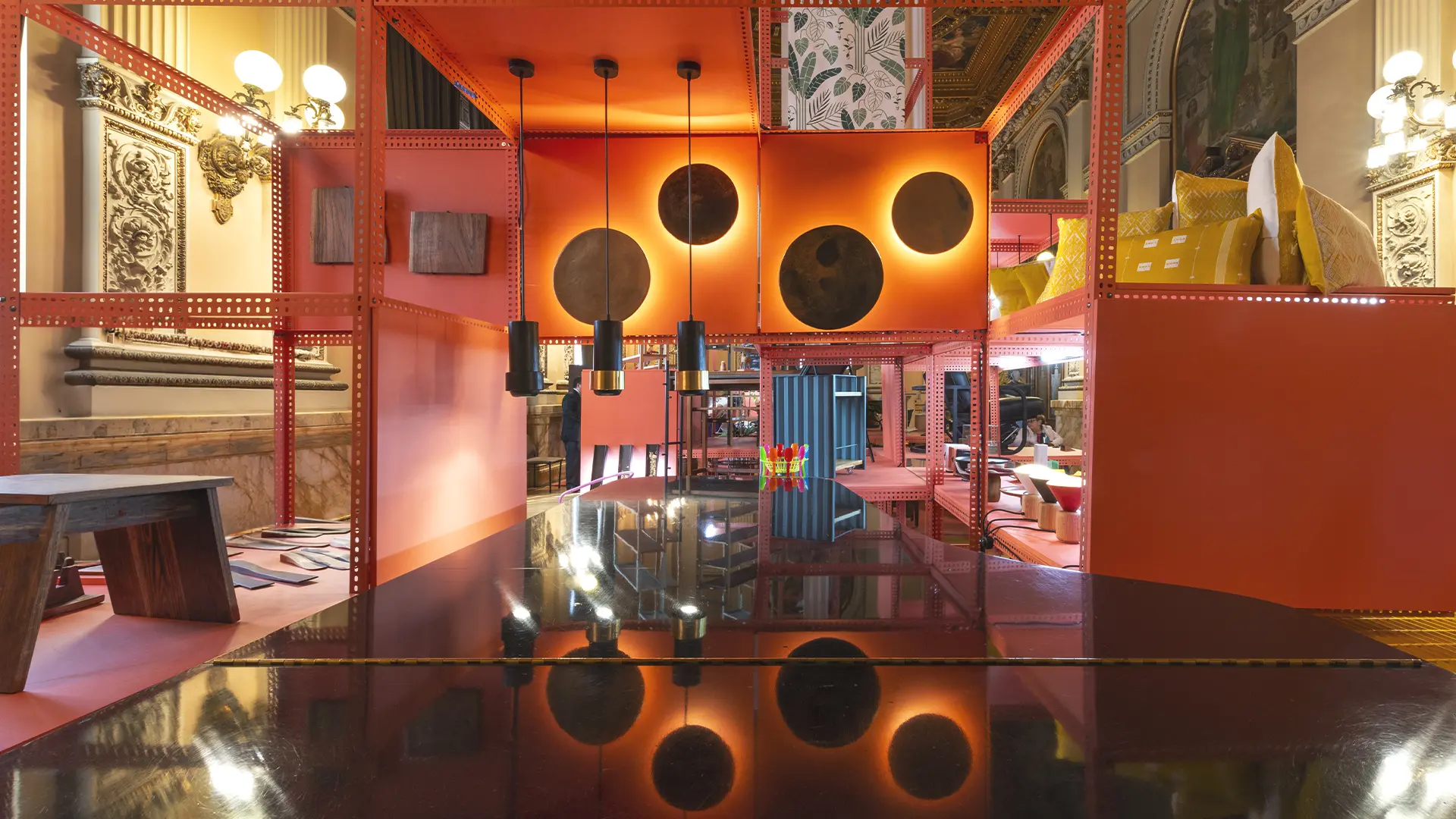

Joanna Ruiz Galindo is a co-founder and co-director of the Abierto Mexicano de Diseño (AMD), a cultural festival that, since 2013—with a hiatus during the pandemic—has brought together and promoted independent design and the creative industries in Mexico City. The initiative, founded together with designer and cultural manager Ricardo Lozano, is now in its tenth edition after 14 years.
This year, the event invites us to look toward possible futures through exhibitions, workshops, and public activities that address issues such as the climate crisis, new materials, and the—dreaded?—artificial intelligence. Costa Rica is participating for the first time as the guest country. We spoke with Ruiz Galindo about the festival’s evolution, the current state of Latin American design, and the fears that shape our future.

The Mexican Design Open is now in its tenth edition. How has it evolved, and where does it stand today?
We’re absolutely thrilled to reach our 10th edition—even though we’ve actually been around for 14 years, since the festival began in 2013 but then took a much-needed hiatus. We believe the Abierto is an indispensable platform for the design community. It’s ten days of celebrating design.
As the name suggests, it is an open space where we invite the community to participate and exhibit their work. But we don’t just want them to show their work—we also want them to question what design means. We have a public program and hold events at various museums.
How does El Abierto seek to bring design to audiences who are not necessarily part of the design community?
We want design to be visible and accessible to society. And yes, rather than being an event just for designers and architects, we aim to bring design closer to society and help people understand that it is there to serve us, how it can help us improve our lives in every way, and how it surrounds us.

How important is public space in this context?
Public space has always been very important to El Abierto . We borrowed that phrase from Juan Villoro— the “emotional appropriation of public space” — and we always put things there so that people passing by will say, “Oh, what’s this?” Maybe that will draw them in to visit a museum or an exhibition, and from there, they’ll start to soak it all in. We think the 10th edition is significant. It makes us very happy.
One of the event’s main focuses is “Novedades,” the competition that offers a glimpse into the current state of design. From your position at the helm of this celebration, how do you perceive that current state, not only in Mexico but also in Latin America?
I really like how designers are tackling extremely important issues. Materiality is one of them: what they use to make their products, and how they’re exploring other materials. I like that they’re questioning different things—not just design as pretty things. This time, the “New Releases” section features projects in social design and speculative design.
I like that they’re moving a little beyond just the product itself. As I was saying, I believe design is a tool for change. I love that designers understand that El Abierto is a place where they can showcase these projects and that they’re presenting them in the “New Arrivals” section.
So how did “Novedades” come about, and what does it aim to showcase?
The “Novedades” competition didn’t start at the beginning of the festival, but rather in 2019. That was when, together with Mario Ballesteros—who was the first guest curator—we decided to launch this competition. We felt it was important to find out what designers are creating right now, to learn about these new developments—what has been designed over the past year—and to present it as a competition. I like the direction design is taking in Latin America.

Costa Rica is this year’s guest country. What does its participation in the festival entail?
Although El Abierto has always been an international festival, this year, for the first time, we’re introducing a “guest country” section, and we’re thrilled. An incredible pavilion will be set up in Plaza Legorreta, at the Cenart.
Together with Costa Rica Design Week—a sort of namesake of ours over there and a sister festival—they curated and invited more than 15 designers who will be presenting at the festival, as well as some architects who will be creating landscape designs inside the pavilion. We’re very excited to be the guest country for the first time.
Within “Panorama Abierto,” there is one approach that particularly stands out: “Imagining the Future.” What does it entail?
Ever since the first edition of El Abierto, we’ve liked to set a theme so that it wouldn’t just be an exhibition, but so that the designers would also ask themselves questions.
“I think El Abierto had looked back a lot and focused on the past. We’d examined trades, local culture, and so on, and we felt we needed to look toward the future, to see what’s coming,” Joanna Ruiz Galindo.
That is why we invited Jorge Camacho and Karla Paniagua to serve as curators this year. They are experts on the topic of the future. We believe that design is an indispensable tool for imagining how we want to shape those futures.

Why do we talk about futures in the plural?
“Futures” is always plural because there are many of them. We are in the present today, and there are many possible futures that could unfold depending on which path we take, what we design, what materials we use, and how we care for the planet.
I like that designers today are asking themselves more often how what they create affects the future. There’s also this whole field of future design.
The future is also present in the main exhibition, Future Fears. What does this exhibition explore?
Since 2019, El Abierto has invited curators to propose the theme for the public program’s discussions. Designers are not given that guideline, but in addition to that, these curators are responsible for proposing a main exhibition. In this case, Karla and Jorge proposed “Futuros Pánicos.”

How do our fears influence the shaping of those futures?
They wonder how fears influence the way we design those futures: all this climate anxiety, the fear of artificial intelligence, or the fear of being attacked. Depending on where you are, you have different fears. They wondered: living in Mexico City isn’t the same as living in Culiacán. We have different fears, and through them, we shape our future—even if we aren’t designers.
You find yourself saying, “Which truck should I take? Should I take the truck or a taxi?” depending on whether or not I’m afraid. That’s what they’re going to show us in this main exhibition.
Speaking of fears about artificial intelligence, how does an event like El Abierto engage with or address this reality that is influencing design?
Some designers are feeling threatened by artificial intelligence because today you can tell ChatGPT, “Make me a logo; I want it to be elegant,” and so on.
I think it’s a tool. We have to learn to live with it and use it exactly as that: a tool—not stop relying on the designer. I don’t think it will ever replace creative thinking, but it can help us visualize things more easily. It can’t produce a finished product. You can’t tell ChatGPT, “Design my house and draw up the blueprints for me.”
In addition to learning how to use it as a tool, is it necessary to establish collective limits on artificial intelligence?
We have to learn. In fact, there will be a very interesting workshop on artificial intelligence at El Abierto, as part of the public program. There’s also that fear that it might hack us or that we don’t know what information it has. These spaces and platforms are where we need to come together with our community to discuss these issues and ask: “How should we use it, and how shouldn’t we? What should we do, and what shouldn’t we? What’s acceptable, and what isn’t?” We need to reach a consensus—that’s what’s coming.

What specific issues should the design community discuss?
That’s what happened with the Hollywood writers, who banded together and went on strike. Something similar should happen with designers: we need to define what AI is allowed and not allowed to use when creating its designs. You can already ask it to create an illustration like one by a specific designer. To what extent are you stealing from them—or not?
From September 25 to October 4, 2026, the CDMX Design Open will bring its exhibitions, workshops, and activities to the National Center for the Arts, the MUAC, the National Museum of Popular Cultures, the Yancuic Museum, the Carrillo Gil Art Museum, and the Diego Rivera and Frida Kahlo House-Studio Museum, among other venues. The complete program is available on the festival’s website.
Discover more design fairs and articles on contemporary art in Latin America in AW Magazine.