
There is no single definition of Mexican contemporary art, nor is there a single characteristic that makes it uniform. However, its institutional and conceptual consolidation can be traced back to the 1990s. According to art historian Daniel Montero, as quoted by the Excélsior newspaper, a new artistic field emerged in Mexico during that period, characterized by conceptual and non-object-based practices, as well as a crisis in traditional artistic media. Within this field, Mexican contemporary art has produced expressions that could be considered endemic—in the sense that they arise from specific territories, conflicts, traditions, and ways of life—even as they engage in a dialogue with the global context.
To ensure this idea doesn’t fall on deaf ears, at Art Weekends we’re taking a look at some of the works produced in the country over the past few decades. In searching for that umbilical cord—and without forcing the debate—we find recurring themes: identity, memory, violence, territory, inequality, gender, and the relationship between tradition, technology, and globalization.

No, these are not rules or characteristics present in all the works, but rather related elements that allow us to reflect on contemporary Mexican artistic identity through 10 non-determinative themes—themes that are, however, eloquent enough to chart a course. They serve as recurring threads for analyzing an art scene that has developed in Mexico and is linked to various international contemporary art circuits.
1. A Dialogue with Mexican Identity
Contemporary artists reexamine symbols, narratives, and images associated with “Mexican-ness” to analyze how that identity is constructed. They frequently challenge the nationalist style promoted by the post-revolutionary state and disseminated by much of modern art—especially muralism—through depictions of the pre-Hispanic past, the peasantry, the Revolution, and popular culture. Popular culture remains a recurring theme in contemporary Mexican art, but it is approached from a different perspective.
In his 2010 exhibition *Incorruptibles*, Carlos Amorales combines a Maya glyph with his archive of digital images to explore the contemporary significance of pre-Columbian objects and their relationship to official history. The Amparo Museum notes that the piece raises questions about “the formation of Mexican identity.”
2. A Critical Examination of Official History and Collective Memory
In contemporary Mexican art, history is often no longer understood as a closed narrative. Artists examine their archives, monuments, and images, but also their silences, omissions, and absences.
In *Restoration of a Mural* (PRI), the Tercerunquinto collective restored an election mural painted on a house. In 2010, a professional team of restorers intervened to preserve the political propaganda located on a house in San Andrés Cacaloapan, Puebla. By preserving an image destined to disappear after the campaign, the collective transformed it into a vestige of recent political history and a testament to a memory that often remains hidden. The series, which is part of the museum’s collection, extends this gesture through a digital intervention.
3. The existence of political and social issues
Many works of contemporary Mexican art draw on specific issues—consumerism, labor exploitation, environmental degradation, or social exclusion—and transform art into a tool for social analysis.
A clear example is the work of Minerva Cuevas, who reworks logos, advertisements, and corporate identities to reveal the hidden inequalities in both consumerism and the processes of capitalism. Her best-known project is *Mejor Vida Corp.*, which was presented at the Tamayo Museum in 2000.
4. Reflections on Violence, Disappearances, and Drug Trafficking
Contemporary violence has transformed public life, the built environment, and the ways in which the body, death, and absence are represented. In Mexico, violence has become a tragic yet inevitable raw material for contemporary art. Teresa Margolles ’s work stems from this: the material traces left behind by violence. Her installations, photographs, and performances address grief, abandonment, impunity, and communities affected by organized crime. In *¿De qué otra cosa podríamos hablar?* (*What Else Could We Talk About ?*), presented at the 2009 Venice Biennale, she brought these issues to the international stage.

5. Exploring Territory, Borders, and Migration
Mexico is a country of origin, transit, destination, and return for migrants. The border, in addition to being a geographical boundary, serves as an economic, cultural, and political space where art flourishes across its various disciplines.
“Where does Mexico begin and where does the United States begin in this region?” asks Sayak Valencia, who has been studying feminism and Chicano movements for at least two decades. As a thinker from the border, Valencia is interested in “the interstices and hybridity between cultures,” but also in contemporary geopolitics. From this perspective, she developed the concept of “gore capitalism”, through which she analyzes the relationship between violence, death economies, and border territories.

6. Feminist Perspectives and Gender Critiques
Feminism raised new questions about the body, motherhood, violence, sexuality, domestic work, and the representation of women.
In *Evidencias* (2010–2016), Lorena Wolffer gathered 237 objects used to assault women in the home. Each is accompanied by the testimony of the person who suffered the violence. The installation transforms everyday objects into material evidence of assaults that often remain hidden and, at the same time, creates a space for survivors to reclaim their own voices.
7. Improvisation, Recycling, and the Aesthetics of Self-Construction
The use of found, recycled, or seemingly makeshift materials plays an important role in contemporary Mexican art. Wood, sheet metal, cardboard, plastic, and discarded objects are assembled using techniques reminiscent of improvised architecture and traditional methods of building, repairing, and reusing.
As evidence of this, Mexico City artist Abraham Cruzvillegas made this way of working the centerpiece of his project *Autoconstrucción*. Inspired by the constant transformations of the homes in the Ajusco neighborhood, where he grew up, the artist creates sculptures using salvaged objects and disparate materials. Unstable joints, makeshift adjustments, and improvisation are not flaws: they constitute the language of the work.

Designed by Abraham Cruzvillegas
8. Disassembly and Transformation of Everyday Objects
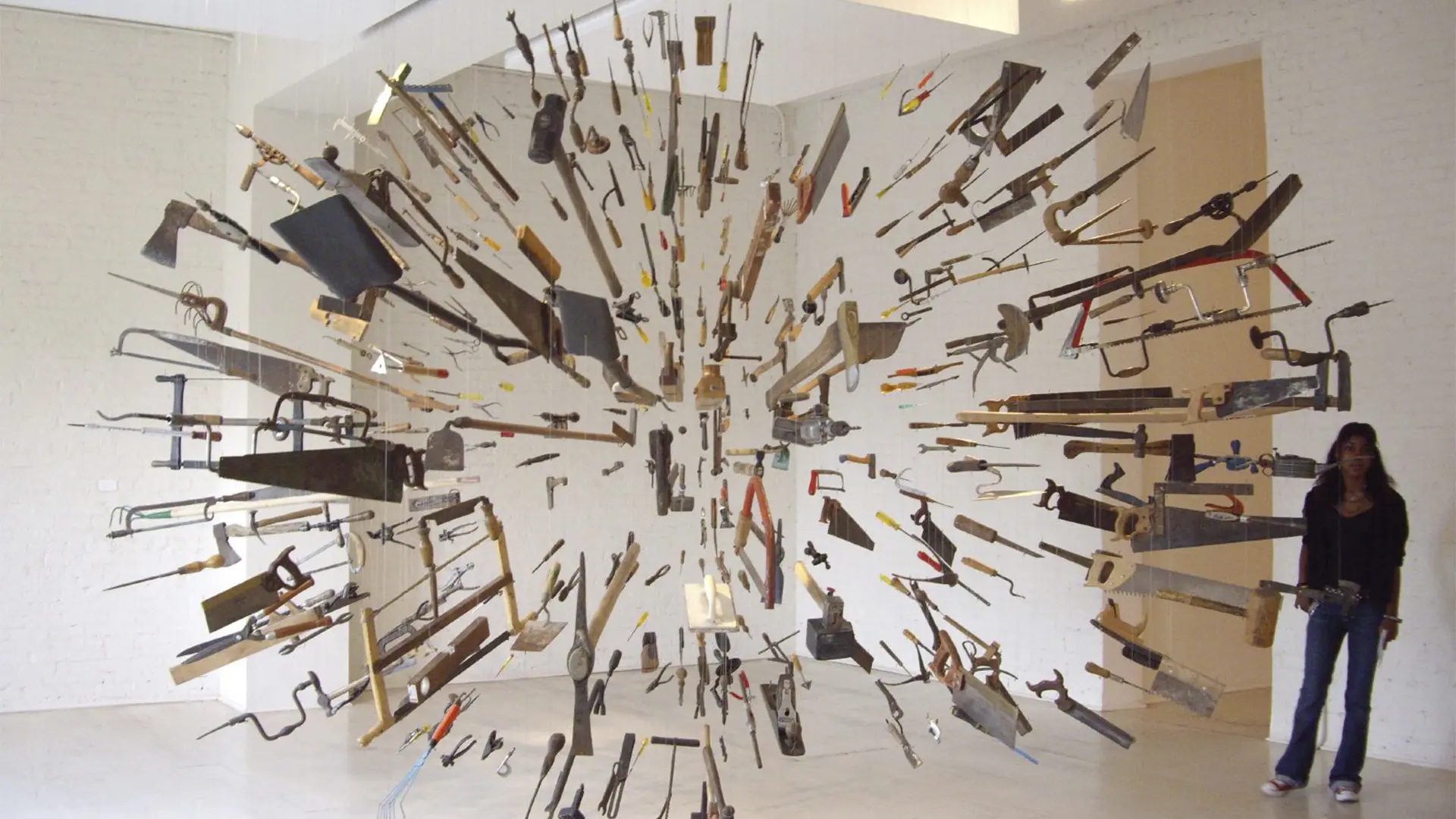
Another recurring practice involves taking recognizable objects, taking them apart, and altering how they function. Cars, tools, furniture, and utensils cease to be functional objects and become sculptures or installations. This process allows us to examine their design, their structure, and the social relationships they embody. In *Cosmic Thing* (2002), Damián Ortega dismantled a 1989 Volkswagen Sedan and suspended each of its parts in space. The car, closely tied to urban life and Mexican material culture, appears transformed into a kind of three-dimensional diagram: it retains its form but loses its function.
9. Performance, Action, and Use of the Body
In performance art, the work consists of an action carried out in front of an audience or recorded through photography and video. The body can become a medium, a tool, and a field of experimentation. In 2026, Galia Eibenschutz, Daniel García, Iván Gabaldón, and Roselys Oropeza presented IN SITU at La Tallera in Cuernavaca. The video installation emerged from a performance practice for the camera, in which bodily movement, repetition, and the relationship with a former industrial warehouse construct a kind of choreography of survival. The work blends performance, film, photography, installation, and sound design. The body does not merely occupy the old industrial warehouse: it measures its dimensions, acknowledges its wear and tear, and reacts to it.

10. Collective Work and Self-Managed Spaces
A significant portion of Mexican contemporary art has developed outside of museums and commercial galleries. Faced with a lack of venues to present experimental work, numerous artists have formed collectives, opened independent spaces, and organized their own exhibitions. This approach has fostered collaboration, the exchange of ideas, and the emergence of artistic languages that would have had little room within traditional institutions.
Guadalajara has been one of the main hubs for these practices. Since the 1990s, artists, curators, and cultural managers have fostered an alternative scene that challenged dominant artistic paradigms and helped decentralize the country’s contemporary art production. Figures such as Carlos Ashida and collectives such as Sector Reforma helped create networks, exhibitions, and platforms to connect local artists with national and international art circuits.
These ten themes are not rules, nor do they claim to define all of Mexican contemporary art. They are points of convergence that show how artists view, question, and reinterpret the country from different perspectives that, at the end of the day, converge in distinctly Mexican processes.
Discover more lists about Ibero-American contemporary art in AW Magazine