
The exhibition *A Dialogue with Art*, curated by Eloy Martínez de la Pera, brings together paintings, jewelry, and archival documents to trace more than eight decades of history of the firm founded in Bilbao.

A young woman is holding a fish in her hands. She is wearing a scarf in her hair and a pink blouse. There is no jewelry in her portrait. However, *Pescadora* (Fisherwoman), painted by Alberto Arrúe in 1943, is the work chosen to welcome visitors to *A Dialogue with Art*, the exhibition that the historic Suárez jewelry house is presenting at the Lázaro Galdiano Museum in Madrid.
The painting comes from the Álava Museum of Fine Arts. Its presence is the result of a historical coincidence. In 1943, while Arr´e was painting that figure, the Suárez jewelry house was founded in Bilbao. Eloy Martínez de la Pera, the exhibition’s curator, uses that date as a starting point to tell a story that encompasses both the designs and the people who crafted, sold, bought, and preserved the jewelry.
From Bilbao to Madrid: The Origins of a Jewelry Store

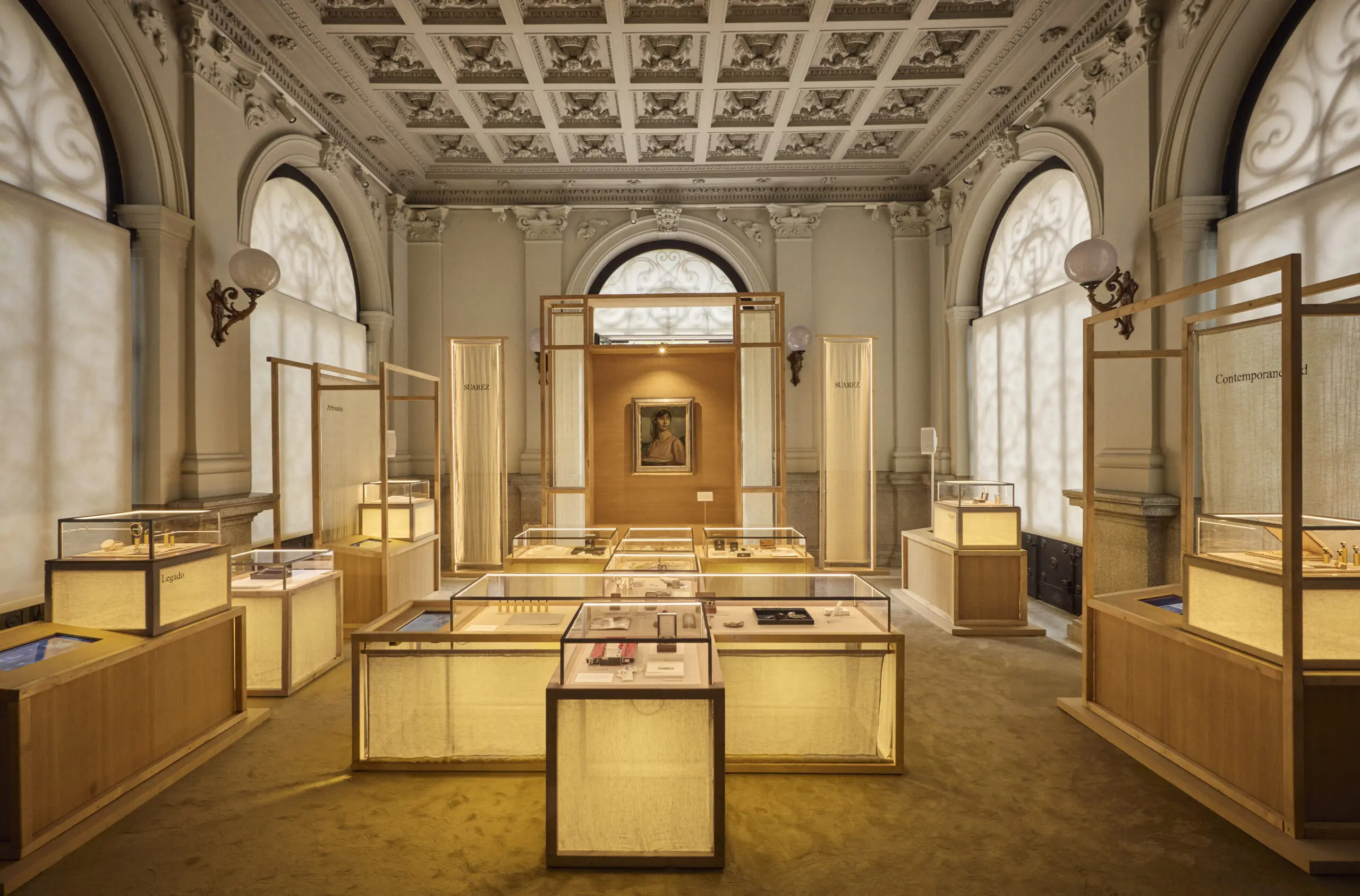
Four concepts structure the exhibition: origin, craftsmanship, legacy, and contemporaneity. In the entrance hall, surrounding Arrúe’s painting, are preparatory drawings, workshop tools, gemstones, and pieces from different eras. These materials help us understand some of the processes that precede a finished piece of jewelry—the journey from an idea to an object that will ultimately hold profound significance for both the person who commissions it and the person who purchases or receives it.
During the presentation, Martínez de la Pera recalled Suárez’s origins as a family business and the importance of craftsmanship in its development. He also highlighted the relationship between the jeweler and its clients. Several pieces in the exhibition come from private collections and have been temporarily returned to the firm after passing through various generations; we can now see them displayed alongside the firm’s new collections and pieces of jewelry recovered from family and private archives.

Among the documents in the archive are small cases containing rubies, sapphires, and emeralds wrapped in paper. As the curator explained during the tour, some stones were set aside to replace any that might be lost from jewelry purchased by customers. This practice sheds light on an aspect of the business that rarely appears in its public history: the care and maintenance of pieces after the sale.
The display cases also feature both vintage designs and recent versions. The Suave collection retains an Art Deco-inspired silhouette, while certain chains from the 1980s find parallels in later models. The sketches and finished pieces allow us to trace these changes, which have occasionally been reintroduced in new collections.
What the Portraits at the Lázaro Galdiano Museum Reveal

In the museum’s galleries, the jewels are displayed alongside works from different periods that José Lázaro Galdiano collected over more than sixty years. The connections proposed by the curator are based on the materials, colors, and uses of ornamentation, particularly in portraiture. One such connection is with *Eleonora de Medici*, a painting attributed to Sofonisba Anguissola. The subject’s attire and adornments serve as a reminder that jewelry was part of the court’s codes of representation. Necklaces, rings, and brooches could indicate rank, family affiliation, or social status.
In front of Claudio Coello’s *The Immaculate Conception*, the exhibition focuses on the color blue and relates it to sapphire, lapis lazuli, and aquamarine. Here, the color serves to draw a comparison between the painted surface and the properties of carved gemstones. The *Portrait of Charles II* by Juan Carreño de Miranda introduces the black of courtly attire. The comparison draws on the codes of appearance and authority that characterized the monarchy’s official portraits.

In other rooms, connections are established through specific materials. Federico de Madrazo’s *Portrait of Gertrudis Gómez de Avellaneda* is linked to pearls. During the tour, Martínez de la Pera explained their presence in 19th-century jewelry and in portraits of women. Coral appears alongside Raimundo de Madrazo’s *Portrait of Consuelo Gaztambide Aguader*. The curator noted that, in addition to being used as an ornament, coral was historically believed to possess protective properties, especially during childhood. Its use in jewelry, therefore, stemmed from customs that went beyond mere decoration. The Geniani store, by Luis Paret y Alcázar, introduces the trade in luxury goods in Madrid of a bygone era. The painting accompanies a section of the exhibition dedicated to Suárez’s business activities, featuring historical photographs of his stores and timepieces. The documents serve as a living archive of how retail spaces and product presentation have evolved.
Strata, a gem for the museum

Suárez has created and donated to the Lázaro Galdiano Museum a piece designed specifically for the exhibition. It is titled *Strata*, a one-of-a-kind piece of jewelry whose design incorporates references to Art Deco and the gardens of Retiro Park. Two aquamarines evoke the park’s ponds, and the emeralds allude to its vegetation. The central aquamarine pays homage to Paula Florido, wife of José Lázaro Galdiano, whom the exhibition’s documentation links to a particular fondness for the color blue. The donation adds a contemporary creation to the museum’s jewelry collection. In the catalog, the museum’s director, Begoña Torres González, places this collaboration within the institution’s efforts to establish connections between its historical collections and other forms of artistic creation.
The exhibition also includes “Sinfonía,” a collection inspired by a logo patented by Suárez in 1987. Its geometric elements reappear in new pieces with different proportions and materials.

During the presentation, Eloy Martínez de la Pera stated that “a jewelry box is the biography of each one of us.” He was referring to the pieces we keep for reasons unrelated to their value: a family wedding ring, a watch received on a specific occasion, or an inherited brooch. Some of these pieces of jewelry, on loan from private collectors, are part of the exhibition after having been passed down through several generations.
The private collection assembled by José Lázaro Galdiano—the paintings and objects he acquired throughout his life—later became part of a public institution. Over the next few weeks, the jewelry on loan from the families will undergo a similar temporary change: it will leave its usual storage locations to become part of an exhibition that offers a glimpse into part of its history.