
Ana Casas Broda and Hydra Editorial share a history shaped by photobooks, experimentation, and independent creation. In this interview, Ana Casas traces the evolution of Hydra Editorial, the Photobook Incubator, and the Latin American scene, while also discussing her own work, which is marked by themes of the body, memory, identity, and motherhood.

Hydra Editorial describes itself as a space for reflection, dialogue, and collaboration. Tell me a little about its history and how it has evolved.
I’ve been working on my personal body of work—which includes photography, text, and photobooks—for many years. That context is what made it necessary, from my perspective, to launch Hydra. Gerardo Montiel-Klindt and Gabriela González Reyes started it, and now we’re both active partners. She comes from the field of conservation and is the director of the Fotobservatorio de CDMX.
What were Hydra’s early days like, and what were the circumstances surrounding its creation?
In 2012, we opened the bookstore, and I began bringing in books—mostly from Europe, where photobooks had already been in production on a massive scale for quite some time. Since the ’90s, there had been interesting publishers breaking away from the traditional paradigms of the book as a container or a catalog. If you go back even further, that’s always been the case. Ever since Felipe Ehrenberg in Mexico, there have always been many people experimenting with the photobook format. Even Marcos Kurtycz, with whom I worked for a long time.
At what point does the culture of the photobook begin to change?
The photobook as a phenomenon began to emerge clearly with the expansion of possibilities offered by digital printing technologies. And it happened much more quickly in Europe. There were publishers like Self Publish, Be Happy, who very quickly realized the great potential this offered. Or Bruno Ceschel, whom I’ve invited to lead workshops here in Mexico three times. These were truly very, very innovative ideas for their time.

How would you describe the current state of the photobook in the publishing world?
It’s a very rich medium that plays a major role in photographic creation because most artists now produce photobooks. It’s the format that circulates most widely and best represents an artist’s body of work. However, there’s a disparity between production and the large-scale market. The major publishers—well, the ones that remain, like Steidl—are going out of business, which is interesting. Michael Mack, who is next in the food chain, used to work with Steidl. That’s the global landscape.
How did the Photobook Incubator come about, and what were you hoping to achieve with this program?
I started this program in 2016, inviting many of these very famous editors, such as Bruno Ceschel and Ramón Pez, who is a designer and art director of photobooks. It was innovative as a program at the time, and it remains so because it has a very unique approach to photobook creation.
What are you looking for when putting together the groups that participate in the Incubator?
It’s very important to me that these be diverse groups: people from different cultures, from different parts of Mexico—people from Chiapas, people with muxes, people from Colombia. I want the group’s interactions alone to be so interesting that they spark reflection and give rise to contradictions.

How did the Incubator’s methodology evolve?
In the second generation, I reduced the number of instructors to create more in-depth workshops and invited Yumi Goto from Japan. Yumi runs a space called Reminders Photography Stronghold and, around the same time we did, began offering a workshop called “The Photobook as Object.” She works with laser and inkjet printing and does the finishing by hand. The authors print, bind, and produce a limited run—but they create their own book, which they then present with her. Later, major publishers take them on and print them in much larger runs.
Can you think of any projects that started out as independent ventures and were later picked up by a larger publishing house?
One notable example is *Atomic Ed* by Janire Nájera, a book about Hiroshima. The author produced 49 copies, and then the publisher RM printed 1,900 more, bringing the total to 1,949. Very symbolic.

What challenges were involved in moving this production model to Mexico?
When Yumi Goto came, I had to get a laser printer and an inkjet printer. It turns out that in Mexico, it’s impossible to rent them like you can in Japan, because you have to be a major paper manufacturer or something like that and pay 30,000 pesos a month under a three-year contract. I don’t know how I managed it, but I managed to get them to lend me a laser printer and an inkjet printer. People reacted so incredibly well to those books that, when we returned, we printed using a mixed offset process, because we do hybrid production: part offset, part on these printers, binding some by hand and using very experimental papers.
What production volume did the Incubator eventually reach?
We published 22 books in 2018. That year, I started taking them to all the book fairs. And what’s interesting is that each book is very different from the others. For me, it was important to bring a large number of books—to have a good selection—because that was like a statement, a declaration of principles about what the Hydra publishing house is all about: we don’t aim to make a book for the person; rather, we want the person to learn how to make the book. We want them to be works that have a reason for existing.
What role has Beatriz Novaro played within the Incubator?
I’ve been working with her for many years. She works with authors. It’s not a matter of teaching writing classes, but of working with each author. What she does is draw out the potential of the themes people carry within themselves. It’s not about writing in a formal sense, but about writing as a way to connect with one’s inner self—with what needs to be said, with how to say it, and with going deeper within. She’s the most extraordinary person I know in the world. And believe me, I’ve worked with millions of teachers from all over the world. She’s truly one of a kind.
How did Hydra’s books begin to circulate internationally?
We did a project where I invited Antoine d’Agata, a Magnum photographer who does very powerful personal work. He shared with us his work from the past 35 years in Latin America, and together—he and I—we invited five other publishers. Using those same photos, each person created their own book. We placed them in a box, and, by chance, we were offered a section of a booth at the Grand Palais for Paris Photo. That time, I traveled with ten authors. For me, it’s important that the authors be part of the experience.
How important has Latin America been to the evolution of your work?
Starting in 2016, I began attending many fairs in Latin America. That has had a huge impact on my work because I was invited to work in Valparaíso, at the Valparaíso Festival; at Santiago Foto; at the Montevideo Center for Photography—amazing places where there’s a very alternative photobook scene. You also begin to understand that Mexico is a country where, during all the years these other countries were under dictatorship and things had to be done clandestinely, here there was a cultural boom—museums, publishing houses. There have always been counterculture groups in Mexico; however, there have also been a large number of museums and a large number of grants. There hasn’t been political persecution of the kind that has occurred in Latin America—except in ’68—while here, culture was explored within different parameters.
In which other Latin American countries can you find publishing activities linked to alternative or countercultural circles today?
There’s still a very strong counterculture in Argentina. There’s a tremendous amount of incredible publishing work available at very low cost that operates entirely through other channels. That experience has been very enriching for me. It also led me to start another initiative called Fotolibros.lat.
What differences do you see between photobook and print art fairs in Latin America and Europe?
In Mexico, there really weren’t any photobook festivals. There’s INDEX, which has been around for many years. We started going to Zona MACO. Elsewhere, the concept of “printed matter”—in the sense of printed materials, including fanzines, vinyl records, screen prints, and all kinds of things—is really interesting. It’s something incredibly vital, prolific, and extraordinary.
“In Europe, there are many fairs dedicated exclusively to photobooks, and they’re very interesting, but in some places it has become insular: it’s the same people who travel from one fair to another every year, the same publishers.”
How was your recent experience at the Hardcore CDMX Art Book Fair?
Very good. Hardcore is a really well-organized fair—full of energy, packed with things, and teeming with people. It’s true that there are relatively few photobooks; there are way more fanzines. We’re there with our publishing house and our bookstore, and we have a huge variety of books from all over the world. We’re doing very well because we offer something you can’t find anywhere else.
Where does the need to create a network like Fotolibros.lat come from?
In 2016, I was invited to a photobook exchange event at the Montevideo Photography Center, which is one of the most incredible photography spaces in Latin America—and, I believe, in the world. That’s when I started thinking that I really wanted to create a Latin American photobook network. I bought the domain Fotolibros.lat in 2016, launched the website and Facebook page, and it remained dormant all this time. Later, Ben Gold, who was the curator of the photobook section at Photo London, told me, “You have to come—this edition is going to be dedicated to Mexico and Latin America.” So I said, “Yes, I’ll go, but I’m going with Fotolibros.lat as well.”
What projects demonstrate the impact this Latin American network has had?
We sent two of the books we had finished to StogoFoto. The winner is part of Fotolibros.lat: he’s an Argentine, Rod Isaurralde, with a self-published book called ¿Vos de qué jugás? And one of our books, Hay pájaros en el alambre, won second prize. It’s by Gabriela García Rivas, although it lists multiple authors because she included the photographers—who are also her parents—as co-authors. She is the daughter of Zapatista healthcare workers and grew up during the Zapatista movement as a young girl in the middle of the jungle. It’s a reflection on Zapatismo from the inside, from the perspective of someone who experienced it as a child and now as an adult. The texts are incredible, and it’s printed on papers like kraft, butter, cardstock, and gray paper. The materials and the entire book invite a reflection that is highly coherent in both form and content.

What other recent books reflect Hydra’s approach?
*To Be Like Everyone Else*, by Anaí Tirado Miranda, is about her great-grandmother, who was erased from the family history because she was treated like a bastard. They literally erased her—there are no photos, nothing at all of her. We’re also publishing *Come Eat My Body*, by Raúl Jiménez Jiménez. It’s a very powerful book. We used coated paper and bond paper to create different textures within the same images. For the cover, we decided to use a watercolor-like paper that will wear away with use, just like the body. *Disturbed Moments*, by Mariana Gruener, is a small collection of tiny books held together by magnets. It features writing and drawings and is a reflection on everyday life, death, and the passage of time. It’s a small library that becomes a sculpture: you can buy one book or all of them, and when put together, they form a sculptural piece.
Which classic photo books have left a lasting impression on you?
One of the books that had a profound impact on me is *Raised by Wolves*, by Jim Goldberg and Philip Brookman. The book is kind of chaotic, with a completely unique design that incorporates objects and writing about street children. It features a lot of handwriting by the kids themselves, objects, scraps of paper, grease stains, graffiti, and Polaroids. It was very experimental, and it had a huge influence on me.

How has this whole process influenced your own work?
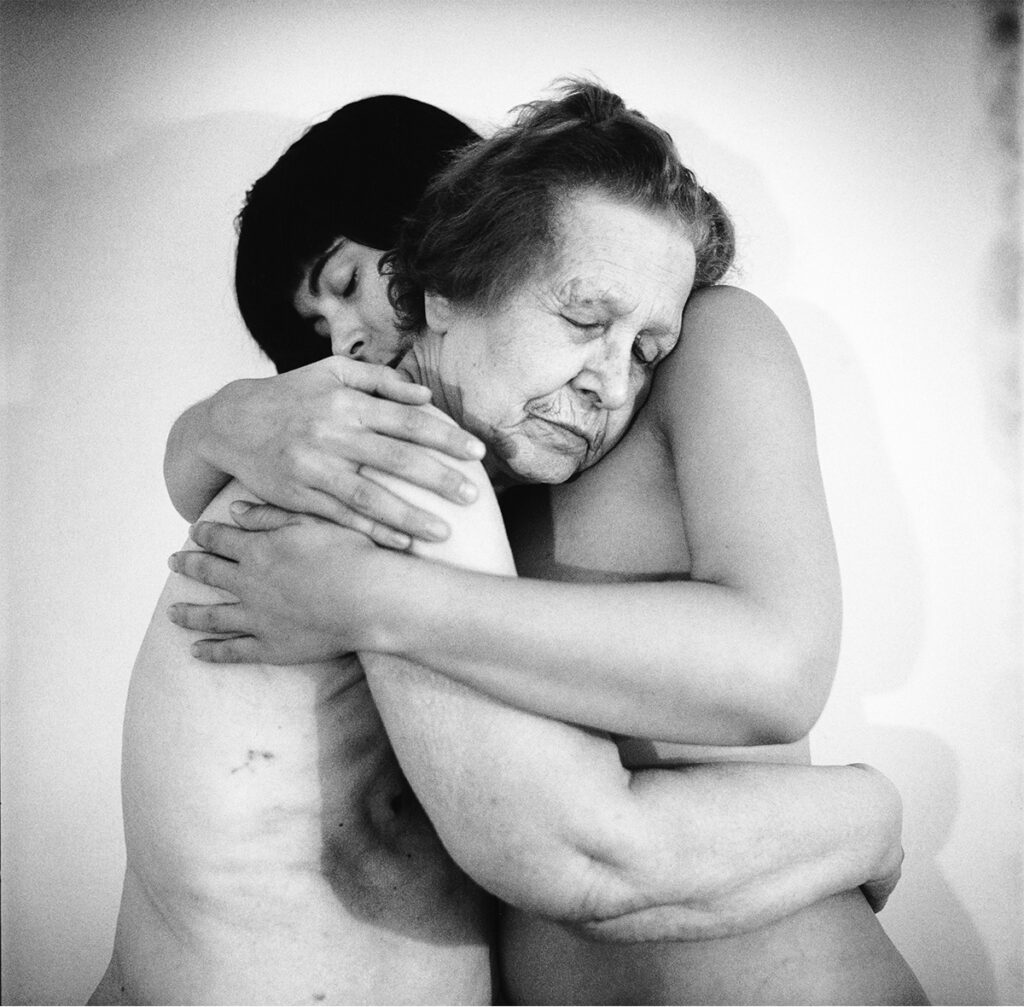
At that time, I was working on my first book, *Álbum*, a collection of text and images that I started when I began taking photos with my grandmother in Austria. When I started taking photos, I moved to Austria for a year, and I began taking all my photos with my grandmother. I began to explore her archive and discovered that she took self-portraits. It’s a very powerful, introspective series that dealt with our identity and the body. I moved in with her, cared for her during a second cancer surgery she underwent at age 83, and we took nude self-portraits together.
What can we find in Album?
Afterward, I took on the task of clearing out the entire house, and there were files, photos, and diaries. My grandmother was always taking photos and snapping selfies. I have thousands of photos of her taking pictures of my grandfather when he was on TV, and it’s like a preview of what we’re experiencing now—of people connecting with others through Instagram. The bond between her and me is through photography, because she was my witness and my partner in crime.
How has your approach to the book evolved?
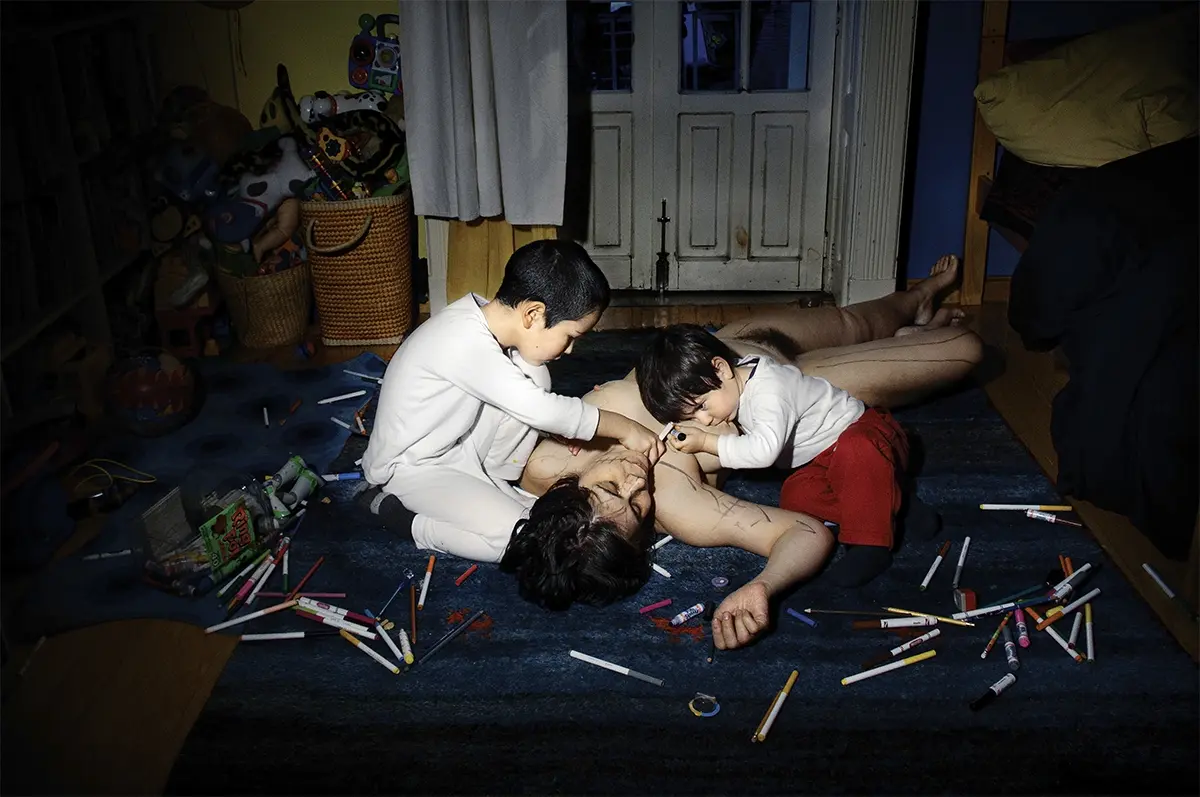
I have a second book called *Kinderwunsch*, which in German means “the desire for children,” but also refers to desire in the Lacanian sense—as that which makes us alive and keeps us constantly filling ourselves with meaning. I worked on fertility treatments and then with my children during their first ten or eleven years. It’s a progression over time, a very complex narrative about motherhood.

Given the insularity you point out in some European circles, what is happening differently in Latin America?
Right now, the most interesting photobook scene is in Latin America. In Europe, there are a ton of incredible publishers, there’s still a very interesting movement, and there are a ton of fairs, but the really powerful stuff is in Latin America.
Discover more art and photography in AW Magazine.