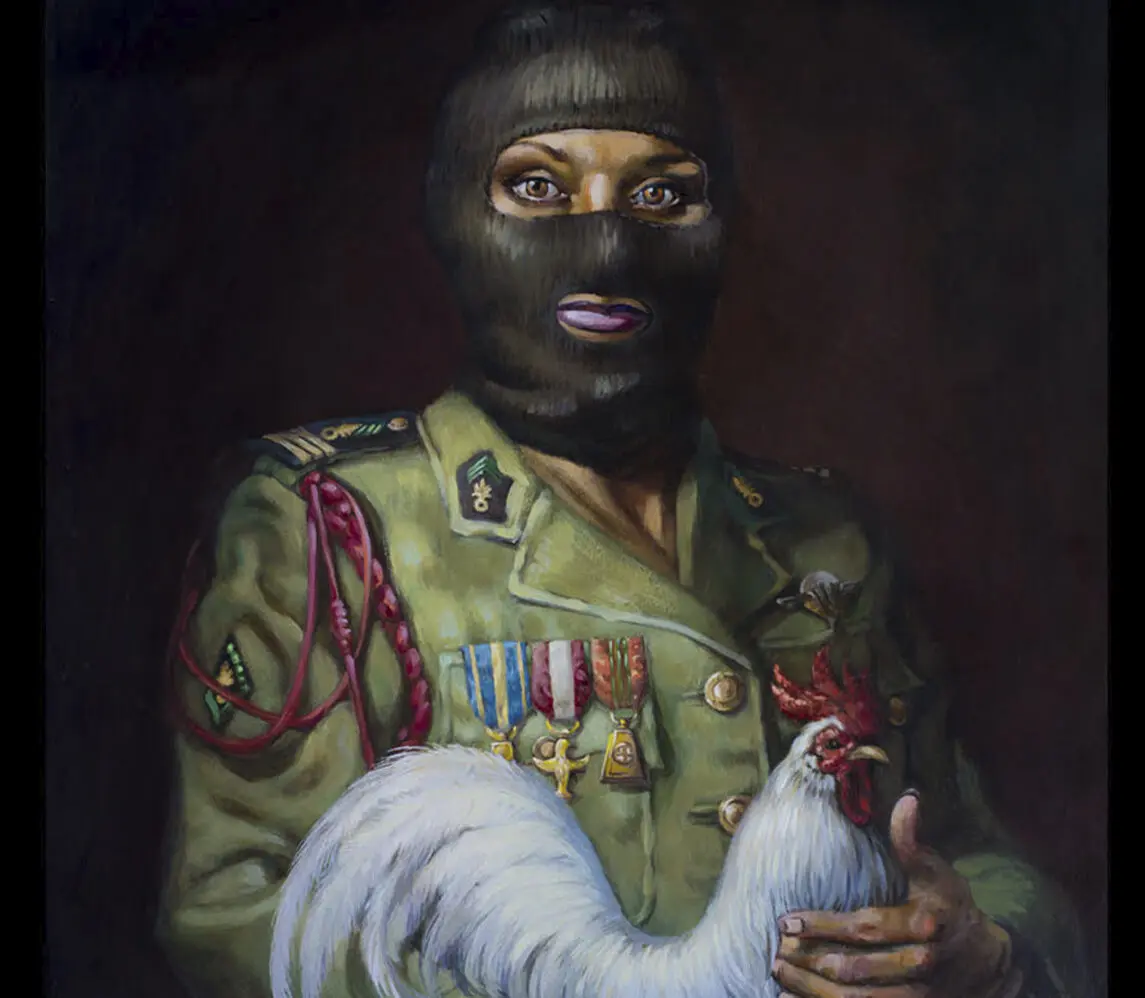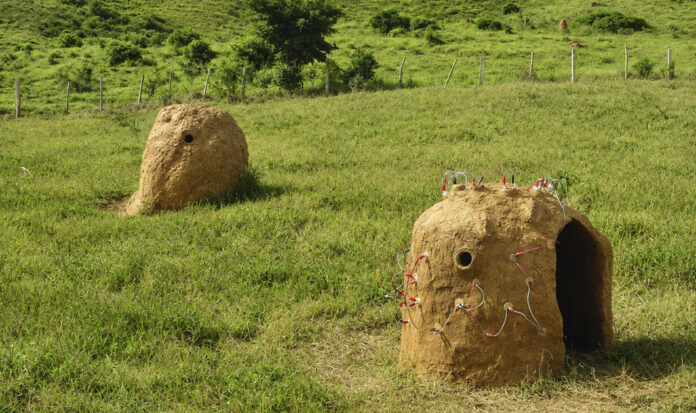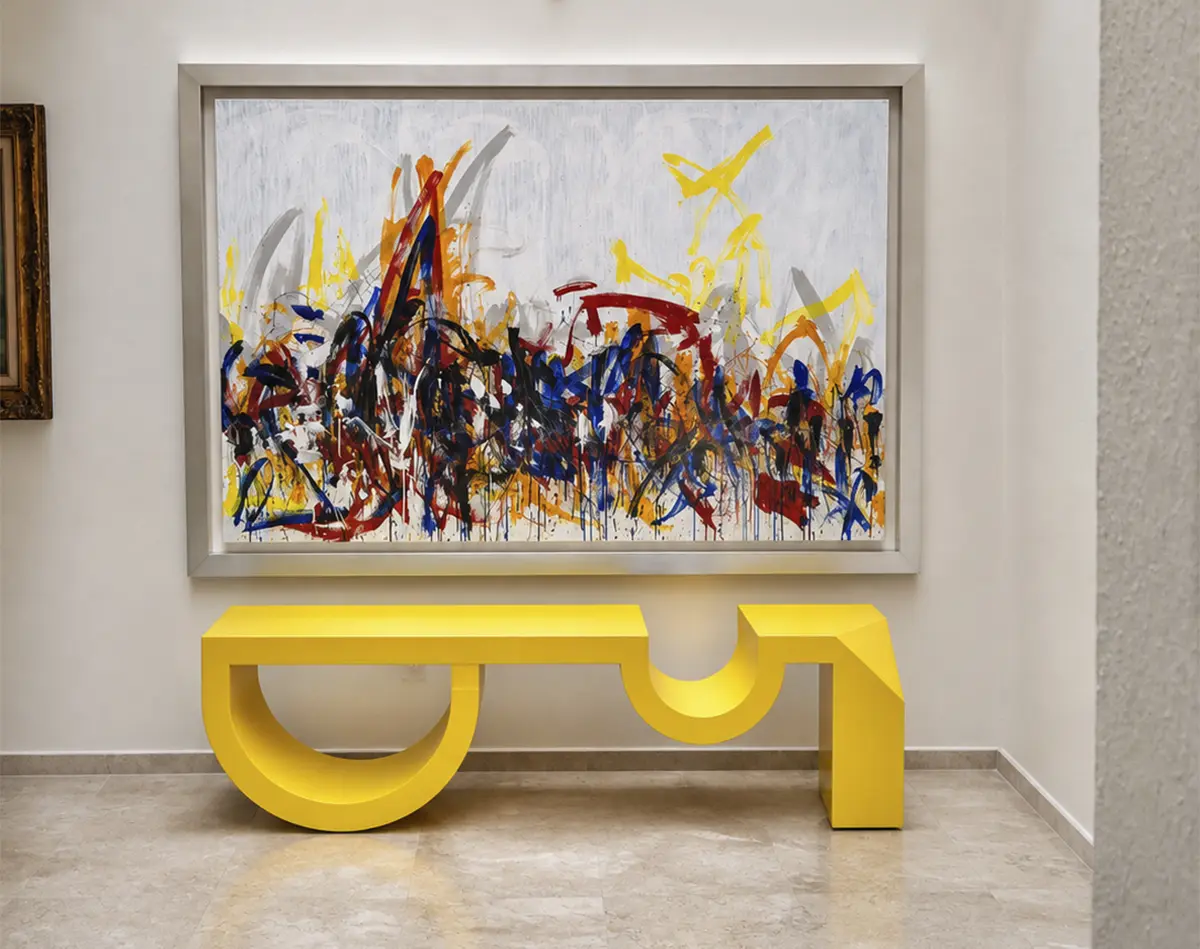

I came face to face with the work of the master Fernando M. Díaz during a recent visit to San Miguel de Allende. His studio stands out among the galleries that fill La Aurora Factory, a space that’s always bustling with activity, where visitors seek out collectible pieces from various artistic circles.
With a career spanning more than twenty countries in Europe, the United States, and Latin America, Díaz has participated in over a hundred group exhibitions—the most recent in Kazanlak, Bulgaria—and is currently presenting his solo exhibition *Leviathan* at the Carlos Mérida National Museum of Modern Art in Guatemala City. In addition, his work is part of public and private collections as diverse as the José Luis Cuevas Museum, the Museum of Contemporary Art in Chicago, the Museum of Modern Art in Cuenca, and the National Library of Romania. I spoke with the artist about suffering and comfort in art and about the Soviet Union (yes, the USSR—just as you read it), among other topics.
I understand that he has been living in San Miguel de Allende for several years.
Almost twenty years. Right now I have a piece in a studio in New York for the Rome Triennale. In Italy, they also consider me an Italian artist, since I’ve lived there for thirty years. But I’m still working. I work mainly in San Miguel de Allende, Guatemala, the United States, and Italy.
These recent paintings are inspired by New York. How did this series come about?
It’s a slightly more laid-back series, one that makes you feel a little freer. Sometimes you just need to relax and enjoy some lighter pieces. It’s like an exhibition in New York in the fall—a chance to really soak up the atmosphere.

Are these paintings more cheerful?
The truth is, I don’t know. Art plays a role at different moments in our lives. Someone once told me: “I grew up with your paintings, maestro. Your paintings were in my house when I was a child; I always remember them. And I want to see those colors I saw in my childhood.” Then there’s the more intellectual engagement with painting. When we think of paintings as truly pleasurable, we don’t dwell on the depth with which they were conceived.
There are cheerful paintings that emerge from suffering, don’t you think?
The other day I was talking to someone who works here at the gallery about the smile. I was telling him that the smile has a long tradition in Italy, long before Leonardo. Antonello da Messina studied that expression of the smile on faces long before Leonardo.
Now we see that the Mona Lisa, at the Louvre, is surrounded by a huge crowd, and we can hardly see it; it’s very difficult to get close. But it’s a painting that expresses Leonardo’s entire theory on portraiture and light. It requires a certain amount of preparation to understand what he’s telling us. He explores the relationship between internal and external light.
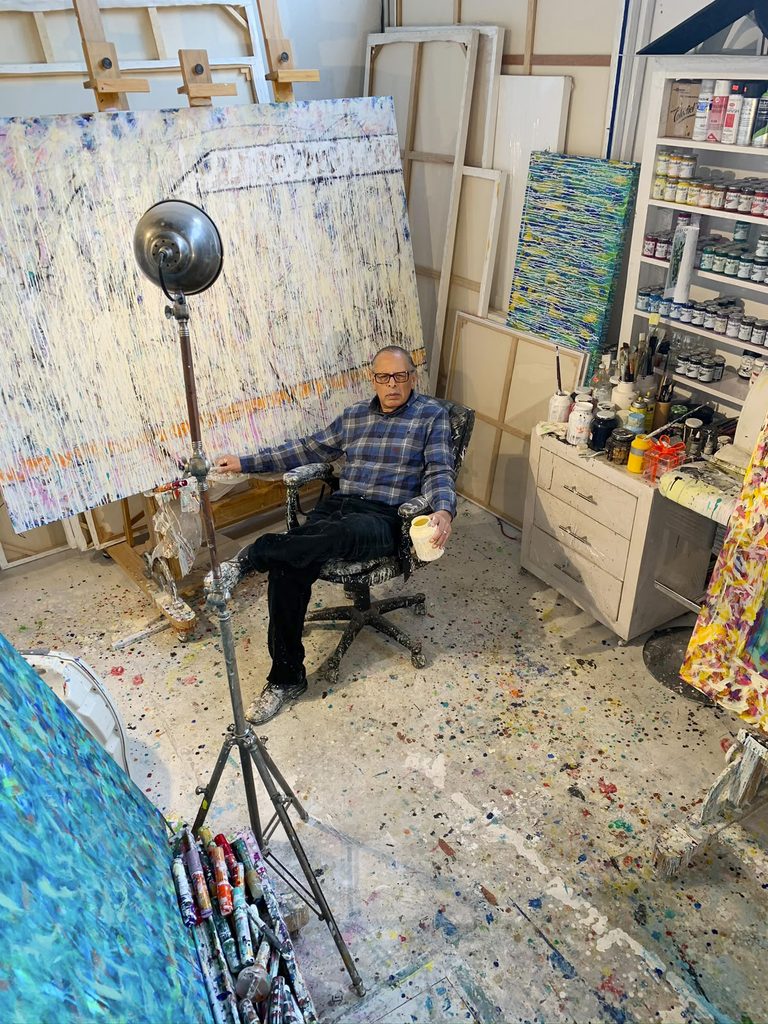
So did this new series come about simply because you wanted to do something a little more laid-back?
No. I wanted to savor this series a little longer… I wanted to do something a little more low-key, even though it’s based on an aesthetic discussion and a book by Martin Buber called *Daniel*. I was reading that book, which was very important almost a hundred years ago. There’s always a literary inspiration.
“When people say that art is always a pleasure, that’s not true for me. For me, it’s always a struggle.”
Why do you say your work isn’t always enjoyable?
Because there are many nights when I can’t sleep because I can’t figure out a painting. I’m thinking about my commitments, about the exhibitions. It’s not like I just enjoy it. I enjoy music; I enjoy literature. I do enjoy those things. I go to the opera, and afterward I go out for dinner, have a few glasses of wine, and I’m delighted. But my work—no.
Among all the exhibitions and retrospectives of your work, which international recognition has been the most important to you?
The truth is that the Venice Biennale is the highest honor an artist can receive. So, to me, being part of the Biennale is the most important recognition an artist can receive.
He mentioned to me off the record that the design of a traffic light in Italy caught his attention. Is an artist constantly observing everything around him?
I travel and read every day, for at least two hours. An artist’s role is to absorb the world, and it’s important to observe every field. It’s the design, but what’s behind that design? That’s what’s interesting. For that traffic light to be on the street, there’s a social consensus or a political will to stand out. I could go to a traffic light company and say, “We need a traffic light here because there have been several accidents.” But the fact that they solve the problem with an eye for beauty is what I love about Italy.

Does your sculpture engage with painting, or are they two separate worlds?
No, it’s all about the world. Before I made my first sculpture, when I was a student, the director of La Esmeralda would say to me, “You’re a sculptor—what on earth are you doing painting?” I’d tell him I wanted to explore the most primitive aspects. I traveled the world, and when I was in Spain standing in front of some stone bulls, I said, “I’m going to approach this in a particular way.” It’s exciting to wonder how some Neolithic men came to carve stones there. What’s behind it? What on earth are we doing?
I also saw a reference to Moscow. Did you live there?
I didn’t live there; I visited and exhibited in Moscow. It’s a wonderful story about a man who contacted me because he really liked my work. He bought seventeen paintings from an exhibition I had in Argentina and offered me a lot of money. I told him I could even give him a discount. He replied, “No, because I’m going to make a very good deal with you. This is what I’m going to pay you.”
I signed a seventeen-page contract. As I was reading it, I said to him, “Okay, tell me what’s wrong with this.” He told me that if I didn’t comply, I’d be penalized. I thought the penalty was fifty thousand dollars, but he said, “No, you have to give me another painting.” So I signed it.
When we’d fulfilled all the conditions and everything, he told me, “You have to give me another painting.” I replied, “But I did everything.” He said, “Yes, you did everything, honestly, but you have to give me a painting as a gift.” And I gave it to him. He invited me to Moscow, although at first I was suspicious of him. In the end, I introduced him to a very pretty friend of mine, and she did go to visit him. That was about 20 years ago.
Was he a collector or a curator?
He is a very wealthy man who works in the food industry. His name is Narek Poghosyan.

Do you think artists in Mexico are sufficiently recognized and supported?
Look, it’s not just Mexico: Latin America, in general, is made up of countries that don’t support their artists. We need to discover the wealth that beauty holds, including in economic terms.
Let me give you an example: We live in San Miguel de Allende, and I go to León to see the opera. They built a theater there about ten or fifteen years ago. When I go, I book a hotel, have dinner at the hotel or at a restaurant, go to the opera, and have breakfast the next day. Plus, it’s a two-hour trip back, and you can take advantage of the time to buy something you need—a pair of shoes or anything else.
I’ve talked to people we’ve met at the opera who come from all over Mexico. That means they’re spending just as much as I am. That economic impact comes from the theater.

How is that economic value of culture reflected elsewhere?
In Sicily, for example, there are theaters dating back to the 5th century B.C. To get a ticket… They put on Greek plays on some rocks, and you sit on the ground. In other words, zero comfort, and they sell you the ticket for whatever price they want. That’s what culture produces. I’ve met Americans and people of all nationalities there. Entire tour groups arrive and buy tickets, and that’s part of what keeps the city of Syracuse going. In other words, beauty generates an impressive amount of money.
People come to San Miguel to buy art. So they arrive, stay here, eat, have breakfast; sometimes the whole family comes. Just now, I was with someone from San Diego who came to buy one of my paintings. On top of what they spend on a painting, there’s what they’ll spend on a hotel and what they spent on transportation. They could have bought a painting from me over the phone, paid for it, and not spent all that money.
Discover more art made in Mexico in AW Magazine.