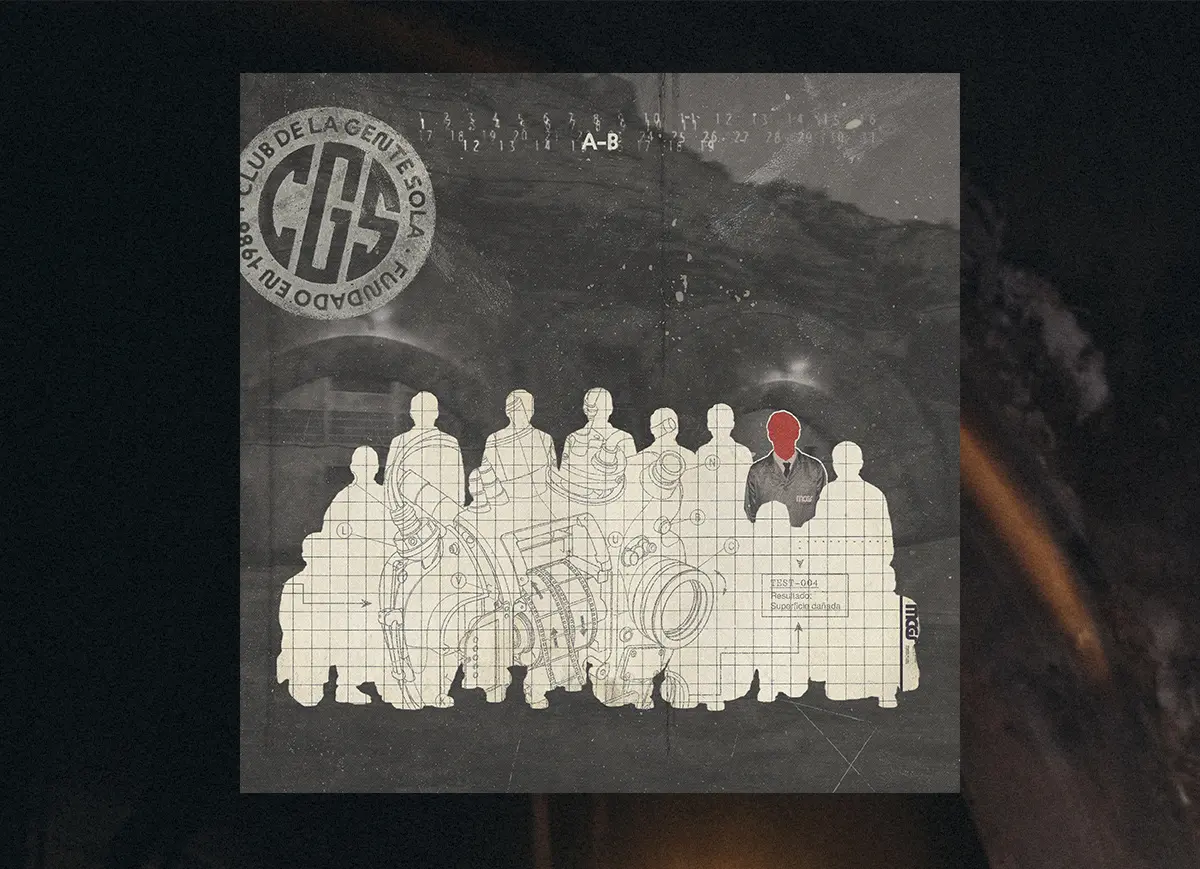

Arde Bogotá is a very unique name for a Spanish band. Ahead of the band’s upcoming visit—they’re originally from Cartagena, Spain—we spoke with Antonio García (vocals and guitar) and Dani Sánchez (guitar).
The band will be coming to Mexico and the United States this November, with shows in Mexico City, Brooklyn, Los Angeles, and Miami. By the way, they’re named after the Colombian city where their demos and songs were first played. And no, it wasn’t because of the album title “De un país en llamas” by their compatriots Radio Futura. The band recently released their third studio album, “Manufacturas del Club de la Gente Sola (MCGS).”

What are your expectations for coming on tour in the Americas?
Antonio García: We’ve been going there relatively often for several years now, touring different countries as part of our adventure to bring our songs to other places. The truth is, I was thinking about this with my brother yesterday, and I told him that one of the interesting things about traveling across the Atlantic to play is what it gives us as people.
Does a band that travels change?
A.G.: What it gives you as an individual—what you learn from going to another place to make music and interacting with other professionals, other audiences, other artists, other venues, other cities, other cultures, and other types of music. That’s the great treasure you take with you after having played in Chile, Argentina, Colombia, Mexico, and the United States.
If you pay close attention to the lyrics, there are tons of pop culture references, from anime to bands like The National in “Antifiesta.” Are you fans of pop culture in general—TV shows, albums?
A.G.: We are her children; we are her creation as individuals, as citizens of the late millennial generation. But you know what? As a lyricist, I’ve always been interested in artists who use those kinds of references to tone things down a bit.

What do you mean, pop culture still surprises you?
A.G.: I really like it when the narrative of a work—whether it’s a poem or a novel… Let’s take a novel called *Leche Condensada* as an example, in which each chapter is named after a Pokémon move. It’s actually a really dense, profound, and hard-hitting novel, but the fact that you use a Pokémon reference to explain it, I think, allows you to break through the reader’s resistance.
The reader thinks they’re entering a more or less pleasant and humorous world, and suddenly you stab them in the back and tell them something very serious and very dark. I think that’s what it’s all about.
Hey, speaking of Bogotá, something really strange is happening in Colombia: the government censored a lot of artworks at the National Museum. What do you think is happening in the art world right now?
A.G.: I’m not familiar with the news about censorship in Colombia; I had no idea. I haven’t been following current events in Colombia very closely lately, but I do believe the world is caught in a spiral of polarization.
Do you think that kind of censorship could have an impact, or—in the age of the internet—does censorship no longer exist in the same way it used to?
A.G.: I do feel that, in every corner of the planet, societies are practically moving toward a “with me or against me” mentality, and there are few common ground. This creates a brutal clash with freedom of expression and artistic freedom, because if everything is divided into camps and it’s all “with me or against me,” anything that isn’t on your side will seem wrong to you, and you’ll want to silence it.
Are we making the same mistakes as in the past?
A.G.: I think it’s a tremendous mistake—a repetition of moments from the past that proved to be absolute disasters. Because, in the end, it’s through communication and understanding one another—as strange as it may seem—that harmony and true coexistence as human beings can emerge. So I’ll look into what you’ve told me because it strikes me as a powerful idea.
How did you come up with the title, and how does it structure the album’s narrative?
Dani Sánchez: We started writing songs for the album and immediately came up with the idea of making it like an instruction manual—one that explains how to build yourself a heart that doesn’t feel. We wanted each song to be a step—like the instructions for a drill—so you could learn to build a shield against sensitivity, against emotion, against connection, and so that in the end, it would leave you alone.
A.G.: Within that story, that creative process, there are a series of mistakes, incidents, and twists and turns that ultimately change the result you end up with. And when we think, “OK, all right, we have this on our hands, but who’s behind it? Who writes that manual? It has to be a separate entity, one that’s above this band.”
Who is the author of the instruction manual?”
D.S.: We started a company called Manufacturas del Club de la Gente Sola. They would be the engineers behind that heart that helps you stop feeling.
Who designed the album art, and what can you tell me about it?
D.S: The artwork for the entire concept and everything surrounding the album is created by Diego Andrés and his team, called SABOTAGE®️ Propaganda
A.G: He’s someone we’ve been working with for a long time, primarily on live shows, but he has an incredible ability to adapt and branch out into any kind of medium. So we wanted to bring him on board for everything: for the design and concepts of the music videos, for the album covers, and for the packaging design across all versions.
Are the influences still the same—the ones that have been reflected visually?
D.S.: It’s a more industrial phase, let’s say. Even though nature eventually appears and creeps into the songs… But with something so industrial—even anachronistic or from another era—what were we aiming for? Well, we wanted to create an album that, when you saw it, would automatically transport you to the fictional era where the factory and all the fictional events take place.

A.G.: From the simplicity of this album’s cover—with its gigantic letters, which is almost brutalist, isn’t it?— just like the idea of that fictional company in your head, something very human emerges: a tiny little window that reveals yet another aspect of that universe—the so-called “original” factory—which appears in the music video for “Instrucciones.”
D.S.: We’ve taken great care throughout the entire process, and I think we’ve worked very well together. When you open the album, that’s when you realize that within all that cold factory full of screws and gears, an olive tree can appear. Nature and emotion can coexist. That’s ultimately the concept behind the album as well, and I think it’s come through very well in the music.
Is the entire concept of the album set in a dystopia or in an unspecified time period?
D.S.: Specifically in 1986. The idea—especially from a visual standpoint—was that someone had tried this before us, that someone had tried to create a heart that doesn’t feel before us, and that we were bringing it back.
A.G.: Actually, I think it’s closely tied to the adventure of making an album or creating music, because ultimately it’s about gathering the legacy you have as an artist—what people have told you and sung to you, and what resonates within you—and suddenly turning it into new songs. Well, the same thing happens with the message. It’s as if someone had already tried to stop feeling and had failed at it—we come along and spread the message of their courage.
More content and interviews on cutting-edge music and alternative pop in AW Magazine.