
Collecting, memory, and the emotional connections we form with objects play a significant role in Marianna Dellekamp’s art. And no, it’s not about hoarding; rather, it’s about nostalgically reinventing those everyday objects and giving them new meaning.

Prior to the opening of his exhibition Domestic Scenes, we spoke with the artist about her exploration of her own family archive, in which she transforms objects that have lost their original function, giving them a new existence. Unlike other projects in which Dellekamp engaged with collections belonging to others, Domestic Scenes is based on objects collected by her mother and her family.
Memory and Collecting
“I’ve been working with memory and collecting for many years. In one way or another, these two themes are always present in my work—perhaps separately at times—and little by little they’ve come together, because I believe that objects say a lot about memory and how we organize our thoughts, why we choose some objects over others, and why we accumulate objects,” explains the artist.

“In *Domestic Scenes*, I think this is the first time in my work that I’ve shifted my focus from the objects collected by others to the objects I’d accumulated myself—because I wouldn’t say they were objects I’d collected, but rather ones gathered by my mother, by my family, but which, in one way or another, had lost a certain meaning, a certain practical value—perhaps because it was a pot missing a lid or a teapot that no longer had its cups,” he acknowledges.
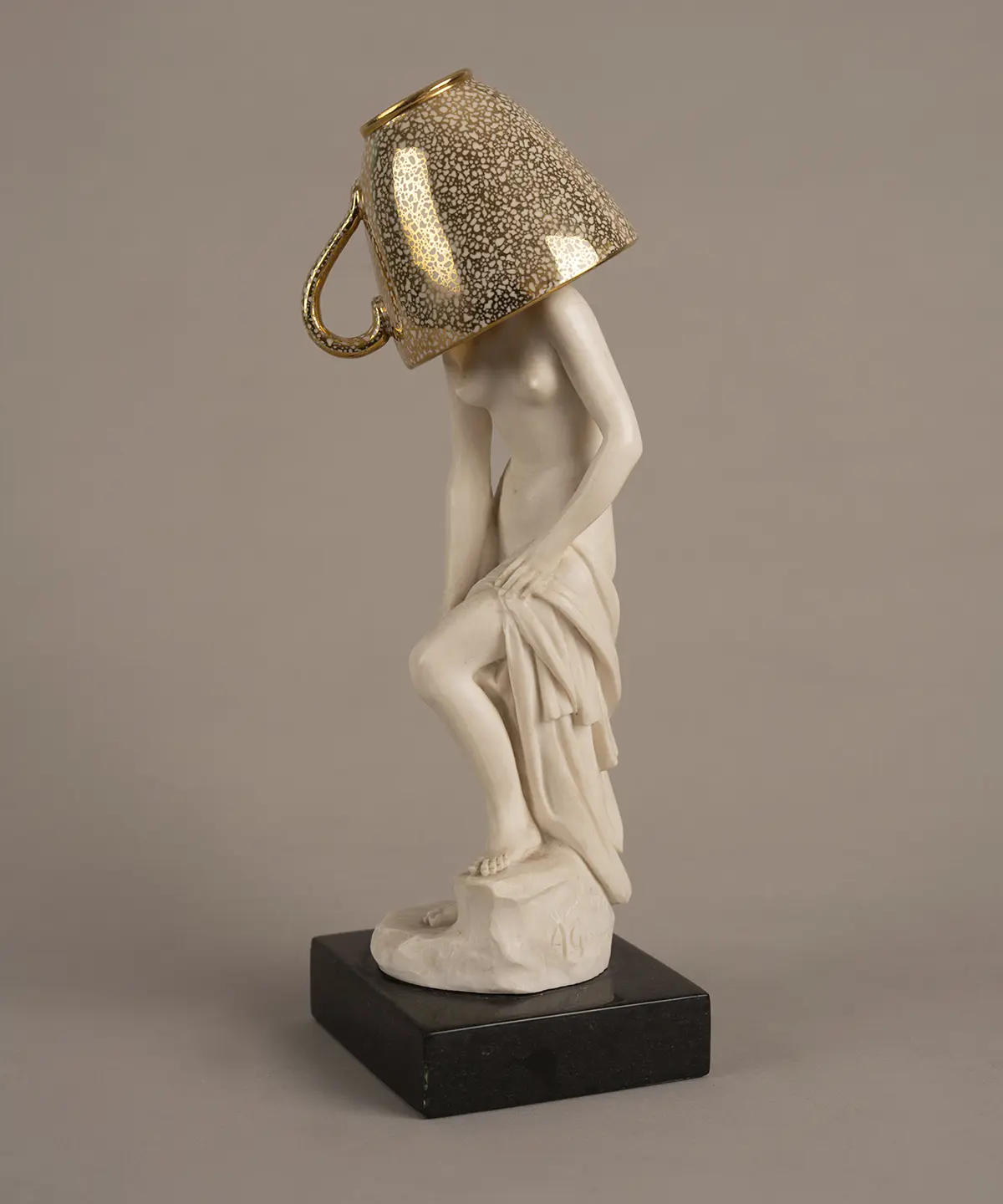
According to the exhibition press release, written by curator Tania Ragasol, EDomestic Scenarios brings together sculptural, photographic, and installation works created through the intervention and transformation of utilitarian and decorative objects from Dellekamp’s family archive. Cups, teapots, soup bowls, trays, and other utensils are modified using materials such as cement and beeswax.
Rethinking the Home Environment
For Dellekamp, the project also involved a more personal approach to his own work: “By trying to reconfigure that domestic setting that I remembered in one way or another, I also allowed myself, for the first time, a bit of freedom to immerse myself more deeply in the pieces—perhaps on an emotional level, not just in terms of how I approach a series. When I explain how I approach a series, I’m talking about how I see the series, how I structure them before I start working. And here, it was a little more playful and more about emotions as well.”
“Domestic Scenes is a way of reconfiguring what, over time, undergoes a transformation—not only in objects, but also in memory and in life itself.”
The transformation of objects finds a parallel in the way memories change over time. “For me, *Domestic Scenes* has a lot to do with how those domestic scenes are reconfigured as the years go by. How those objects, just like life itself, are gradually restructured.”

Objects That Are No Longer What They Used to Be
In the exhibition, household objects are stripped of their everyday utility and are reworked to become something else. The transformation does not necessarily seek to restore what they have lost, but rather to work with the very utility they no longer possess: “How do you restructure? How do you fill that scar? How do you repair that scar on the object so it can continue to function?” These are some of the questions the artist asks herself. This interest is also tied to an attachment to objects whose value is not necessarily evident to others.
“To me, this idea of keeping objects you just can’t bring yourself to throw away makes a lot of sense, because maybe someone who walked into that home or that house would say, ‘Oh, that’s just junk.’ But for the person who has kept it for so many years, it carries an emotional weight that makes it impossible to part with it.”
Even the smallest-seeming objects can serve as repositories of personal experiences: “Right now I’m standing in front of a cabinet. I have a little box on my bookshelf that, to me, is a cabinet of curiosities. And they’re all objects that maybe many people wouldn’t understand, but for me, they represent a moment—they have a reason to exist because of the moment they came into my life.”
Cement and wax
According to Dellekamp, the choice of materials in *Domestic Scenes* reflects the stories and sensations she seeks to convey. Her practice began in photography and later shifted toward installation and object-based art. “I come from a background in photography, and from there I moved on to installation and object-based art. So, my choice of materials always has something to do with the story I want to tell.”

In the case of cement, she explains: “I choose the material, and for me, in this case, choosing cement had to do with this idea of encapsulating and creating something much more rigid. It’s about that much more rigid emotionality that exists within families and how things are kept inside this cement. There they are, in this object, and they’re encapsulated.”
Her interest in wax, however, stemmed from the materiality she observed in the lost-wax process. “In the case of wax, the truth is that I was drawn to it for visual reasons—because of how lost-wax is used to create sculpture—and I fell in love not with the lost-wax process itself, but with its materiality: this wax that has a reddish hue, that looks like flesh, that has a very visceral quality.”
Objects and Sensations
“And it was this visceral aspect that I wanted to put on the grill, you know? Like putting meat on the grill, but in a way, ‘putting my own meat on the grill.’” The artist also contrasts the sensations produced by both materials.
“This much more tactile material makes you curious to touch the coldness of the concrete, but at the same time, wax isn’t a cold material. We could say that there’s a cold material and a warm material in terms of sensations. Not that they’re actually cold or hot, but I’m talking about the sensations.”
Object, Photograph, and Reflection
The exhibition space is an integral part of how Dellekamp conceives her series. The artist explains that she does not think of her works as groups that simply end up arranged in a linear fashion on a wall.
“When I start thinking about how I’m going to set up an installation, space is very important to me. For me, a series never ends with, ‘Oh, the series is over—I’m going to hang it horizontally, traditionally, or linearly.’ I always feel the need to engage it with the space.”
In *Domestic Scenes*, mirrors take on a central role. Tania Ragasol’s press release cites Joseph Kosuth’s*One and Three Chairs* (1965) as a conceptual starting point , along with the relationship the work establishes between object, image, and definition. Dellekamp revisits that structure through his own research on memory.

Reflection as a Representation of Memory
“What I’ve decided to do here is to use reflection as yet another form of representation of that memory. That’s why I decided to revisit [Kosuth] and explore this idea of the representation of a chair—a chair and a chair. The description of a chair, the visual interpretation of a chair, and the object itself.”
In the exhibition, that relationship shifts toward the physical object, its photograph, and its reflection. “In the series, in the exhibition, what the viewer will encounter is the physical object, the photographic representation of that object, and the representation of the memory of that object—its reflection in the mirrors. I’m using the reflection in the mirror as something fleeting, much like how memory works.”
The viewer’s presence temporarily completes that construction:
“You’re going to leave with yourself; you’re going to become part of that installation with the mirror, and at the same time, the mirror is reflecting the objects. So, you’re already functioning as a metaphor for that memory.”
One Last Conversation
Tania Ragasol’s curatorial statement explains that the aim of *Domestic Scenarios* is not to restore the objects to their original condition, but rather to establish a final, transformative dialogue before “letting go.” The interventions preserve traces of what the objects once were, but at the same time shift their meaning toward new representations of memory.

Through inherited objects, photographs, cement, wax, and reflections, *Domestic Scenes* explores the different lives that belongings can take on when they cease to serve their everyday purpose but remain tied to a family history. As Dellekamp says: “a way of reconfiguring what, over time, undergoes transformation—in objects, in memory, and in life itself.”
Visit ” Domestic Scenes ” at Le Laboratoire, from August 29 to October 31, 2026, at General León 56, San Miguel Chapultepec, Mexico City.
Discover more galleries and artists in AW Magazine