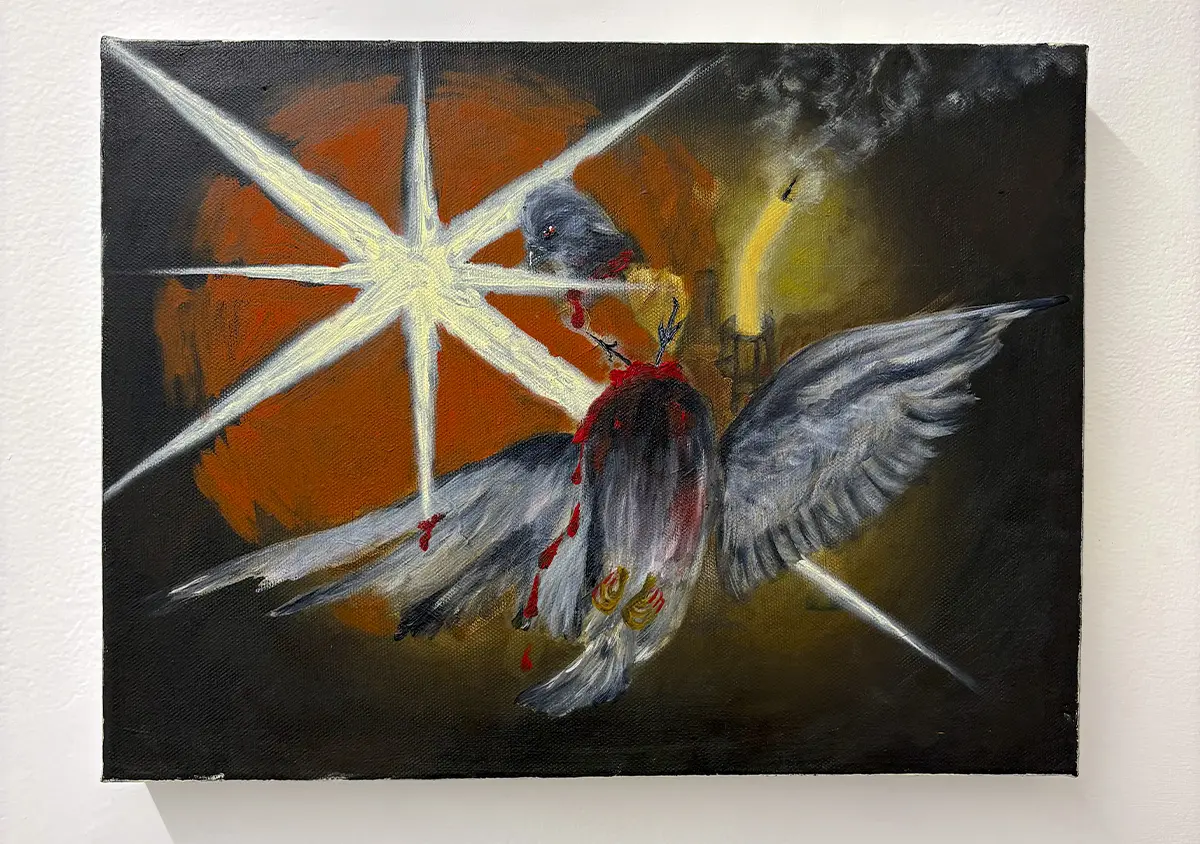

The exhibition *Between Heaven and Concrete* stems from a play on words: the curators sought a concept that seemed to make no sense at all, to present it in a gallery, and from there to uncover the connections that emerge around it. “And the word that sparked this exhibition was ‘paloma,’” Lourdes Bárcena, who curated the exhibition alongside Frisa Mesa, tells me.
This winged rat that litters the scene and the urban environment
The goal of bringing together the 11 artists in the exhibition was to reflect in the pieces a bit of this dystopia in which the pigeons live—one that relates to our own humanity: “This winged rat that litters the scene and the urban environment. And which actually uncovers and exposes the illusion that the city creates of progress and modernity. So, those of us who live in the city, much like the pigeons, become part of this fiction of covering up the filth,” says Lourdes.

The city thus constructs a fiction in which dirt and decay are left out of the picture. This is the inspiration behind the works of the featured artists, “who draw on the grotesque and various analogies involving the dove,” the curators explain. In some cases, they use the dove literally as a symbol and depict it in their works. This is the basis for the curatorial concept and also the source of the exhibition’s title, which, yes, also references a famous album by the Spanish band Mecano.
“Perhaps our shared references also led us to a name that sounds like Mecano—like an album we actually listen to together. And the theme of the pigeons also comes from our visual references.”

This reflection extends to a way of understanding the city “not only as a human creation, but also as an environment that is constantly being created—and that is in a state of constant dialogue and transformation.”
“Our algorithm has also led us to a great deal of content about pigeons—and what that really means for human beings. And how they’ve been abandoned by humans who don’t see them as sentient beings or as equals to us, but rather as something else—an ‘other.’ So, the meaning of an animal that was useful to us for a long time is being manipulated. It has been forgotten. And so, what is forgotten is also part of the curation.”

The dove, given all the different roles it embodies—from religious figures to symbols of peace or messenger doves—is ever-present. In *Between Heaven and Concrete*, however, that role is also demystified, and the doves appear as outsiders, so to speak.
“Yes, and at the same time, we also have the religious one. Because that’s exactly how we like our doves to be,” Frisa Mesa then interjects
The contrast lies in how pigeons are accepted when they appear in that form, but rejected when they appear in the opposite form. This reaction has even been observed among visitors to the exhibition: “Several people who have been there, when they see the pigeon—literally—say, ‘Ew, that’s gross!’”

The curators researched the world of pigeons in general and found that they are very intelligent and very clean animals, and that they have good memories. However, when they share this information during guided tours—especially the claim that pigeons are very clean animals—the typical response is: “No, I don’t believe it; I don’t think they’re clean.”
“On opening day, we were just arriving when a pigeon pooped on my arm right here,” Lourdes admits.
But if the pigeons are, in some way, free, the question also arises as to whether that freedom was conveyed to the art and the artists selected for the exhibition. Was the curatorial approach entirely free, or was there a guideline for the works—that they had to be disruptive or respond in some way to a specific direction?
“I truly believe that it coexists—it doesn’t even simply juxtapose—with both our dialogue and the work of certain artists. So, it even seems as though it was created as a setting for the dove.”

As Frisa said, there’s the pigeon drinking fountain. Celeste Oca’s work is a fountain made of steel sheets and soil encapsulated within a steel circle, onto which water constantly falls. “So, within our fiction, it functions as a resting place for the pigeons.” It’s a work that doesn’t seem to fit in with all the other symbols of the grotesque, the hidden, the dark, and the unsightly.
There is also a work by Manuel Fidal, who focuses heavily on exploring the Baroque and subverting it through the decolonization of both the ship and this Baroque style. “And there it is like this divine dove, but darkened, right? So, this divine dove is a glimmer within the total darkness of the canvas.”
Freedom extends to various proposals. Luis Muñoz speaks of a work of fiction in which Colombia, instead of being called Colombia, is called Palombia—based on the very etymology of the word “Colombia.” Although the country’s name comes from Christopher Columbus, it is also being decolonized. “What if we give it new meaning? Because the word ‘Colón’ also refers to a dove. So, when we change it to Palombia, the focus shifts from the human to the animal.”
In this way, different concepts engage in a dialogue, and the exhibition is not limited solely to the dove. The work of Leonardo Asensio is also included: stained tiles that seem forgotten, “like these colonial structures that are stained and in a state of constant decay, remaining there to remind us of their own aging and the very stains they produce.”
In one of Santiago Medina’s works, a fox decomposes in the forest, which once again brings to mind that process of decomposition and what humans consider disposable. The reflection no longer focuses solely on pigeons but begins to turn toward other forms of life.

“So, I think that freedom does emerge. I think you can see it most of all in the pieces, because incorporating this into a commercial gallery is a bit complicated in the sense that the gallery’s goal is to sell. And in the end, we included—I mean, that freedom was definitely there—pieces that we don’t actually think will sell.”
One of them is an oscilloscope displaying an image generated by X and Y coordinates, in which a dove is flying. The piece is by Eduardo Durán. “We’re always interested in incorporating these other works—ones that are perhaps electronic or a bit more daring in that sense.”
There’s also a life-size dove that has a photosensitive circuit inside and makes sounds as it pleases. It’s the piece by No Individuo—basically an installation. Added to that is the GIF piece: “I mean, we did include two-dimensional pieces and paint, but there’s also this digital or media art aspect—I feel like that’s where the risk-taking comes into play a bit more.”
Added to that risk is the exhibition’s theme itself, which doesn’t necessarily appeal to many people. “Pigeons—I mean, that’s when I realized there’s actually a fear of pigeons; I mean, a lot of people are really repelled by them and afraid of them. So I think that in that sense, the gallery did give me complete freedom.”
The word “palomophobia” then comes up in the conversation, although there’s also the other side to the story: pigeons are loved, many people feed them, and—just like people—they also have that dark side.
The exhibition extends this reflection into its own curatorial text, which concludes with an anecdote involving Eduardo Durán. While he was creating his piece featuring an oscilloscope and a cassette, someone helped him record it so that it could play and the sound could be projected onto the oscilloscope. The audio he created is Morse code—a sort of letter to the pigeons in which he acknowledges humanity’s neglect of them.
The person who listened to the cassette realized they were pigeons because he turned out to be a big collector of homing pigeons. He even offered Durán a pair of them—not for his piece, but to keep at home. The anecdote is surprising because one would think this is a practice that has long since died out. However, there are still groups dedicated to raising and collecting pigeons.

“So, we, too, are faced with a hypothesis that demonstrates that the tradition of domesticating pigeons continues to exist, even though the city dominates these forgotten creatures.”
Here, technology once again intersects with the analog world and with that generational trend of returning to it. They even featured carrier pigeons in the midst of an exhibition that was itself permeated by technology. “So, this juxtaposition and constant struggle between the digital and technocracy on one hand, and a return to the analog on the other, right? And the need for the analog as a means of survival, too.”
The conversation then leads me directly to Frisa and her work at PETRA. I ask her whether her membership in this collective, which takes a critical stance, also influenced her approach to a contemporary curatorial project like this one.
“I don’t feel like we’ve—I mean, I feel like the point is to move beyond the image we all have of the pigeon as some kind of winged rat and instead portray it as a living being that feels and that, well, at the end of the day, is living here alongside us,” Frisa replies.
It also revisits an idea raised by Lourdes: a critique of how we are always overwhelmed by the city, particularly within cities. For Frisa, another reflection that emerges during their walks is the way in which human beings treat other living beings, dispose of their lives, and, when they are no longer of use, discard them or leave them to fend for themselves.
Ross Itzel’s piece touches on that a bit through a little sheep. In the middle of the conversation, Frisa asks Lourdes about the title of the play, which they’re both trying to remember. But the idea that serves as the introduction remains: “It’s exactly that—I mean, like the fact that we have control over the lives of other beings, I don’t know, all the scientific experiments conducted on animals in laboratories for our benefit, and, well, yeah, I mean, how after that we just discard them.”

From this perspective, the same thing happened with the pigeons: “When they stopped serving as messengers and helping us in the war, we cast them aside, and that’s why they’re out there on the streets like pests.”
Sometimes we don’t stop to think about what’s right in front of us. And one of the things art can do is precisely to make us notice things that are there but that we don’t necessarily realize are there.
With Lourdes, I then returned to the topic of tours and the importance of having Zona MACO extensions that aren’t limited to just one event a year.
“Yes, I think this dialogue also takes place within public and social spheres, which is important, isn’t it? As you say, I mean, highlighting the everyday—that these practices, which, aside from being part of a network of collectors and gallery owners, also help spread art, artistic expression, and a discourse.”
A discourse that, in this case, consists precisely of “turning our gaze toward the everyday” and contextualizing these human errors, returning to a holistic environment that includes other sentient beings. “I think that’s where the importance lies in engaging with this kind of work, this kind of curatorial approach that can make certain circles uncomfortable.”
More interviews about contemporary art in AW Magazine.