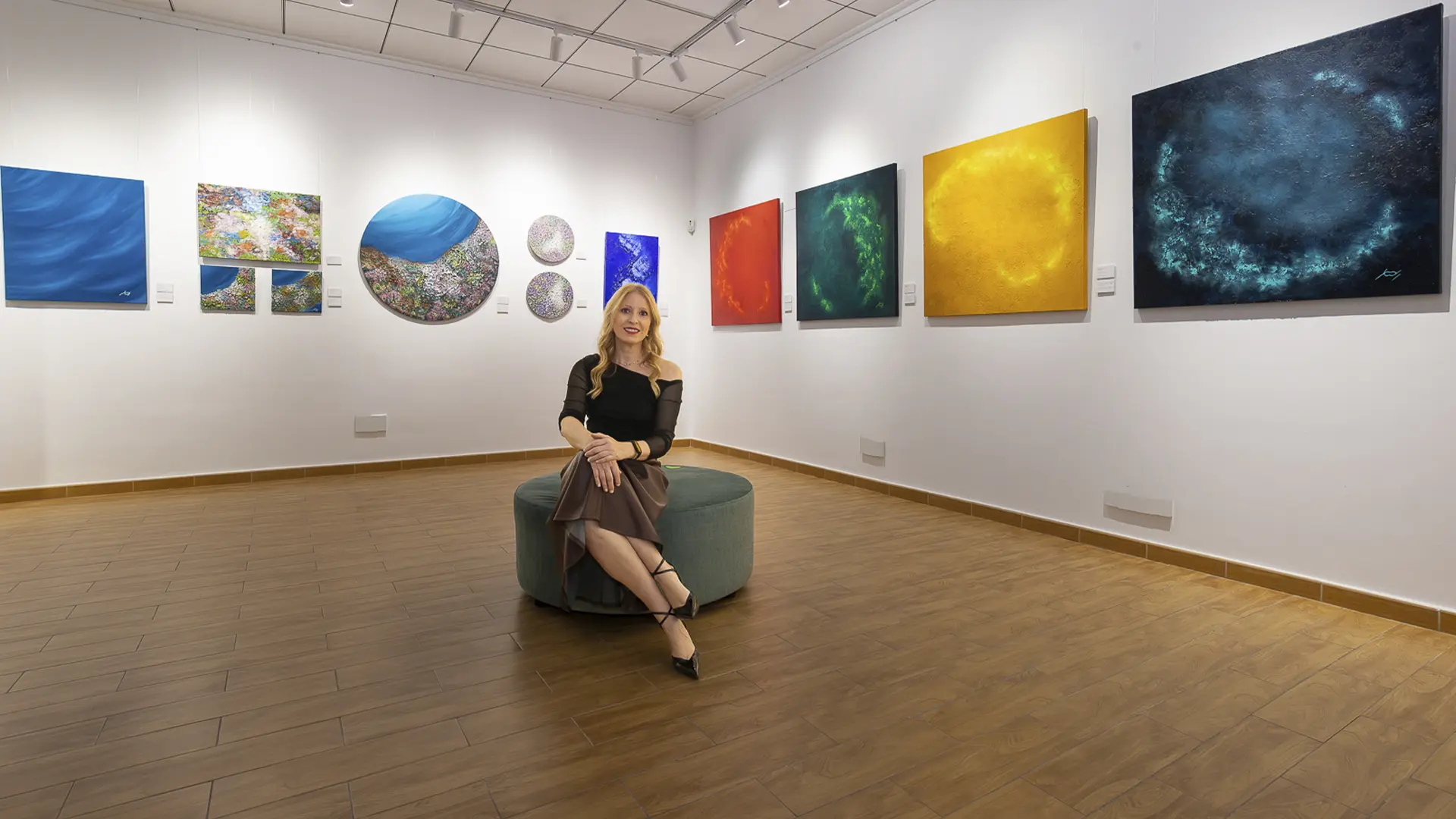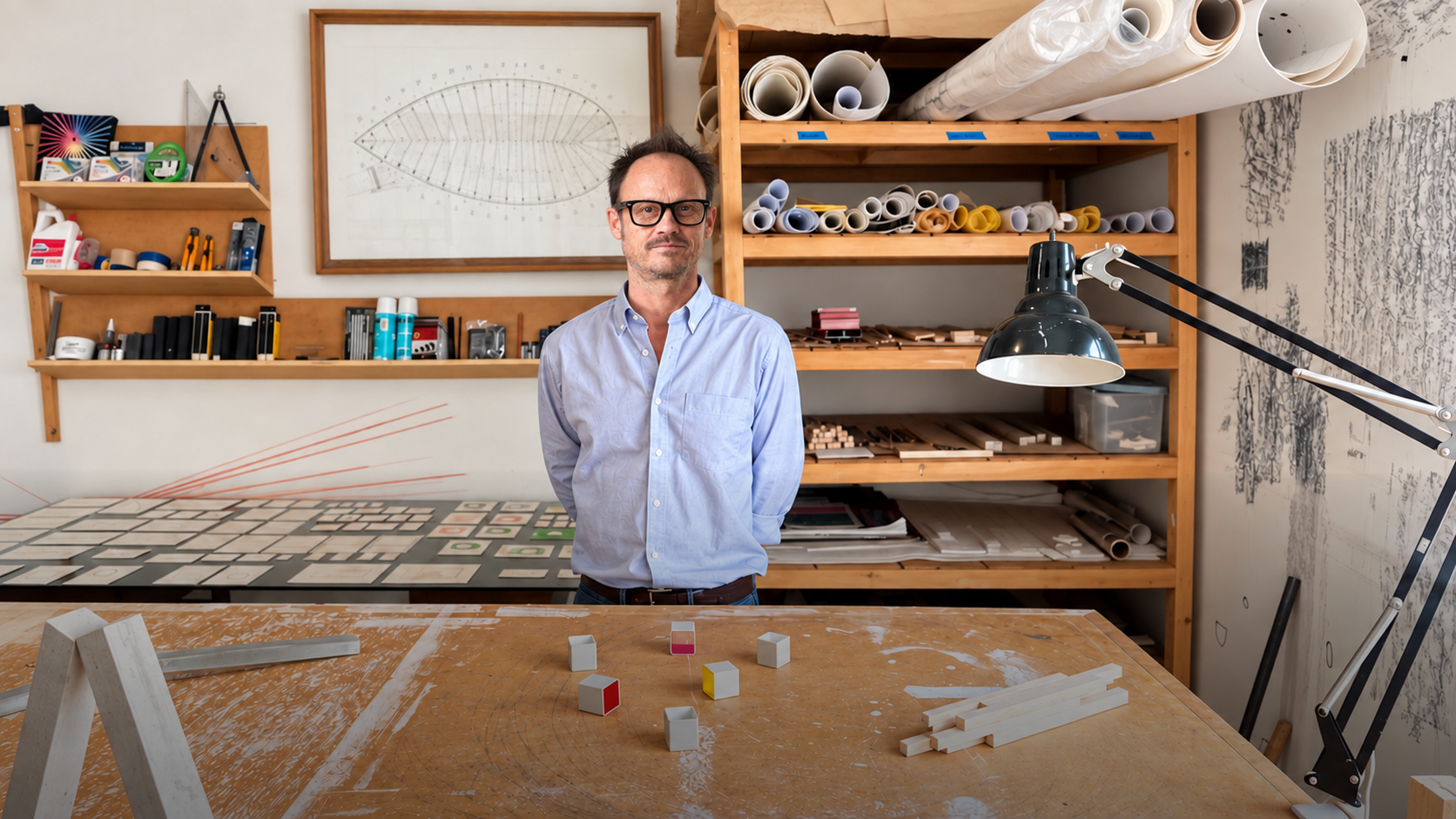

Blue Remnant on Yellow 2 is one of the pieces found in Francisco Ugarte’s studio. Light, color, and space permeate a body of work that ranges from drawing and painting to sculpture and slide installations. As part of Estación Material vol. 5, we visited his studio to discuss these explorations and how his approach to making art has changed.

Absolute Contemplation
The artist/architect (or architect/artist) was part of the exhibition presented by Galería CURRO at Material, featuring the series *Nothing but the Color of Light*, in which he exhibited a work “that explores the relationship between line and background, form and space, the finite and the infinite: a landscape that seeks to transport the viewer into a state of absolute contemplation.”
In his office, on a vintage record player, sits the LP by the British band The Cure, *Kiss Me, Kiss Me, Kiss Me* (1987), an album renowned for its contrasts and its dense tracks, among which songs full of light shine through. “I’m a huge fan,” he admits.
An artist’s aesthetic is linked to everything they see and hear. Does listening to music influence your brushstrokes and artwork?
Yes, I think making art has to do with what I like and what I usually do. I feel like my work has been directly connected to my hobbies since I was a child, and that connection is becoming more and more evident.
What kinds of hobbies did you have back then, besides buying records?
Noticing what happens with the light. As a child, that was my way of zoning out a little.

Did your interest in art begin before you started studying it?
Sure. Ever since I was a teenager, I’ve been interested in art through movies, music, painting, and literature. As for everything else, I didn’t find it appealing or feel comfortable with it.
In your work, do you seek to connect with that childhood stage?
Look, I drew this little picture when I was 11, and it’s very much in line with what I do now. I’ve always been obsessed with figuring out, for example, how many sets of three circles I can make without repeating the color combinations.

Did that first piece have a name?
Concentric circles, I think. I don’t know if it was a specific school assignment, but that obsession has been very present ever since. My work has always been about contemplation, about understanding reality through the senses. It used to be more conceptual, but over time I’ve become more intuitive.
Why did you move away from the purely conceptual? Does it have to do with returning to the playful?
I studied architecture, and the first things I developed as an artist were site-specific projects—something I continue to do. Architecture taught me to view the creative process as the solution to a specific problem. I began creating interventions where the space itself provided the clues; I would add an element to highlight its own characteristics. I develop an idea based on something that already exists. Little by little, that exercise became more personal.
“Architecture taught me to view the creative process as the solution to a specific problem,“ Francisco Ugarte
How do you distinguish the architect from the artist? Do they always go hand in hand?
Creating a painting comes solely from within me. These are decisions that have to do with the proportions of the canvas—something much more intimate. I feel that I have become more of an artist and less of an architect over time.
When does that artistic side come out the most?
When work becomes more personal. Right now, painting is what keeps me most engaged; painting is a very unique process, and I’m constantly learning—something I never experienced at an art school.

Many architects claim that architecture is not an art…
Well, it depends on how you look at it. All definitions have their limitations. I see architecture more as a service: it can be functional, but it can also be art.
“Architecture has it all; it has a fundamental artistic dimension, but ultimately it must function and serve society,” Francisco Ugarte
In addition to painting and the works presented at Estación Material, you have also worked with slides and installations.
In fact, when I decided to become an artist, I was studying the nature of light in great depth, so I began working with altered slides. It’s a technique I constantly incorporate into various works.

Speaking of learning, what has been the biggest challenge in making the transition from architecture to the visual arts?
Dealing with ideas: how to tackle certain issues while learning as I go. I started painting with very minimalist pieces, but little by little I’m discovering different techniques. In my work, the materials and tools are what give me the clues.
Parts of the material itself…
Sometimes, the simple act of rubbing the oil stick —solid oil in stick form—onto the canvas gives me the inspiration I need. Rather than drawing a figure, I want to turn the material itself into the object.
What do you consider to be the milestones in your career?
I had an exhibition that came as a real shock: an installation at Casa Barragán in Mexico City, where I covered every object in the house with aluminum foil.

Were there purists who questioned the intervention?
A little bit, yes, but not too much. In the end, there were a lot of people from other countries visiting the house, and the reading was very interesting.
“Nothing but the Color of Light,” following its run at Estación Material, is on display at Galería CURRO (Andrés Terán 726, Col. Santa Teresita, Guadalajara).
Read more about major contemporary art events in Mexico and Latin America in AW Magazine.