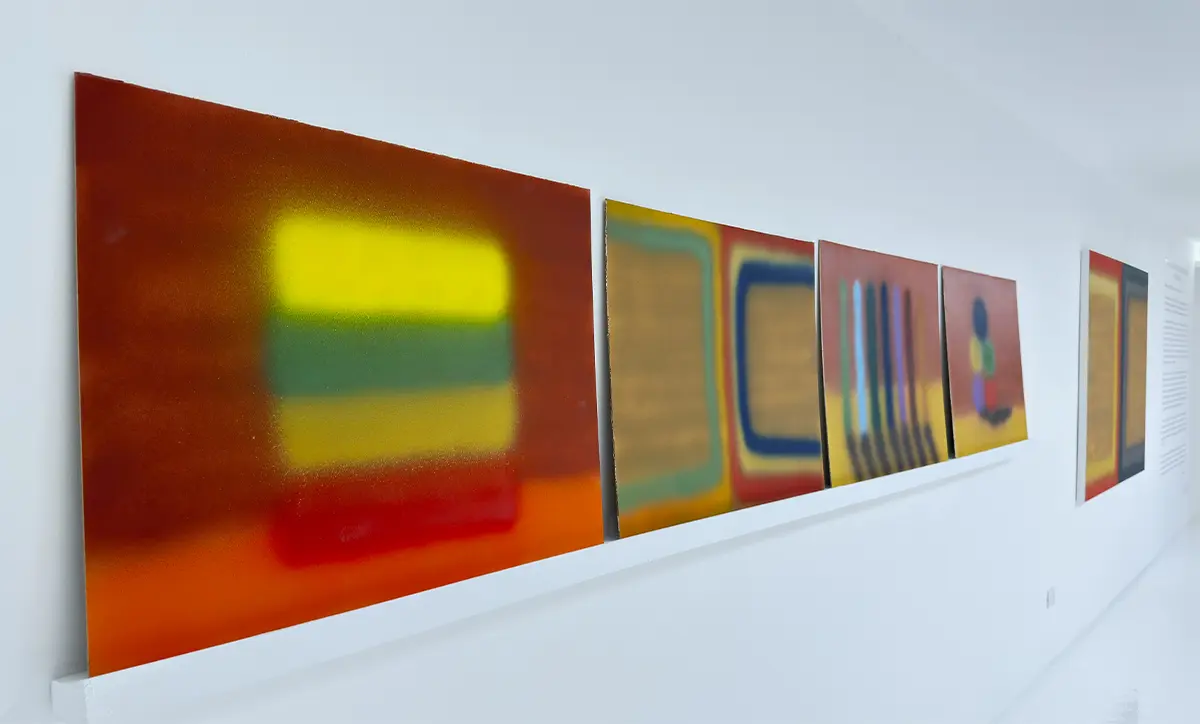

Mexican artist Ilán Lieberman —who has exhibited at venues such as the Sala de Arte Público Siqueiros, the Musée d’Art Moderne de la Ville de Paris, and the El Paso Museum of Art—presents Entrecerrar los ojos, an exhibition where painting functions as a visual trance. The 101 pieces, created with an airbrush in just one year, float in an ambiguous territory between the sharp and the blurred, as if they were about to appear or disappear. Drawing on references to Zen meditation, altered perception, and even the emotional intensity of bipolar disorder, Lieberman constructs a hypnotic, fast-paced, and almost compulsive exhibition. Squinting can be viewed at the Le Laboratoire gallery, located at General León 56, San Miguel Chapultepec, Mexico City, through May 30.

“To see better, you’d better squint”—is that something you said?
The truth is, I asked Otto Cázares, who wrote the text, to help me come up with a title, because I couldn’t figure out what to call the exhibition. And it just so happens that this title—this phrase—is quite meaningful to me, because I’ve always used it when teaching my students. I ask them that, when they have trouble seeing—especially the range of tonal values in something—they should squint their eyes. And, on the other hand, it turns out that the technique of squinting the eyes is also used in Zen meditation.
Squinting places you in a state halfway between the outside and the inside, allowing you to enter a suitable state of vision or meditation.
“Squinting places you in a state halfway between the outside and the inside, allowing you to enter a suitable state of vision or meditation .”
And how does this idea of “squinting” relate to the images in the exhibition?
I think it’s a metaphor for what happens when you look at the paintings. Most of them appear to be somewhere between in focus and completely blurred, where you can no longer make out anything. So, those hazy images, as Otto says in his text, put you in an intermediate state. You’re in a more passive state, letting the image enter your eyes.
But tell me, what is the conceptual theme of this exhibition? I understand there are 101 pieces.
Yes, there were 101 pieces in total, and it took me about a year to produce them. I had never done so many paintings in such a short time. There are two reasons for that. First, my drive to just keep painting and painting and getting work done—as a kind of catharsis. And on the other hand, the technical aspect of the airbrush used to create those paintings. It’s a very fast technique. You put the paint in the reservoir and the airbrush sprays it onto the canvas in a matter of seconds. So it’s something that, with a brush, would take much longer to do.
Yeah, sure, because I was doing the math, and to make 101 pieces in a year, you have to make about one every three days.

Yeah, more or less.
So I guess your approach to the work was similar to what you’d been doing before.
Well, that’s unique to this technique. I’ve never painted as many canvases as I have now. I couldn’t have done it before because every technique and every project is very unique and has its own distinct characteristics. But the challenge I set for myself was to paint them all with the spray gun.
And you also bring up something important: a quick, direct painting, where the body plays a different role.
This series I’m presenting is something I’ve wanted to do for a long time. I’ve wanted to paint this way: a style of painting that’s quick and direct, where I engage my whole body, and where the very materiality of the paint plays a central role.
But even though you’re talking about a technical change, you weren’t opposed to—nor have you ever been opposed to—exploring other tools.
In fact, there’s nothing new about this technique. Siqueiros used it extensively for his murals in the 1940s and 1950s. So it’s been around for a long time. Tin smiths, in particular, use it all the time.
Yes, I was thinking it might be something new within your own process.
That’s true. It’s a bit of a novelty for me because, before I started using the spray gun, I used an airbrush for quite a while—it’s like the little brother. The airbrush is good for doing much more delicate and detailed work, but for large surfaces, it’s easier and more effective to use the spray gun.
I also see that you have a workshop coming up: The Possibilities of Drawing Through Shamanism.
Yes, that’s right.
That’s interesting because it’s Polynesian shamanism. Is there a common thread among different forms of shamanism?
Yes, from what I’ve studied, shamanic traditions are indeed related to one another. Although each has its own distinct forms, myths, legends, and practices, it seems to me that they are all connected. Although I couldn’t say exactly how they’re connected, it’s like an intuitive feeling that there is a connection, because they’re based on aspects we might call spiritual or extrasensory, regarding a spiritual origin of the physical world.

And specifically, what does drawing through shamanism entail?
The workshop is based on a manual I wrote, which was my bachelor’s thesis—my final project for my bachelor’s degree in Arts Education, which I earned at La Esmeralda.
And how did the idea of combining drawing and shamanism come about?
For this manual, I decided to combine two areas of study. First, the study of drawing. And second, the study of shamanism—specifically Polynesian shamanism—because that’s what I was studying at the time. Also because I came across a book that serves as a manual on shamanism, written by an author named Serge Kahili King. The book is called *Urban Shaman*. And this book outlines a series of steps to follow in order to experience certain things through other senses and also through what are called extrasensory senses.
I also notice that the urban theme is something that comes up constantly in your work. You’ve had several exhibitions related to that. I’m thinking, for example, of *Disculpen la molestia*.
Well, it was a project that grew out of an urban phenomenon you mostly see in the subway and on the city streets, where indigenous people—often barefoot or wearing huaraches and dressed in traditional attire—ask for financial assistance due to a variety of circumstances. When I received these flyers years ago, they really caught my attention, and I decided first to start a collection of them. So, as I went around the subway and asked my students to do the same—to collect these flyers in exchange for a coin or by helping the person asking for it—I realized there was a huge variety of little pieces of paper with different texts and different colors. That’s also worth mentioning, because they usually use very eye-catching colors.

You’re also working on a documentary now.
Yes. A documentary about the relationship between bipolar disorder, mystical perception, and creativity.
And why is that topic coming up?
I have bipolar disorder. My dad had it, too. It’s often a condition that runs in families without anyone even realizing it.

And has that influenced the way you make art?
Yes, of course. I believe that this latest episode is, for me, a clear indication of the effects of bipolar disorder.
And how can we see that in the play?
Well, in many ways. First: the sheer volume of work. The amount of work involved. And also the intensity of the process, in terms of both time and emotional strain; there’s a lot of stigma and reluctance to talk about the subject. But the fact is that artists are ten to twenty times more likely to have bipolar disorder.
Discover more interviews about the art world in AW Magazine.
To keep exploring this thread, visit contemporary Latin American art.