Para Karlos Gil el tiempo no es solo un concepto abstracto: es el material con el que da vida a sus obras. El artista contemporáneo e investigador español (Talavera de la Reina, 1984) se define como un time-based media artist. Su obra explora la delgada línea entre lo natural y lo artificial mediante instalaciones, arte digital, escultura y tecnología obsoleta, combinadas con referencias a la ciencia ficción, y la evolución biológica e industrial. Doctor en Bellas Artes y formado en la School of Visual Arts de Nueva York, conversamos con él en el marco de la presentación de su pieza Uncanny Valley, sobre el tiempo, el arte contemporáneo y la tecnología como herramienta creativa.

What is one of the advantages of being a multidisciplinary artist in this day and age, when tools like 3D printers, editing software, and artificial intelligence are available to anyone? I know you’ve used AI in a very unique way.
To start at the end, the AI project was something I worked on quite a while ago, during the pandemic. I was collaborating with a neurosurgeon, a neuroscientist, and a mathematical programmer who is quite well-known here in Spain. We used artificial intelligence solely as a tool.
What was that project about that combined science, medicine, and art?
It consisted of a visualization of dreams, memories, and the relationship between memory and imagination. We conducted various neurological assessments of approximately fifty patients, and, together with this mathematician, we analyzed all the information obtained while the patients were recalling their memories.

Was it a way to physically represent something as intangible as thoughts?
There was also that idea of where memories are stored. It made a lot of conceptual sense because it seemed similar to when we store things in the cloud. I’m able to hold images in my head, but there’s no physical or organic device where they’re stored.
Isn’t the human brain where they’re stored?
The idea was to create a tool capable of directly visualizing what we have in it. We built the entire algorithmic component with mathematician Claudio Mirasso and neuroscientist Fernando Maestú. Using artificial intelligence—specifically a deep neural network—we created a visualizer for all of this. I haven’t worked on it since, and besides, that was back when artificial intelligence wasn’t generating the buzz it does today.
So, for you, the medium isn’t the message—it’s a tool for creating something.
Working with many different media wasn’t a conscious decision either. I think I have a conceptual foundation. My projects start with an idea and some research; then I try to find the medium that can express it most faithfully. I always give the same example: we all have this cliché that saying “I love you” in French sounds more romantic than saying it in German. Even though the message is the same, certain languages help convey it in a different way.

Your work blends a lot of technology with organic themes. Did your time in Berlin have anything to do with that exploration?
I come from a very remote part of Spain where I had never had any exposure to contemporary art. I’ve lived in New York for many years, spent a year in London, have been in Madrid for some time now, and travel a lot for work. But whenever I think of the city that shaped me and to which I still belong, it’s Berlin.
Did you get to experience the cold, artsy Berlin that influenced Bowie and Eno?
I arrived in 2007, and some of the essence of 1990s Berlin still lingered. I had just finished college. It was an incredibly dark, empty place where nothing seemed to be happening. It was hard to make friends; it was hard to socialize. German culture isn’t very welcoming. If you sit a Mexican and a Spaniard down together, within an hour they’re already drinking and laughing; it’s not like that there. That really made an impression on me and helped me understand that the most interesting things are often the ones that remain hidden.

In your work, you also discuss the relationship between human beings and their environment, as well as the concept of time.
Perhaps lately, for personal or autobiographical reasons, that has become more evident; I’d say I’m a time-based media artist. We all are, in a way. A painter paints in space, but also paints in time. I’ve always been interested in temporality, time travel, temporal collapse, and issues related to a more conceptual kind of science fiction. I realized that my primary medium was time. Just as a painter might say they paint with oil, I connect with the idea of working with time.
Does that influence come from somewhere, or was it a personal discovery?
Partly because of direct references to Andrei Tarkovsky and his wonderful book *Sculpting in Time*. That idea that the filmmaker, director, or film editor sculpts in time. More recently, following a very important exhibition I had in Madrid at the Dos de Mayo Art Center (CA2M), titled *Decline*, I began to connect with certain theories of modern geology. Also with authors like Siegfried Zielinski, but mainly with Jussi Parikka and his book *A Geology of Media*, where he discusses the geological reality of all technology, of the technological, of *techné*, which can be practically any instrument, from a spoon to a cell phone.

What I notice is that you don’t romanticize either the past or the future. You don’t idealize either of them.
The idea of not romanticizing something has to do with trying not to control the outcome of things. Perhaps what weighs on me most is that, if I were a little more romantic or more politically and culturally correct in these times, if I had a more critical or more nostalgic stance toward the past, my work would be very different. My approach is more about creating a series of constellations or points where what matters isn’t how you connect those points, but the trajectories that exist between them.
Do you think that idealization—or, failing that, that sense of inevitability about the future—is still a cliché in art?
Yes. One of the problems with contemporary art today is that many artists are more concerned with defining those starting and ending points than with everything that happens in between.
“What I’m trying to do is create a context where not only I, but also the viewer, has the tools—and, above all, the curiosity—to imagine things for themselves. I don’t want to think that my work doesn’t offer an answer, because I certainly aren’t looking for one,” Karlos Gil
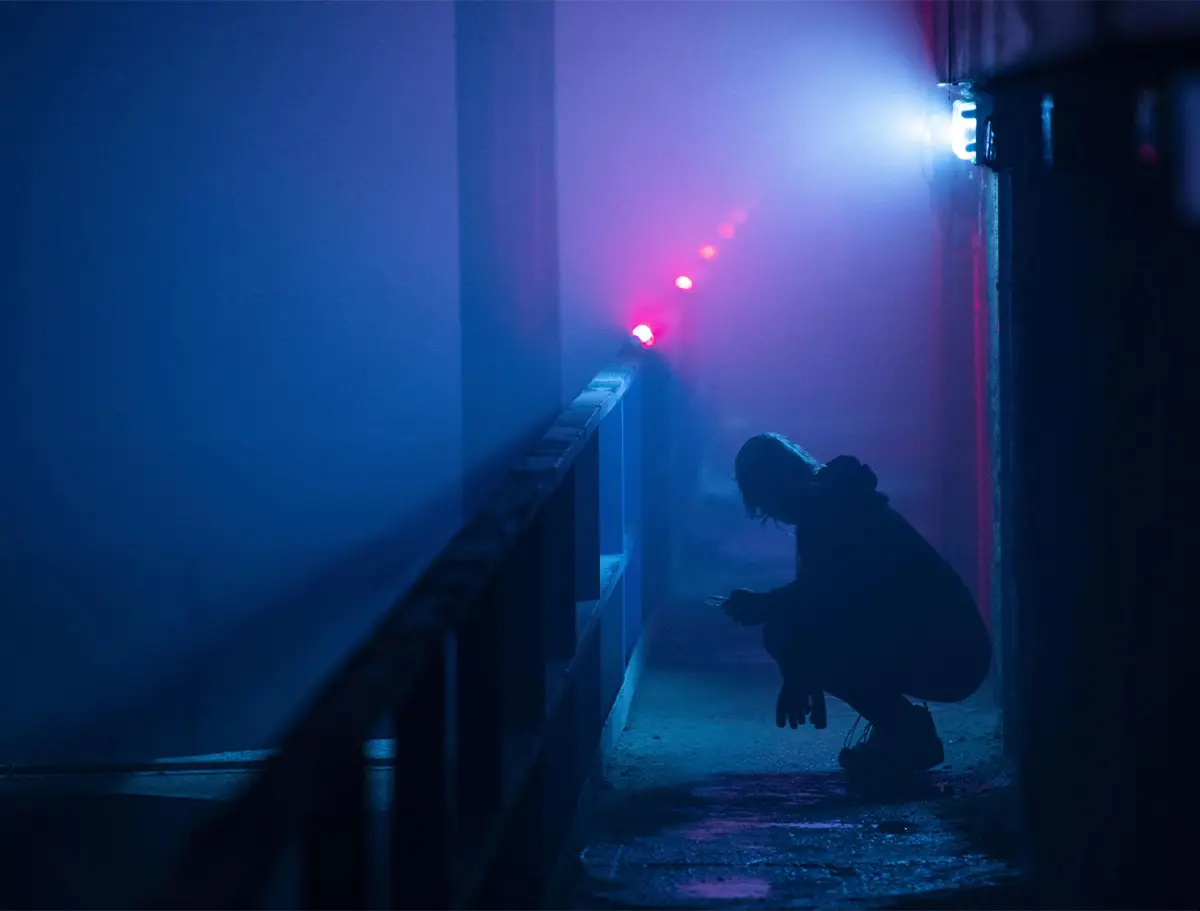
In *Uncanny Valley*, you draw on many references from science fiction to explore the relationship between the natural and the artificial. Does Cronenberg’s film work also engage with your own work?
A lot. That whole universe is the one I grew up in. As I mentioned, I come from a family where no one ever talked to me about contemporary art or art in general. But there was always that science fiction with a very retrofuturistic design and special effects that you were very aware were special effects—and that’s precisely why they were wonderful, because they weren’t trying to be realistic.
Which movies do you think resonate with your work?
There’s one that’s always on my mind: *World on a Wire*, by Rainer Werner Fassbinder. It’s kind of like *The Matrix*, but made in the 1970s. It’s incredibly complex. It’s about a person who’s hooked up to a machine and enters a dreamlike realm. I think art should offer that to the viewer: more than just a long-winded rant, as we say in the heart of Spain, more than just a sermon.
Which of your works do you think is the most provocative?
I’d like to present a new piece now. It’s called *Timefall* and comes from a previous exhibition I mentioned to you, called *Decline*. It consists of a series of aquariums—like terrariums—that are essentially environments of accelerated aging and aim to bring about the destruction of the piece itself, the destruction of what’s inside. I’ve always been interested in this idea of a piece that seeks its own destruction.
How does that system work?
It’s a kind of uncontrolled metastasis within a body—which, after all, is the very essence of the autoimmune concept: something that seeks its own destruction. These are environments of accelerated aging where there is indeed room for life, but transformation is the key element. It works using programmable accelerated aging technology. It’s the same technology used in materials engineering to observe how the casing of a cell phone or any industrial product ages. We’re able to observe in one hour a process that would normally take a very long time because we accelerate the conditions within those environments.
And how does that translate into the piece?
What I do in the studio, together with several people who help me, is create these environments of accelerated aging—of accelerated time—where the piece eventually disintegrates, but always in relation to the duration of the exhibition. If the exhibition lasts three months, the process takes place over those three months; if it lasts a week, it happens in a week.We once had one that was incredible. There was a bronze object that was oxidizing very, very quickly, like when we used to have a VHS player and would fast-forward or rewind the tape. Perhaps that could be considered a provocative piece because my gallery owners always tell me, “It’s a very difficult piece to sell to a private collector.”
I know that, among other things, you’ll be at the upcoming Lyon Biennale.
That’s right. I was selected for the upcoming Lyon Biennale, which—after the Venice Biennale—is the most prestigious here in Europe. The project looks really promising. It’s being curated by Catherine Nichols, chief curator of the Hamburger Bahnhof in Berlin.
You mentioned that you just got back from the Netherlands. What play were you working on there?
Right now, the project I opened on Friday in Eindhoven at M.U.—a very important venue in the Netherlands—is what I’m focusing on the most. My next art fair is Frieze in New York in October, with my Lisbon gallery, Francisco Fino.
Do you feel that art runs the risk of becoming an imposed religion?
It’s just that sometimes I think there are already too many artists who, instead of being artists, seem more like priests—but in the negative sense of the word. Like priests who try to lecture and preach. What should happen in contemporary art is a return to that idea of serving as an interface so that people can truly transcend, pushing both ourselves and the viewers toward a point where the rational isn’t so important.
Discover more articles on contemporary art in AW Magazine.