At age 12, she won a painting contest that led her to represent Colombia in China. Today, she exhibits professionally in many parts of the world, including Asia. “I’ve always wanted to have a positive impact on the world through art,” says María Mercado. The artist made history by becoming the first Colombian woman to hold a solo exhibition at the Beka Museum at Rockefeller Center in New York (U.S.) in 2023.

The Force Behind the Dancers
In her work, Mercado —as she usually signs her pieces—prioritizes beauty in its organic state. While a large segment of the art world seeks to transgress, her unique canvases point in another direction. “Well, what I want to portray is the Colombian woman—what we’re like as Colombians. For example, if you notice, I paint palenqueras—women of African descent from the coastal region of San Basilio de Palenque.”
“I paint ballet dancers because I practice family law, and in that field I’ve discovered many remarkable achievements by Colombian women—women who are incredibly resilient, feisty, feminine, and determined. So I interpret what it means to be a Colombian woman through these ballet dancers,” she says.

“If you look at the feet of ballet dancers, you realize the enormous effort that goes into it. They stand on their toes, and that reflects the strength that drives them—a strength born of passion, but also of discipline. I try to portray Colombian women through them,” she adds.
An identity that is recognized
In Colombia, ballet is not one of the most deeply rooted traditions; the country has other cultural dances, such as the bambuco: “However, I decided to use ballet as a source of inspiration to explore who we are beyond our culture. Each of my works speaks to the beauty of Colombia, but also to the beauty of its women. There is beauty, there is vulnerability, and there is strength,” she explains.
Although she also practices family law professionally, Mercado does not view that aspect as separate from her artistic work. On the contrary, he believes that both disciplines feed into each other. “It’s a career that has brought me much closer to people and made me more attuned to their real, day-to-day feelings,” he acknowledges.
Between Law and Art
That practice has not only given him structure and mental discipline, but has also become a source of inspiration for portraying human beings from an empathetic perspective. Because he works independently, he can alternate between court appearances and legal meetings and long days of painting in his studio, moving seamlessly from one vocation to another without drawing boundaries.
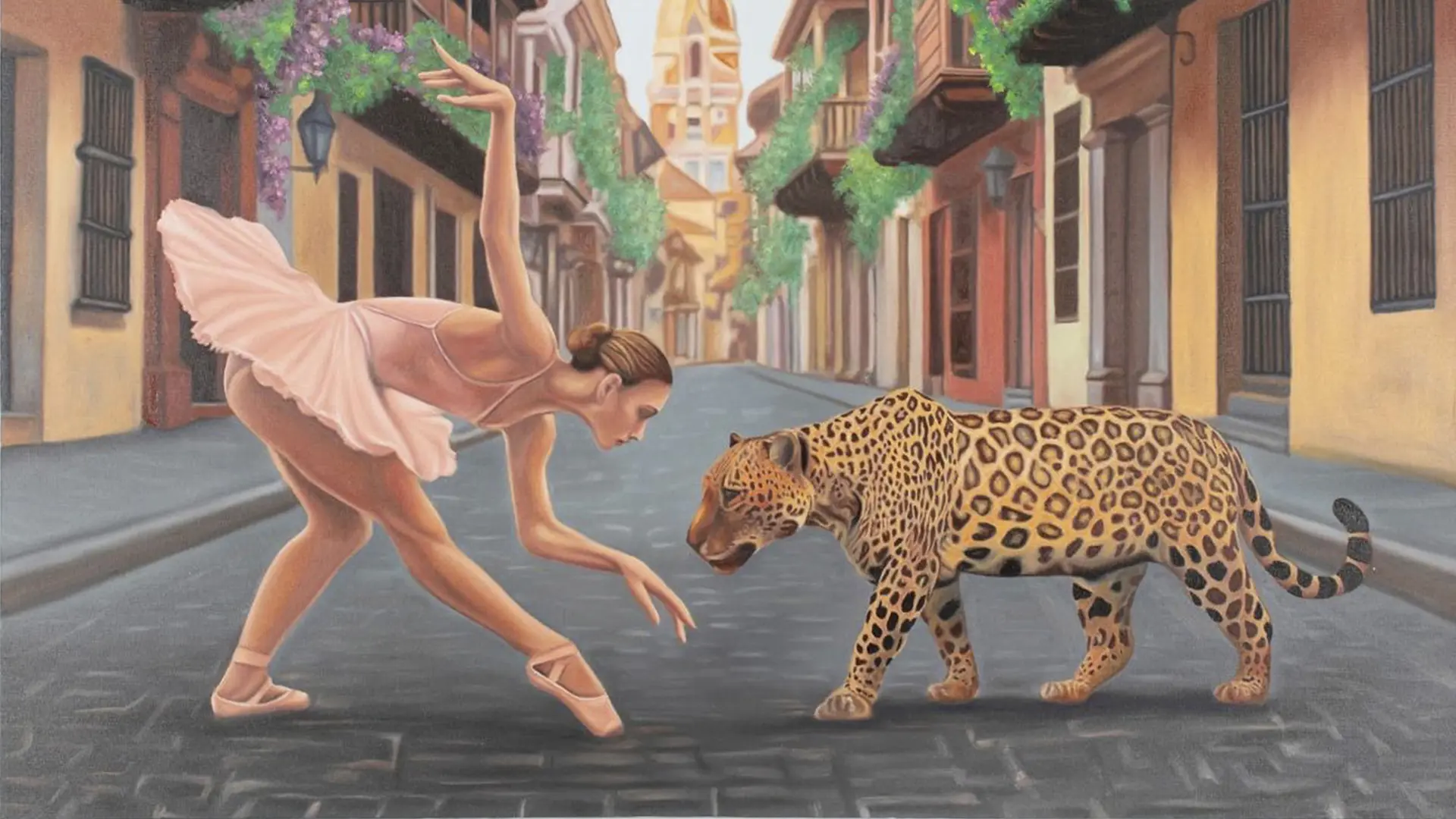
That same perspective was evident in her recent participation in the Vassar art fair in Colombia, where she exhibited her ballet dancers as well as much of her new work: “I also exhibited a series called Dualities of the Soul, in which it’s as if you were holding up a mirror between two works—a similar yet opposite figure. I exhibited jaguars; I’ve actually been a devoted follower of the Virgin Mary, and for shamans, the Virgin is the jaguar—an animal that is also a very important figure in Colombia’s biodiversity.”

But dancers and palenqueras are not the only characters that inhabit the artist’s pictorial universe. The work also features reinterpretations of figures such as Marilyn Monroe, as well as references to seminal works and powerful visual icons.
“I also have a Marilyn or a Menina dressed as a ballet dancer. A reinterpretation, for example—I could tell you—is a painting by Velázquez that I really like. It’s called *Las Meninas* by Velázquez, which is in the Prado Museum, in Gallery 8. I lived in Spain, in Madrid, and I used to go to the Prado Museum to admire the painting, which I find truly majestic. I believe that artists identify with different things, and that’s where they draw their inspiration,” he explains.
Painting Colombia’s Roots
While acknowledging various influences, Mercado also reflects on the place women have historically occupied in the art world and the figures who shaped her career.
“Art has always been very sexist, hasn’t it? I think we’re in a very fortunate period right now because if you look back at the artists of yesteryear—well, Van Gogh was a man, Degas was a man; almost all of them were men,” María Mercado
“Let’s say that Frida Kahlo was something of a rarity in her day, but I love Edgar Degas. Plus, he was born in Paris and studied law for a while, so I also feel a bit of a connection because I studied law too and work in the arts. I identify with him not only in that regard, but also in our shared passion for ballet dancers,” she explains, though she acknowledges that Botero is her national role model: “Everyone always has their Colombian role models.”
“I think Botero was a real force to be reckoned with, not only because of his mastery of oil painting, but also because of his international work, for raising Colombia’s profile so high, and for making a name for himself. If you travel to many places, you’ll find one of his sculptures in the world’s most iconic cities,” he asserts.
“Another influence is the Colombian-Spanish artist Alejandro Obregón. I’ve always been very inspired by that red color he used in his condors and other works. Also, there’s a Colombian artist named Manuela Echeverri who’s doing great work at Fargoncillo; she’s one of the leading figures,” he says.

He is currently working on a new series inspired by Colombia’s anthropological roots, a phase that marks a shift in color within his body of work without straying from the themes that have characterized his career.
Women and Jaguars
“I’ve been working on a new series that’s mostly in shades of gray and explores our anthropological origins. I’m painting indigenous Colombian women. The piece I’m working on right now depicts three indigenous Colombian women on a raft in a river. It’s all in black and white, but I’m adding color to a parrot in the middle of the jungle, a jaguar, and some fruits—for contrast. These works are deeply connected to our roots, to where we come from. I think artists always talk a lot about that.”
The artist remains true to her roots: “I paint many women, not just because I’m a woman, but because of the work I do, which brings me into contact with many women. I’m a devoted admirer of the home where I was born and of my mother, so I also believe that all of that is reflected in my work.”
“I believe that artists always reflect their lives, in one way or another, in their work,” he reflects.
When Colombia Goes Out into the World
That search for identity has also resonated outside Colombia. Mercado recalls that, during an exhibition in Tokyo, the pieces that drew the most interest were those depicting elements deeply rooted in his country’s culture.
“The works that were most popular in Tokyo were precisely those by the palenqueras, because I believe that at international exhibitions, people are often drawn to things that stand out culturally in other places—things that are different from what they themselves are,” she concludes.