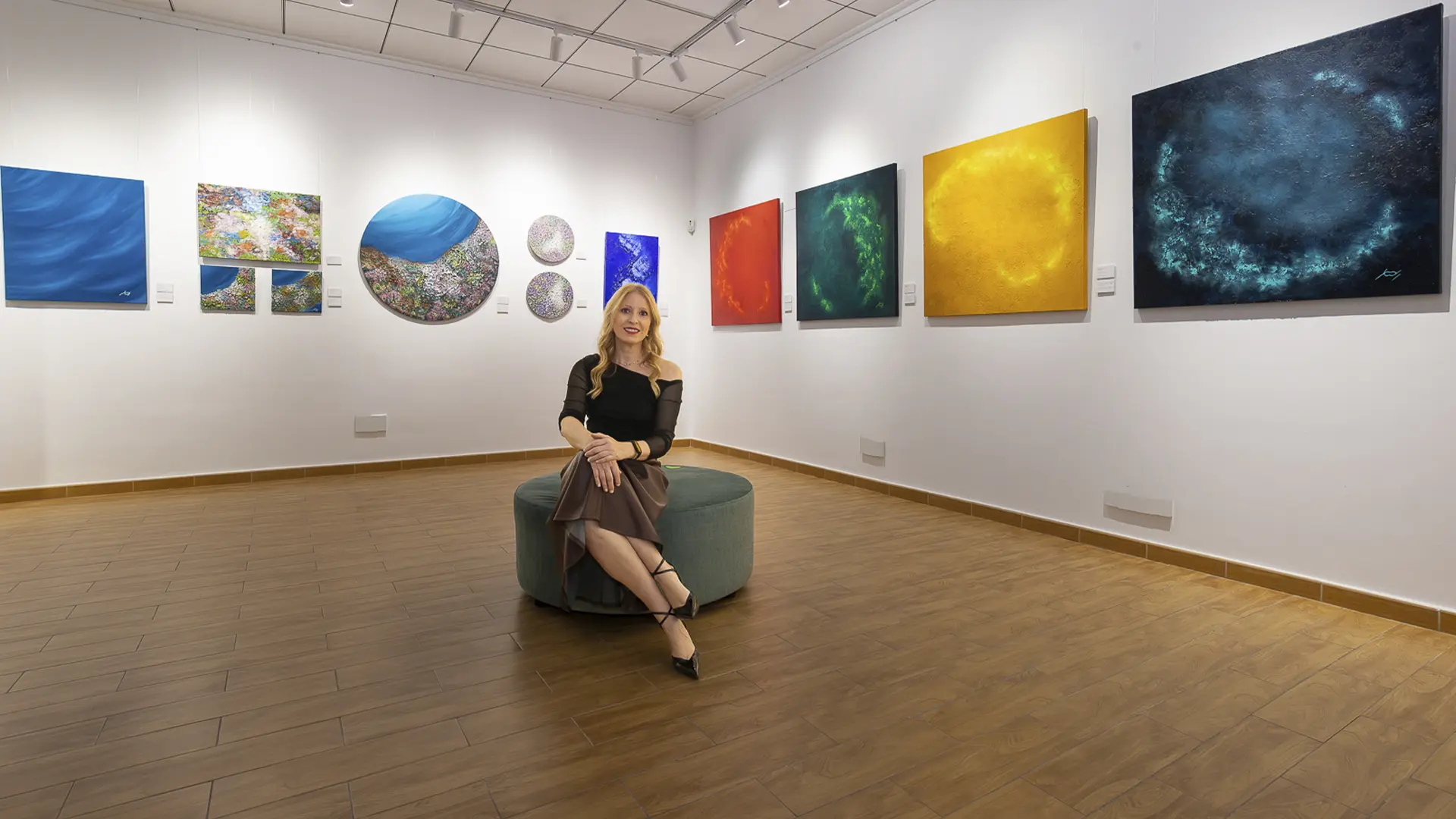

Alicante—located southeast of the Spanish capital and about four and a half hours by car from Madrid—has become a perhaps unexpected hub for contemporary art. Mariam Cremades Studio and Art Gallery is located in this city. Conceived as “an experiential gallery,” the space prioritizes artistic discourse and a carefully curated selection of works. We spoke with Mariam Cremades—gallery owner, artist, and chemical engineer—about the project’s origins, her work, and art collecting in Alicante.

A gallery with soul
What has happened during this relatively short period in the gallery’s history?
I started my own project when I found the space. First, I set up my studio and held an exhibition of my work in February 2025. In July of that same year, I began working with other artists and launched the gallery’s program.
What was your main goal when setting up the space?
I wanted the gallery to be a gathering place. As an artist and art lover, I sought to create a space where artists and their work would once again be valued. It was always very clear to me that I wanted an experiential gallery, where the artistic discourse would take center stage and everything would be carefully curated to create a genuine experience for the visitor. I wanted visitors to be able to enjoy that discourse and understand the reasoning behind why one work is placed next to another as soon as they entered each exhibition.
And what mistakes did you want to avoid that are commonly made by the galleries you know?
I wanted to avoid it being just a place where artists are showcased and works or paintings are hung. I’ve always said that I wanted to create a place with soul. For me, the true purpose of the gallery is for visitors to enter with one perception and, after calmly enjoying each work of art, the talk, and the guided tour, to leave with a different perception.

Programming, curation, and artistic selection
Did you have a clear idea of what the programming and curation would look like, or did they take shape along the way?
That was one of my main goals when I created the gallery. Based on that approach, I have developed a program in which each exhibition has a purpose and a narrative. I’ve also incorporated different artistic languages, disciplines, and career paths.
Perhaps because I’m also an artist, one of my roles in the business world is to help other artists grow. That’s why I like to welcome emerging artists, support them throughout their careers, give them visibility, and help them build their artistic careers. I always start with a very careful selection, in which I can recognize an artistic narrative and a language with potential.
The program also includes mid-career artists and more established ones, whom I’ll begin incorporating starting in October.
“I don’t want to be just a gallery that exhibits art; I want to help foster the city’s cultural movement by promoting art, ” Mariam Cremades
So, you’re the founder and director of the gallery, and you also handle the curation.
Right now, yes. I also handle the curation of the exhibitions. Down the road, I’ll likely bring on a curator or art critic who can offer a different perspective on the work I’m doing. But for now, I’ve launched the project on my own.
Is your selection based on your personal taste, or do you also consider the market? It doesn’t quite suit my taste. It’s true that I’ve gravitated toward contemporary art because it aligns with my taste and my vision. However, even though I’m an artist and don’t create anything figurative, I do include figurative works in the gallery.

From Engineering to the World of Art
I wanted to ask you about your professional background. In addition to running the gallery and being an artist, you have a background in engineering. How do you apply that training, and how do those two aspects coexist?
I think engineering led me into the business world, although I never actually practiced as a chemical engineer. I started out in consulting and then worked for 19 years at Tempe, the Inditex Group company based in Alicante that manages footwear and accessories for all of its brands. Engineering and business taught me to develop an analytical and strategic mindset, to manage teams, create new processes, and work on a wide variety of projects. At the same time, I began searching for a purpose and a creative outlet, which I found in art. That’s how I developed my artistic side alongside my business career.

Collecting in Alicante
Now tell me a little about your art, but first I wanted to ask you what collectors are like outside of Madrid—specifically in Alicante. Do you think collecting and the role of the collector are different? Yes, there are art collectors in Alicante. It’s true that almost all the galleries in the city closed, and now we’re starting over by creating and opening new spaces.
Collectors have more and more places where they can reconnect with art. I think that before, they used to look elsewhere for what they couldn’t find here, but now they’re beginning to see how the art scene is developing again in the city. I do sense an interest in seeking out and engaging with art.
And how do you view the generational shift in the world of collecting?
When it comes to collecting, I think there’s a general trend: some of the most established collectors—who already have their own collections and are accustomed to seeking out art—belong to an older generation. That’s why we also need to offer interesting opportunities to young people, because they will be the collectors of the future.
And how can we strengthen that middle generation and bring collecting to new audiences?
My vision has always been connected to young audiences and to the idea of bringing culture closer to the public, because I believe that’s where future collectors will also come from. We find ourselves in a situation where that middle ground is becoming increasingly blurred. In the past, many collectors were businesspeople who built their collections over the years. I believe such people still exist, but we need to strengthen that middle ground and continue to foster a culture and a love of art.

The Work of Mariam Cremades
Now then, tell me a little bit about your role as an artist, beyond your role as the gallery’s founder. What is your work like?
My work was born out of a need to explore. It arose from my search for my purpose in life—what made me happy—and that’s where I discovered painting. My work is rooted in learning, self-discovery, personal growth, and finding the best version of myself. The lessons I’ve learned and everything that has happened throughout my life are what I capture on each of my canvases.
And how has your artistic style evolved? Well, I started with Abstract Expressionism, working in oil and acrylic. Little by little, that color and that gesture also began to take on a material quality. Perhaps that’s where my background as a chemical engineer comes in: I like to mix materials, draw out creativity through the experience of the material itself, and incorporate the material as part of the artistic language—it’s not merely decorative, but rather plays a role in the discourse and the creative process.
That material evolves into a sculptural dimension, where the 3D element extends beyond the canvas and becomes part of the language itself. All of my works—in addition to gesture, color, and material—have an underlying symbolism that stems from that inspiration.
What can you appreciate when seeing your works in person that you can’t perceive when scrolling through them?
These days, it’s very difficult to appreciate the evolution of the works on a screen. It’s a shame, because many people mention this when they come to see them. In person, you can perceive all the lighting effects they feature. There are works that show one kind of light during the day, and at night, when more direct light hits them, they reveal many effects that can only be seen in person. The textural quality is also much better experienced in person.
A gallery with an international reach
I know you’ve worked with Latin American artists, right? What has that experience been like?
I’ve brought in international artists because I believe that part of the gallery’s natural growth involves taking steps toward internationalization. Over the course of this year, artists of various nationalities have exhibited at the gallery. Europe has been well represented, with artists from France, Belgium, the Netherlands, Greece, Italy, Ukraine, Romania, and Russia. From Latin America, artists from Colombia, Bolivia, and Mexico have participated. More recently, I participated in the Marbella Art Fair, held from July 30 to August 2. Although it is a national fair, held here in Spain, it has an international scope, with galleries from around the world and artists of various nationalities.
Exhibitions and Hours of Operation
How do you balance showcasing your own work with the gallery’s programming?
Every so often, I spend a few weeks showcasing my work, because there are collectors and visitors who also want to see it. The rest of the year, I let other artists take center stage. The program includes group exhibitions and features established artists.

You also open your studio to the public. What does this initiative involve?
For one weekend, artists’ studios in Alicante are open to the public. Visitors can see where we create, get a closer look at the creative process, and view both our works and those of other artists. It’s a way to establish a more direct connection between the artist and the public.
What exhibitions are currently on view, and what’s coming next? In September, we will present *Habitar el silencio*, a group exhibition running from September 4 to 25, 2026. In October, we will continue with new exhibitions and shows.
You can also check out the “Magnetismo” series. The schedule and upcoming exhibitions can be found on the gallery’s website.
Mariam Cremades Studio and Art Gallery
17 Alcalde José Luis Lassaletta, Ground Floor, Suite 3
Alicante.
Discover more art spaces in Spain and Latin America in AW Magazine.