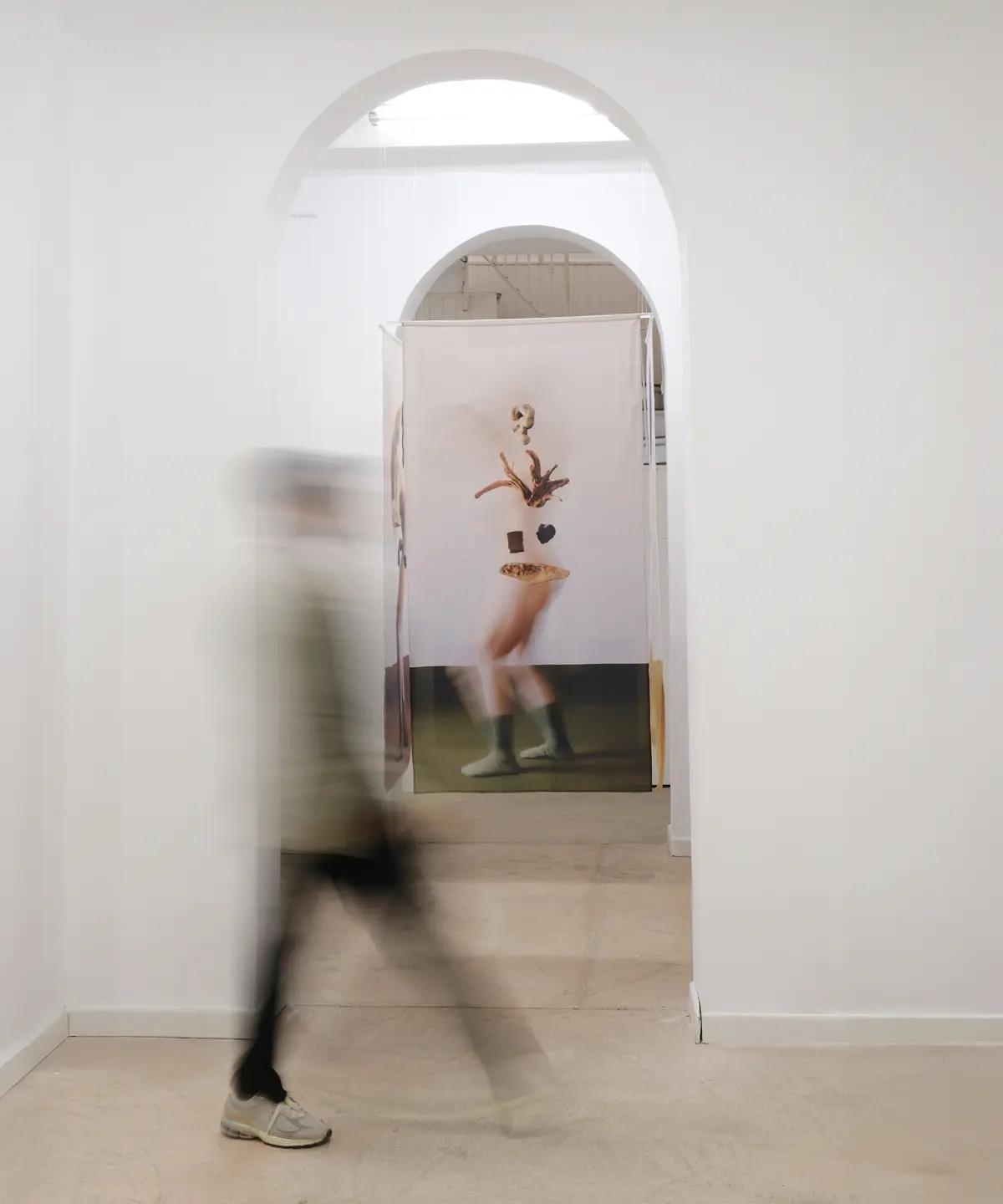

Sorondo Projects was founded in Barcelona with the aim of supporting emerging artists and creating a meeting place centered on identity, a sense of belonging, and the creative process. Located at 32 Trafalgar Street, on the edge of the Ciutat Vella district, very close to El Born and the Arc de Triomf station, the gallery has established a program focused on contemporary art practices, with a special emphasis on Latin American artists. In this interview with Art Weekends, founding gallerist Juliana Sorondo reflects on the exhibition *El calor de otros soles*(The Heat of Other Suns), the role of art in building community, and the way in which Latin American art practices engage today with the international scene and with solidarity that transcends borders.

The Heat of Other Suns: An Exhibition on Migration and Belonging
How did the idea or initiative to create the concept come about? The Warmth of Other Sunscome about?
The Heat of Other Suns stems from a very personal—yet also widely shared—reflection on what it means to leave one’s home and build a life far from one’s place of origin. The idea is based on understanding migration not only as a rupture or a loss, but also as a process of transformation.
The play conveys both nostalgia and the idea of a break with the past and new senses of belonging…
The thing is, when a person leaves, they don’t leave behind everything they used to be. Some things remain, others change, and still others emerge as a result of that move. The title refers to this idea of finding warmth in other places, in other people, and in other communities. I was interested in exploring the experience of being in between different places and how, from that vantage point, we can also build new forms of belonging.

The warmth of other suns and nostalgia as a provocation
Well, the exhibition description mentions that *The Heat of Other Suns* doesn’t just appeal to nostalgia, but to what comes next. What do you hope to evoke or change with that perspective?
I think it seeks to shift our understanding of migration and the idea of belonging. We often talk about migrants in terms of loss—what they left behind. And while that loss is real, there is also an enormous capacity to build, adapt, and create new ways of life.
Does the exhibition’s reference to the book *The Warmth of Other Suns* also imply adopting its interpretation of the power structures that drive migration?
The reference to Isabel Wilkerson’s book is important because it reminds us that migration never occurs in a vacuum. There are political, economic, and social structures that determine who can move, who has to move, and under what conditions. But the exhibition does not seek to directly illustrate those structures; rather, it aims to explore how those realities are experienced on an intimate and personal level. I’m interested in that tension between the individual and the collective.
Individual Experiences, Shared Stories
*The Heat of Other Suns* brings together the works of four young Latin American photographers—Fabiola Ferrero, Marisol Méndez, Silvana Trevale, and Daniel Santolo Franco—who currently live in Europe.
Did each artist participating in the exhibition base their work on that premise or concept, or did they start from their own vision?
Each artist draws on a specific experience, but those experiences also speak to something much broader. Displacement can be a choice, a necessity, a consequence of violence, or simply a quest. And in every case, it transforms the way we understand the place to which we belong.

Marisol Méndez and the Narratives of the Latin American Diaspora
What aspects of Marisol Méndez’s work did you consider essential in deciding to include her in *El calor de otros soles*?
In Marisol’s case, the story is really lovely. We met in person at Paris Photo, when she came to visit us at our booth, and she told me she really liked what we were doing. For me, it was a very special encounter between a gallerist and an artist, especially because I felt we shared common interests and a very genuine sensibility. When I looked more closely at her work, I was delighted to discover how she tackles deeply complex themes rooted in Bolivian culture and how, through beauty and imagery, she manages to offer a profound critique.
«Una de las funciones del arte es abrirnos los ojos hacia otras maneras de ver y entender el mundo, incluso hacia realidades que pueden resultarnos ajenas o difíciles de mirar»

In recent years, you’ve focused on Latin American artists living outside their home countries. What does the diaspora’s perspective bring to contemporary art today?
I think there’s something to be gained from constantly being in between places. Artists in the diaspora often have the ability to view their place of origin from a distance, but also to view the place where they now live with a certain detachment. That dual perspective can raise some very interesting questions. For me, the diaspora is not an aesthetic category.
The Creative Process as the Cornerstone of Sorondo Projects
You mention that the process is just as important as the final result. How does that philosophy translate into the installation and the visitor experience?
For the gallery, the final result isn’t necessarily the most important thing. The artwork that arrives at the gallery is, in fact, the result of a much broader process that we’re interested in showcasing and sharing. We try to ensure that this process-oriented aspect is also reflected in the way we present our exhibitions. We think it’s important for visitors to understand how the works are made, what lies behind them, and the creative journey each artist has taken to get to this point. Ultimately, I like it when someone leaves the gallery with more questions than they had when they walked in.

Latin American Art in the Global Conversation
How do you feel the perception of Latin American art has changed in Europe?
I think it has changed a great deal. For a long time, Latin American art was presented in Europe as a fairly homogeneous category, almost as if there were a single Latin American identity. Today, there is greater awareness of the enormous diversity of contexts, histories, and practices that exist across the continent. I also feel that there is a growing interest in artists who don’t necessarily fit into that more traditional idea of what it means to be Latin American.
“I think people are gradually coming to understand that Latin American art is not on the periphery of contemporary art. It is part of the global conversation and has its own ways of shaping it.”
En tus textos aparece constantemente la palabra “identidad”. ¿Qué significa hoy esa palabra para ti después de haber vivido entre dos países?
For me, identity has to do with a full awareness of who we are, but also with understanding the complexity of our own being, our history, and the places we come from and where we are now.
¿Creen que el arte contemporáneo latinoamericano está dejando de ser leído desde la categoría de “lo exótico” para ser entendido como una conversación global?
I think that perspective still exists. Although Spain has very strong ties to Latin America, historically, Latin American artistic practices have been viewed from Europe as something exotic. My intention is for the work of Latin American artists to be understood within a much broader ecosystem of contemporary art, without their place of origin necessarily being the factor that determines how their work is interpreted.

When Art Also Becomes Solidarity
¿En qué momento sintieron que la respuesta de la galería debía ir más allá de un gesto simbólico y convertirse en una iniciativa concreta de recaudación, como lo que están haciendo para Venezuela tras el terremoto?
I think it was almost immediate. When a tragedy of this magnitude strikes—especially when it affects a community with which you have a personal connection , like Venezuela— it’s very difficult to limit yourself to just making a personal donation. We asked ourselves what we could do from where we are and what tools we had at our disposal. As a gallery, we have access to artists, collectors, and a community that trusts us. We felt it was important to make use of that network.
Históricamente, el arte ha documentado tragedias, pero en este caso también se convierte en un mecanismo de ayuda directa. ¿Qué significado tiene para ustedes ese cambio de rol?
I believe that art has always had a capacity that goes beyond mere documentation. It can spark conversation, build community, and mobilize people. In times of crisis, that power can take on a much more concrete dimension. For us, the fact that art can become a mechanism for direct aid is a way of understanding the gallery as more than just a space for exhibiting and selling art. Solidarity is not something separate from our work.
Discover more art galleries and interviews in Latin America in AW Magazine.