The dreaded Cardiazol and shock therapy were, for better or worse, the muses behind Leonora Carrington’s unpublished work, which has just seen the light of day more than eight decades after it was created under unusual circumstances. Leonora Carrington created Villa Pilar in 1940, during a difficult time, while she was hospitalized in a psychiatric facility.
Carrington’s Lost Work
At the time, curator Vanessa Boni set out to find the works Carrington created during her hospitalization for the exhibition Leonora Carrington: The Symptomatic Surreal. However, Villa Pilar —one of only two paintings the artist produced at Peña Castillo—remained missing. That absence turned the work into a sort of legendary phantom piece within her output from that period.
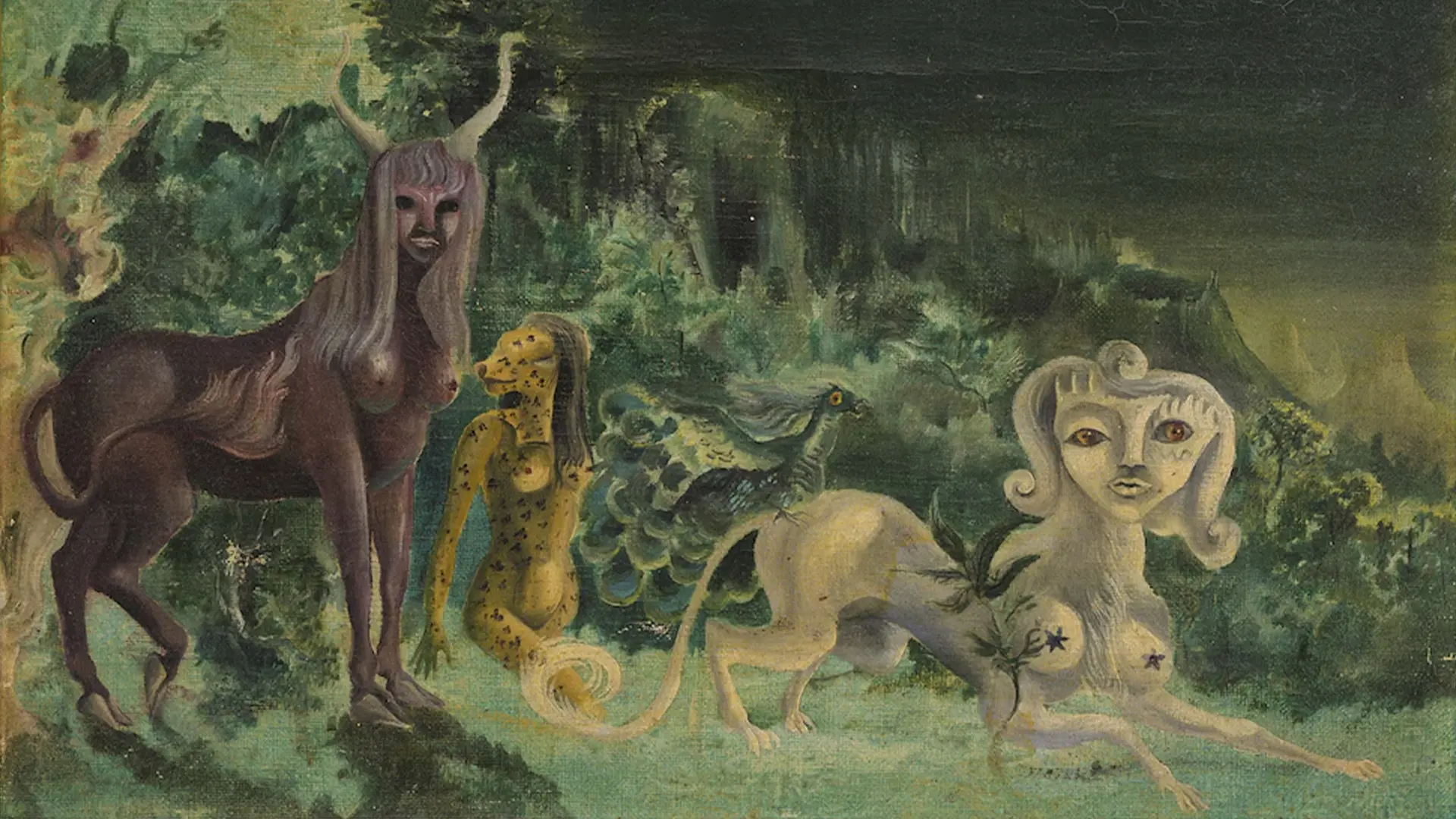
The work resurfaced in Spain in the possession of the family of the psychiatrist who treated Carrington during those years. The Freud Museum in London will exhibit the work to the public for the first time as part of the highly anticipated exhibition Leonora Carrington: The Symptomatic Surreal, dedicated to the works the artist created during the six months she spent in a Spanish psychiatric hospital before escaping and seeking refuge in Mexico.
Art Born of Crisis
And if the ghosts of the place are present there, so too are the scars of war. The Nazis arrested Max Ernst, the artist’s partner, leaving her adrift in the midst of the war. Carrington arrived in 1940 at Luis Morales’s Peña Castillo sanatorium, on the outskirts of Santander, shortly after escaping from Nazi-occupied France. There, Morales subjected her to shock therapy and, at the same time, encouraged her to keep drawing. From that contradiction—between the treatment that kept her in a state of profound distress and the creative impulse that never left her—would emerge part of the symbolic universe that can be seen today in works such as Villa Pilar.
The nervous breakdown that had pushed her to the brink, combined with aggressive therapies—now banned by the medical community—kept her in a state of dissociation, but it also served as the catalyst for this series of works conceived from the depths of emotional turmoil.

A Picnic in the Underworld
Could it get any more surreal? Villa Pilar belongs to that dreamlike universe, though more to the realm of nightmares.
Stylistically, the lost painting reflects the artist’s classic imagery: Celtic influences, anthropomorphic animals with breasts, reclining in a lush landscape at a time of day that is indistinguishable as either sunset or sunrise, as if preparing a picnic in the underworld. That is to say, in Carrington’s mind, weighed down by medication and isolation.
Her autobiographical book *Memorias de abajo* recounts how Carrington managed to pull herself out of that state—both mentally and physically—and settle in Mexico, where she married the Mexican writer and diplomat Renato Leduc—a marriage of convenience, it is said—and became a naturalized citizen.
The story of Villa Pilar is also the story of a body of work that spent decades in obscurity. After leaving Spain, Carrington gave the sketchbooks she had created during her stay at the clinic to the gallery owner Julien Levy during the year she spent in New York before settling permanently in Mexico.
A painting that had been missing for decades
He kept that material until his death in the early 1980s. Decades later, at an auction held in 2004, several of the works created by the artist during her stay at the psychiatric center were acquired by private buyers, helping to disperse a series that had remained virtually hidden all these years.
Today, everything comes together once again around a work that allows us to see how extreme mental experience ultimately became intertwined with the creative process. It is no coincidence that the artist herself once described the hospital stay as a kind of afterlife.
The exhibition will open with this addition on July 1. The organizers extended the exhibition’s run from June 28 to August 10 to celebrate the work’s reappearance. The painting remains in the possession of the Luis Morales family, who has temporarily loaned it to both the Faro Santander and the London museum.

For the exhibition’s organizers, this discovery and exhibition offer a chance to view the artist’s time in Santander as more than just another chapter in her life story.
But also as a pivotal moment in Carrington’s artistic development, whose themes and symbols—shaped by trauma and the aggressive, then-experimental treatment she underwent—would be reflected throughout her later works.
More art news in AW Magazine
To keep exploring this thread, visit contemporary artists and galleries; you can also continue through contemporary art galleries in Latin America.