
Salón Silicón is a gallery and cultural inclusion space in Mexico dedicated to promoting the work of LGBTQ+ artists and raising awareness of sexual dissidence in the arts.
Salón Silicón LGTB galería CDMX is a cultural space that challenges the very notion of inclusion within contemporary art. “Include whom? There are always some left out,” says Olga Rodríguez, when askedwhen a cultural space that aims to be inclusive actually achieves that goal. Appearances can be deceiving: behind her glasses and tousled hair, the gallery owner seems gentle and reserved, but in reality she is quite sharp-tongued. Perhaps having worked for five years, between 2008 and 2013, with the influential and temperamental Juana de Aizpuru —a pioneer of contemporary art collecting in Spain—has shaped her character.

Conservatism, dissent, and contradiction
After that experience in Madrid, Olga—who grew up in the state of Irapuato with a “very conservative” family, as she herself describes it—returned to Mexico. After a brief stint as studio manager at Mexican artist Damián Ortega’s studio, she founded Salón Silicón in 2017, a space dedicated to promoting the work of LGBTI+ artists, where she has produced more than 70 exhibitions both within and outside the gallery space.

The creation of Salón Silicón was an act of resistance: “I left Irapuato as soon as I could, carrying a lot of emotional baggage. It’s a city I find hard to talk about. When I left, I cut off contact with the people I used to spend time with. In the end, I don’t know if my perspective still has a small-town outlook mixed with what I’ve learned from big cities,” she admits.
However, Olga considers herself conservative in many ways, “but I will never be against the exploration of identity and sexuality as acts of artistic and spiritual liberation. I do feel that all of that is what really sets me apart—in my personal case, the fact that I am a lesbian,” she explains.
Queer art as a double-edged sword
Nearly ten years later, in the inclusive venture she embarked on alongside her former partners Romeo Gómez López and Laos Salazar, she is the only crew member left on board. “It’s always a double-edged sword, no matter how hard you try to do things right. Even so, I could be accused of excluding others by my own inclusion,” she says.
“Even now, people still get confused: I was invited to curate an exhibition that was supposed to feature NFTs by queer artists, and in the end, it turned out that what they wanted was colorful, rainbow-themed art, but they didn’t even know what the word ‘queer’ meant—just that ‘rainbow’ meant colors,” he recalls. “Now supposedly everything is gay—there are more of us—but it’s just for show; in reality, the same exclusionary practices remain.”
The Work of Mar Coyol
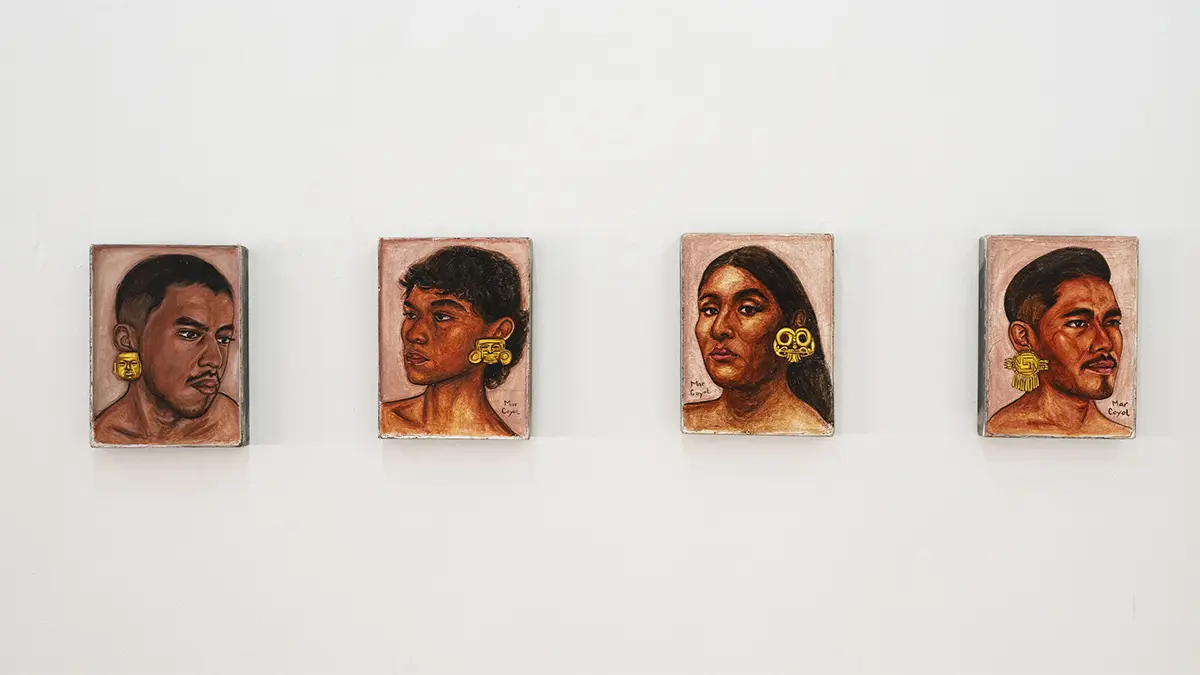
One of the recent exhibitions hosted by Salón Silicón through December 2025 was *Macehual: Songs of Creation and Memory*, a work by the transdisciplinary artist Mar Coyo, which addresses the role of anti-racism and ancestral homoeroticism: “There is a surge in people interested in art that stems from sexual dissidence, but that doesn’t mean that artistic practices didn’t previously exist that took a stance or were created by a gay, lesbian, or trans person,” Coyotl comments on the matter.
“Local history is heteronormative, but we—the dissidents—have different narratives. Ancient Mexico wasn’t organized the way we know it today. Other identities existed, and language is proof of that. I am an activist against the colonial system of oppression based on sex and gender because I know my history.”
The watchful eye that defines what is queer
The artist, a native of a small town called Teoyolucan in the State of Mexico, agrees with Olga that the current moment is transforming the art world and bringing gay culture into the spotlight. But it remains a contentious issue because it also has to do with who curates, who grants access, and who is leading the museums and galleries. “There is openness, but even so, there are filters—or rather, a watchful eye that dictates what is queer or what constitutes dissent. Barriers still exist.”
Among the artists associated with Salón Silicón, Lucía R. also stands out. Her exhibition *My Body, a Device, Consumes a Lithium Battery Daily*, a piece exhibited in 2025, draws a parallel between the artist’s body—or a “bodily device”—and a cell phone, questioning its functionality and charging/discharging; or Sofía Hinojosa, whose work addresses water, natural systems, and invisible infrastructures; as well as Mili Herrera, whose projects explore perception, the body, and the intangible.
Between Desire, Conflict, and Rights: Upcoming Exhibitions
In February 2026, Salón Silicón plans to host three exhibitions. The first is an installation by Bea Millón, a Spanish artist based in Mexico City. Her work is a fountain that is activated by the water from people who sing to it. This exhibition will be located in the gallery’s large courtyard.
The second consists of a collection of works by Alan Hernández, an artist from Oaxaca who creates highly detailed sculptures and embroidered textiles—“absolutely beautiful and incredibly cool,” says Olga.
““There’s a surge of people interested in art stemming from sexual dissidence, but that doesn’t mean artistic practices didn’t existbefore”—Olga Rodríguez, Salón Silicón
The third exhibition is by Carl Frias García, titled WC. Carl is a transmasculine artist, and his work explores this entirely new space he is entering—the men’s restroom—along with all the issues it raises for the trans community. “The sexualization of the restroom is something I have experienced as an androgynous lesbian. It’s a space that can become quite violent, and people aren’t aware of that; they see it as controversial when in reality it’s a human rights issue, although there are certainly other things—like a trans body—that still feel very transgressive to people.”
She also has an exhibition scheduled on pineapple monoculture in Costa Rica and another by the artist Daniela de la Torre, “who is heterosexual, and that doesn’t matter,” Olga says with a smile, “it’s not mandatory for all the artists exhibiting at Salón Silicón to be part of the community.”
A Space of One’s Own as a Means of Survival: Salón Silicón
“People of us who have different desires, gender identities, or sexual orientations don’t feel safe in other spaces, so we create our own,” adds Coyol. “I feel the same need as when I first started,” concludes Olga. “All those struggles I’ve gone through are what have driven me to keep moving forward with Salón Silicón.”
The gallery plays an important role in promoting critical, experimental, and socially conscious practices, as well as its commitment to diversity. In addition to its eye-catching façade—somewhere between kitsch and vintage—this space—which you can find by searching for Tehuantepec 223, Col. Roma Sur on a map of Mexico City—stands out for taking risks with its programming, which doesn’t seem to fit in other venues but finds a genuine showcase here.
It would be a stretch to predict whether Olga will ever be able to look back and think, “I’ve succeeded 100 percent”—though we can safely say she’ll never return to Irapuato—but one thing she’ll surely never regret is having created a place where people feel they belong.
To keep exploring this thread, visit contemporary artists and galleries; you can also continue through the galleries setting the agenda.