We visited Jose Dávila ’s studio during the recent Art Week in Guadalajara, and amid the hustle and bustle of his open studio, we spoke with this contemporary artist, who trained as an architect.

Catharsis? Without a doubt, this is one of the reasons why many artists throughout history have chosen to pursue this path. In the case of Jose Dávila, the Guadalajara-based artist who explores balance, stability, form, and visual perception, escapism is not necessarily the primary driving force.
Jose Dávila and Architecture in Dialogue with Contemporary Art
Born in Guadalajara in 1974, Jose Dávila is a multidisciplinary artist whose practice has focused primarily on sculpture, although he also frequently works with two-dimensional media such as painting, drawing, and graphic design. Trained as an architect—he studied at the Instituto Tecnológico y de Estudios Superiores de Occidente (ITESO)—, the artist defines himself as a self-taught creator who engages in a constant dialogue with art history and with key figures of modernism and minimalism such as Donald Judd, Sol LeWitt, Roy Lichtenstein, and Jannis Kounellis.

“The cathartic isn’t always what drives me, but there are pieces that lead me to question things that are entirely personal or intimate. Sometimes they’re very specific exercises; other times, they do get under your skin to a greater or lesser extent. And sometimes they’re simply graphic exercises,” he explains.
Dávila’s career is extensive and diverse. His work—marked by tension and balance in both a literal and conceptual sense—is primarily expressed through sculptures and installations that challenge perception.
Balance in the Work of Jose Dávila
Does pressure influence one’s work, and could it be another factor that sparks—or stifles—creativity? “I think that, in some way, you always feel the pressure. I think that, in my particular case, I put a lot of pressure on myself, regardless of what I achieve, because I am my own biggest critic and my own biggest source of pressure,” he confesses.

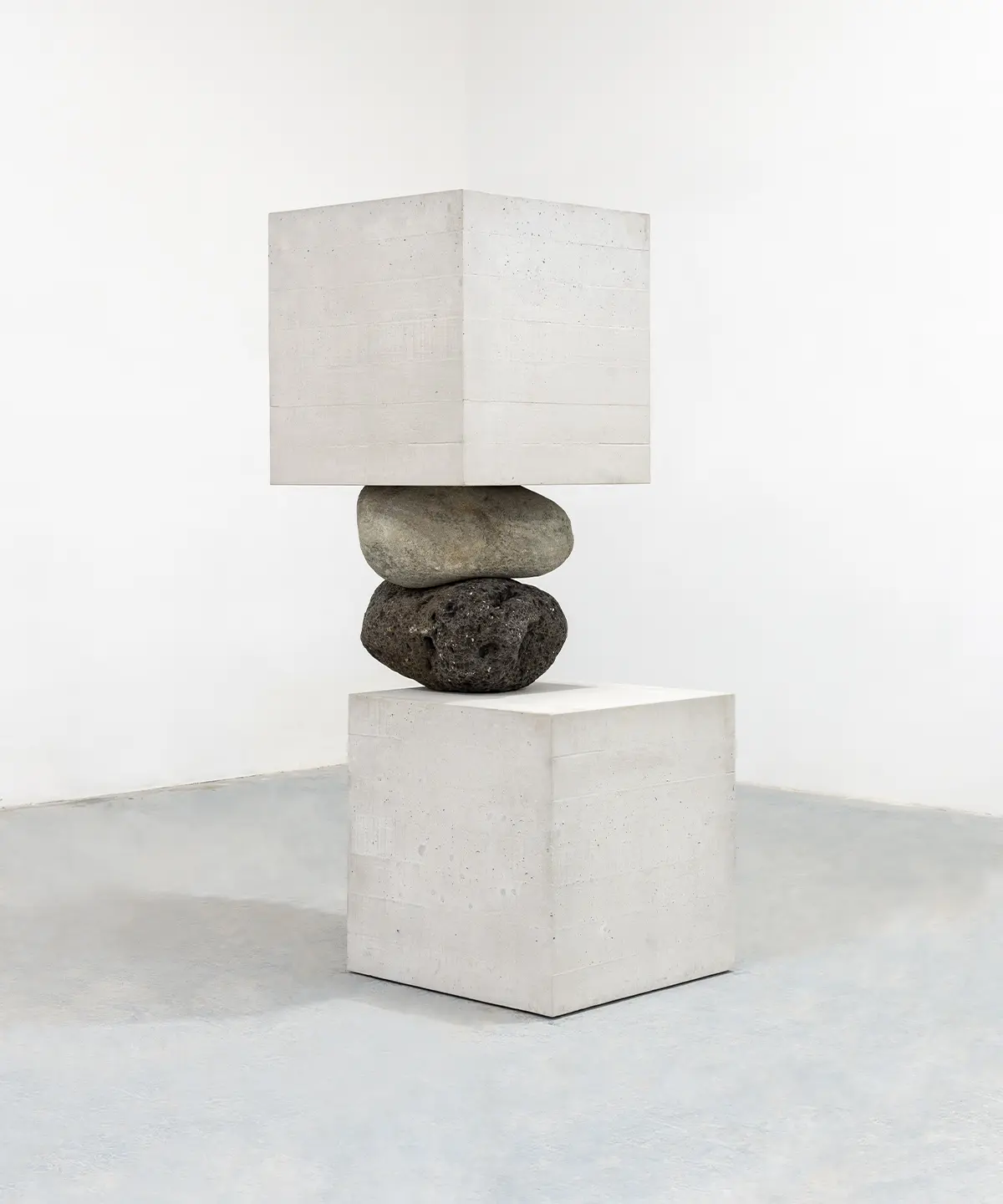
“Balance,” a recurring theme in his work, also serves as its central focus: “We’re all trying to find our point of balance,” he says after greeting a few visitors. “I’m interested in working with the fictional narrative of balance to remind us that the force of gravity is a fundamental element of the sculptural process.”
In his works, materials and structures seem to defy the laws of physics—at least in appearance—creating a sense of controlled instability. However, Dávila tempers the sense of danger.
“Rather than risk, these sculptures offer a sense of trust. You have to trust the connection between what you know and what you see. The pieces are complete; what exists is a fictional sense of precarious balance that I’m interested in exploring”— Jose Dávila
And when he mentions other concepts present in his works—such as the relationship between risk and safety—it brings us back to his background in architecture: Is his history as an architect a decisive factor in his creative processes? “Studying architecture was very important to me. It’s clear that this resonated with me in various themes I’ve brought into the world of sculpture—concerns that may seem technical, such as a certain structural balance, but which are ultimately human concerns,” he says.
2026 is shaping up to be an important year for him. In addition to working on a new series of sculptures, he will present a previously unseen work in April at a location yet to be announced.
Added to this is a large-scale sculpture commission yet to be unveiled. Despite his growing international profile, Jose Dávila is clear about the importance of looking inward. Events like Art Week in Guadalajara, he notes, have transformed the local scene: “It started as a small initiative and grew over the years. Today, the level of international exposure gives it a different weight. It’s motivating to show what this studio does to audiences from many different places. That makes all the difference.”
We let him go; he has to attend to the guests and collectors. Meanwhile, we continue to be amazed by his pieces, which defy the laws of physics and convince us that architecture and sculpture form a brilliant interlocking mechanism. “This work stems from the simple act of placing two distinct elements together, which for me is the quintessential sculptural act. Bringing two objects together and making them interact generates meaning in and of itself, ” he tells me before saying goodbye to attend to the collectors.
To keep exploring this thread, visit contemporary artists and galleries.