The Daniel Orozco Studio has close ties to contemporary Mexican design. Daniel Orozco, the founder and director of the studio that bears his name, is originally from Mexico City but has lived in Tulum, Quintana Roo, for the past ten years, where he launched his project in March 2021. Two years later, the firm expanded to the Mexican capital, where it currently has a showroom.
The work of the Daniel Orozco Studio focuses on everyday objects reinterpreted through a personal lens, and is characterized by a mix of materials and “the creation of pieces that challenge traditional forms,” as he himself explains.

Nature is his main source of inspiration, along with a strong preference for materials, shapes, and textures: “I’m inspired by the jungle, the sea, the sky, and the clouds. But also by what I see around me: a fountain in Paris, a traffic light, a building.”
About its history and its participation in ZⓈONAMACO DESIGN 2026, we spoke with him.
From interior design to product design: the creative turning point
How did Estudio Daniel Orozco get started?
We started out focusing primarily on interior design. Today, at Estudio Daniel Orozco, we draw on contemporary Mexican design to work on hotels, homes, and restaurants, while also creating our own pieces. However, in the beginning, almost all of our work centered on interior design projects.
What prompted that shift toward designing jewelry pieces?
There came a point when I felt that working solely with interior design was no longer enough for me. I needed something more tangible, so I began sketching my first collection, which took me about a year to develop and produce.

What were those early pieces like that are now part of various collections?
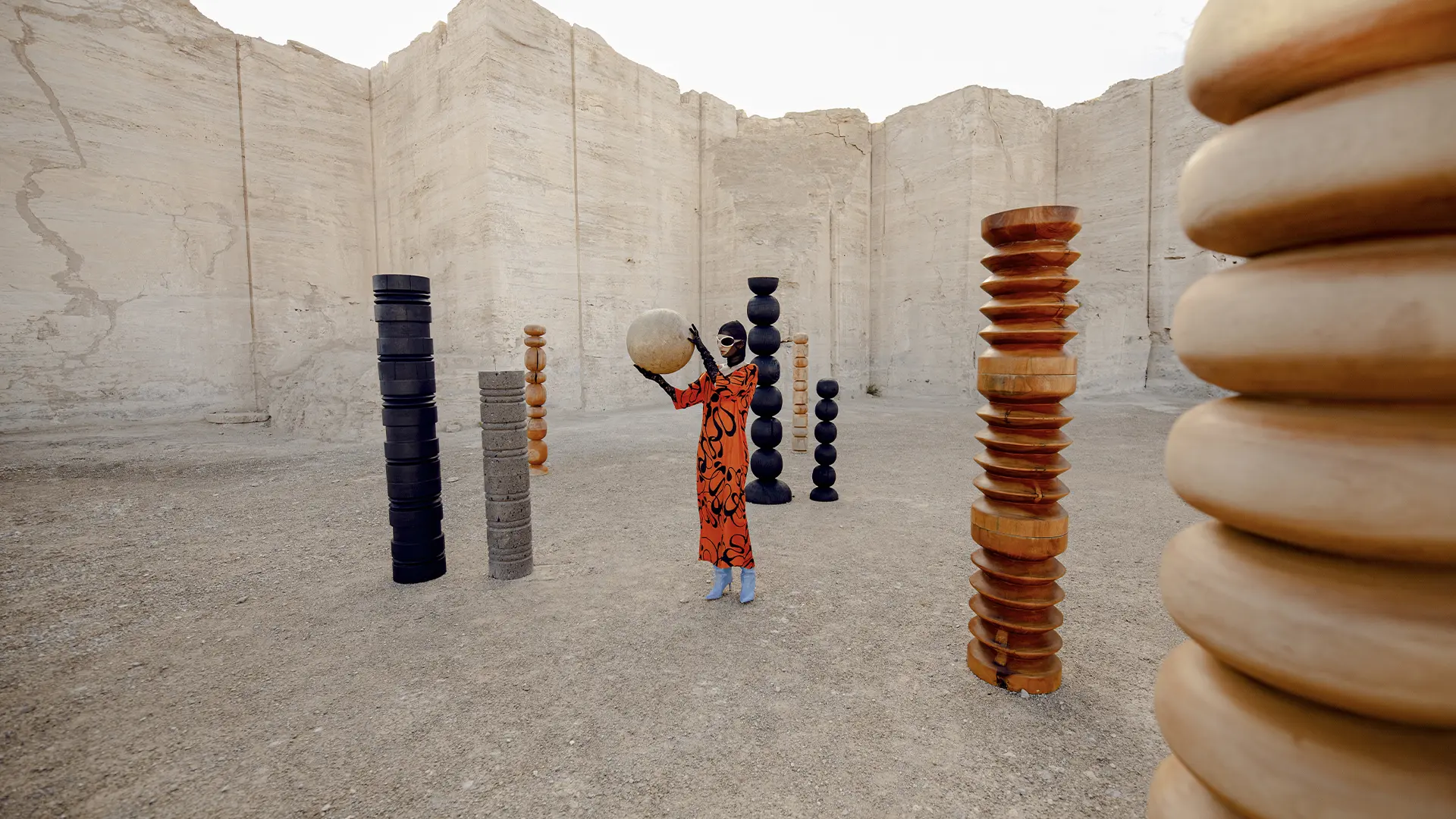
They were pieces made of solid turned wood: pendant lamps, coffee tables, and side tables. The first collection, The Original, was an experiment in doing things differently. Later, we shot a campaign at a hacienda in Mérida, Yucatán, which received significant coverage in international media.
That was when you started working with European brands, wasn’t it?
From there, we were invited to participate in events in Milan and Paris. Later came our second collection, *Forms of Stone*, in which we began combining wood with marble and stone.
The Collection The Tableware—what can you tell us about it?
It was a side project between our major collections. We used the leftover pieces of wood and stone from our sculptures and furniture to create salt and pepper shakers, ashtrays, vases, and bookends. This allowed people to take smaller pieces home from our showrooms. Our market spans from Mexico to the United States. After The Tableware, we began a collaboration with ELLE, and we are currently working on pieces for a high-rise apartment building in Miami.

When was that project announced?
We held a launch event for the collaboration in 2025 during Art Week. We then followed up with another event in Miami at Art Basel last year. We are now in the design phase for the pieces that will be produced for both the apartments and the lobby.
Your collections have caught the attention of international brands. What does this mean for Latin American design?
Daniel Orozco Studio is closely associated with contemporary Mexican design. We have a partnership with Louis Vuitton, for whom we create sculptures and furniture for various stores around the world. It’s important to recognize the talent that exists today in Latin American design; there’s a boom, and it’s a great time to showcase it.
The Rise of Latin American Design and ZⓈONAMACO DESIGN 2026
What does your participation in ZⓈONAMACO entail?
Zona Maco has been instrumental for us and serves as a great platform for Mexican and international designers. This will be the third consecutive year we’ve participated in the design section. Additionally, as part of the event, we organize an annual auction in which we invite 15 artists to reinterpret one of my pieces. All proceeds go to the Los Amigos de la Esquina Foundation, which supports Mayan children in Tulum. The 2026 auction will take place on February 3 at our showroom in Mexico City.
Everyday Objects in Contemporary Interior Design
I understand that you consider your work to be more functional art than purely decorative pieces
They are functional pieces that may be sculptural, but they never fail to serve a purpose. Our tables, for example, have a sculptural form, but they are still tables; the same goes for our lamps. That’s something we’ve always strived for as a brand: not to shy away from decorative objects, but to ensure they serve a purpose.

Do you think it’s important to champion the concept of functional art today?
These days, it’s very difficult to sell a purely decorative item. The constant challenge is to add value to interior design. When a piece manages to be both functional and artistic at the same time, it gains added value and becomes unique. This does not diminish the importance of non-functional objects, but what truly transforms a space is the presence of these objects within the environment.
“These days, it’s very difficult to sell a purely decorative item. The constant challenge is to add value to interior design. When a piece manages to be both functional and artistic at the same time, it gains added value and becomes unique. This doesn’t diminish the importance of non-functional objects, but what truly transforms a space is the presence of these objects within the environment” — Daniel Orozco
Key Projects by Estudio Daniel Orozco
To avoid making an endless list, what would you say are the studio’s most important projects?
The residential space at Villa Xata in Tulum; XIK’NAL—an interior design project in Sian Ka’an that uses local materials such as sapote, Mayan stone, and chukum—and Casa Tropical, a residential project also in Quintana Roo. They represent different stages of the studio and our approach to work.
Looking ahead to 2026, aside from ZⓈONAMACO, what other projects stand out?
A new collection is coming that will be much more art-focused. We’re still working on the name, and the launch will likely take place between summer and September.

What innovations are in store for the new collections?
We are developing new versions of our current collections, incorporating more color, electrostatic painting, and exploring new materials such as glass, aluminum, steel, and copper.
The Daniel Orozco Studio and Local Art
What is it like to work collaboratively with artisans?
I work very closely with Abraham—just Abraham—a craftsman from Yucatán with whom I’ve been collaborating for over four years. We produce the pieces together, especially when it comes to new collections, through a process of trial and error.
At first, they even welcomed me with food, until they told me we’d end up going through a lot of fabric; now I try to go at least once a week. The process is very organic: the idea goes from sketch to pattern and then to the workshop, where a constant collaboration begins—which, for me, is the best part.
How do buyers deal with the fact that no two items are alike?
We work in series, yes, but in reality no two pieces are alike. Since we use natural materials, there are always variations. That uniqueness is part of the object’s value and of our approach.
Does working with these materials present any technical challenges?
That’s right—wood is a living material and reacts differently depending on the climate. That’s why it’s essential to treat it properly and manage the shipping logistics carefully, since these are heavy and delicate pieces that are shipped to different parts of the world.
Daniel Orozco Studio: Contemporary Mexican Design and Sustainability
How do they justify using wood while also positioning themselves as a sustainable company?
We source our wood exclusively from government-certified sawmills in Quintana Roo and Yucatán. In addition, we make the most of the material: scraps from large-format pieces are reused for smaller items in our tableware collection, minimizing waste.
Have you participated in environmental initiatives?
We collaborated for a time with the Robotánica project on conservation efforts in Xochimilco. We are currently working on a reforestation project together with the Mayan community we work with.
Does that relationship with the material also mean knowing when not to use it?
Of course, we’ve stopped creating some sculptures using electrostatic paint and prefer to leave them in their natural wood finish. Covering beautiful wood with layers of paint would be a mistake; ultimately, it’s the material itself that should shine through. We believe it’s essential to understand when and how to use each material. Wood is, in a way, the tree’s second life, and hiding its color or texture makes no sense.
Does your work have symbolic significance?
Not really. I’m more interested in aesthetics, beauty, and the combination of materials. Today we have about 250 pieces in our catalog that can work well in different spaces. The important thing is that people want to live with them.
Without a doubt, through its in-depth exploration of materials and its personal connection to the craft, Estudio Daniel has developed a language all its own. Their third consecutive participation in ZⓈONAMACO confirms not only their consolidation but also their significant presence in the Mexican and international art and design world.
To keep exploring this thread, visit contemporary art from Latin America.