Alejandro Almanza admits it : he’s right in the middle of a difficult stage in an artist’s life— the “mid-career” phase. He seems excited, and that pressure—which is, in theory, inevitable—isn’t apparent.
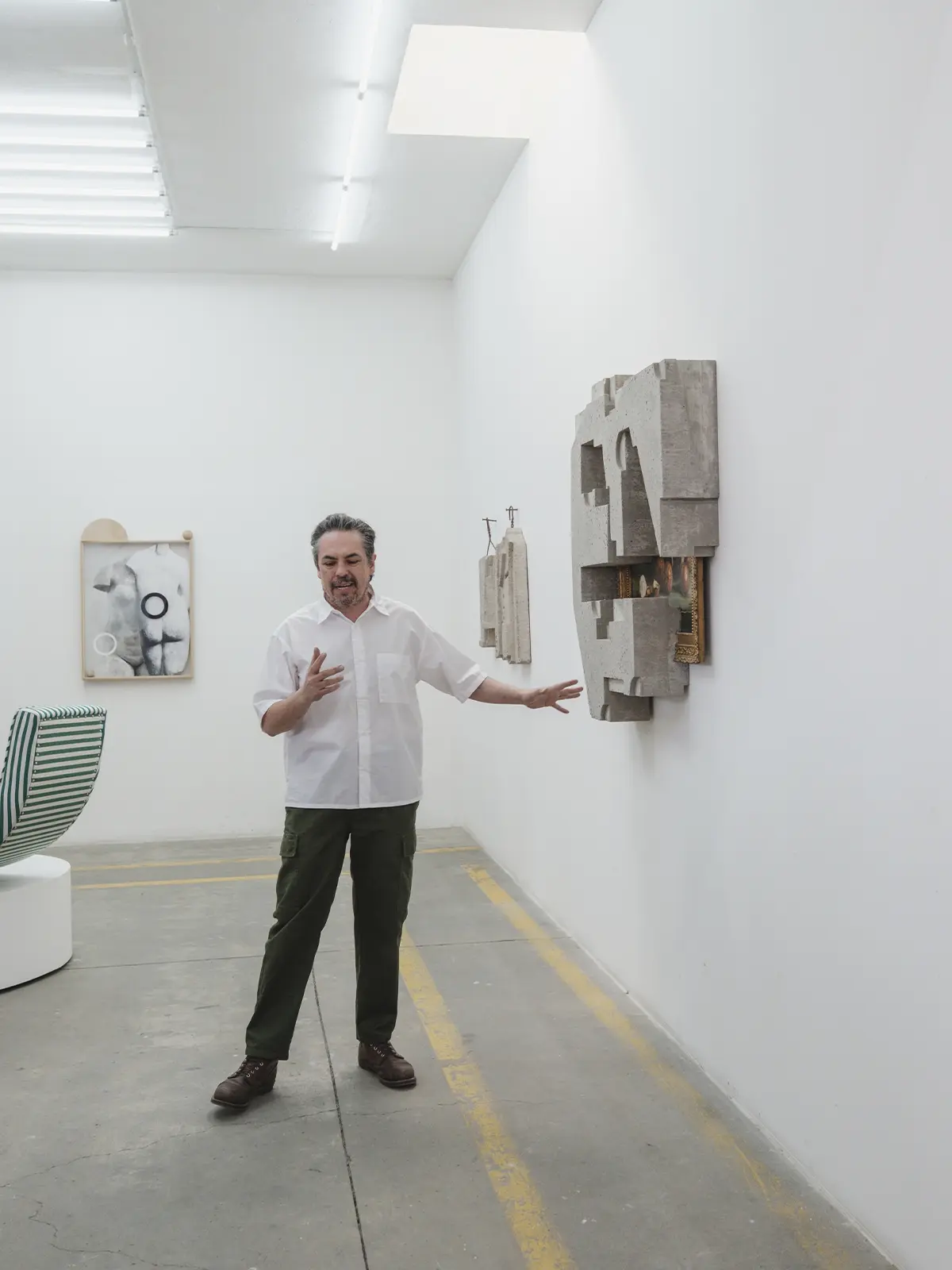
As he walks through the gallery where he exhibited during the recent Art Week in Guadalajara, he greets visitors and passionately explains every detail of his work. We spoke with him at the end of the day, when the flow of visitors had subsided.

A few hours later, back in the studio, the mood is completely different. Without the hustle and bustle or the cameras, the atmosphere has changed. Even the artworks look different in the silence. Alejandro opens a beer while going over some papers with names and details.
“I think the world is going through an interesting phase where emerging artists are being recognized, but it’s tough for creators of my generation: our work is worth more, yet there’s less investment,” he tells me. That said, he acknowledges: “Yes, I’m privileged; I make a living from art, and my wife—the artist Reiko Hamano— and I have a very nice studio. Honestly, it’s a privilege to be able to work in this field.”

He lived and spent part of his career in the United States, until eventually Mexico called him back. “When you realize that the city is bigger than you, that it absorbs you socially and economically, and that there’s no room left, you decide to return. Here, you can do things that go beyond the rules of developed countries.”
Mexico vs. the Rest of the World: Freedom and Rules
“Ask an American architect: many are interested in working in Mexico because we’re more daring. The rules there are very strict—and I’m not saying we’re irresponsible—but here we can push the boundaries. Being Mexican is a huge asset in the world.”
Almanza hits a nerve with the precision of an Olympic archer: people often believe that there is a certain degree of artistic repression in Mexico, or that Europe or the United States are more disruptive. But that’s not the case: it can be done here, too—and very well at that.

“Of course, society or your surroundings can sometimes hold you back, but that’s why it’s so important for an artist to travel and get out there. It opens up new possibilities and lets you see how people think beyond your own country. It’s been very helpful for me,” he says.
“I like Mexican ingenuity, that ‘black work’ mentality: if something is falling apart, we tie a wire around it and fix it. But you’re just patching it up for today, not for the future; tomorrow it’s going to fall apart again. It’s important to think about that, too.”
Materials, Risk, and Perception
His relationship with materials is central to his work. As a sculptor and visual artist, Almanza has developed an intimate connection with objects.“I use forces; I use gravity. So you have to know: how much this weighs, how strong it is, how much it can hold,” he explains. “If I put this can of beer near the table, there’s no danger. But if I put a Baccarat glass there, everything changes.”
For Almanza, material value alters the perception of risk and, with it, the interpretation of each piece. That tension runs through his work: he seeks to provoke, but does not reveal his intentions directly. “It’s hard to recognize,” he admits, before offering a comparison : “Why do you go to the bullfights? Because you want to see danger. In the end, you want to see something happen.”
That flirtation with danger may stem from the time he spent in Ciudad Juárez, Chihuahua. “It was the most dangerous city in Latin America at the time,” he recalls.“Crossing the city meant staying on high alert: walking, going to college, moving about with a constant sense of risk. I became interested in the perception of danger across countries, societies, and cultures,” he explains. The comparison was inevitable: while in a welding shop everything requires strict safety protocols, in Juárez he could see a blacksmith working with a beer bottle as a protective visor. “That really struck me,” he says.
““The greatest thrill lies in danger, in what’s on the verge of failing. That’s always interested me”— Alejandro Almanza
Since then, the relationship between risk, danger, and safety has not only been a constant presence in his work; it has become one of its fundamental themes.
But… what if their toys came with safety instructions? Almanza ponders this as he takes another sip of his drink: “It’s interesting, because our perception of danger changes with age,” he says. In childhood, he explains, it’s practically nonexistent. In adolescence, however, it turns into an impulse: a constant search for risk.
His own work has not been immune to the changes brought on by age; after all, we are now in the mid-career chapter of his life as an artist: “When I was much younger, my pieces were really dangerous. I didn’t care about the risk,” he admits. Over time, his approach has become more sophisticated. “But it’s not about eliminating the danger,” he cautions, “but about controlling it without compromising the experience.”
Manage risk without eliminating it
In works such as his concrete blocks supported by spotlights, that logic becomes tangible: “I could add foam or some internal reinforcement, but that’s not the point,” he says. What matters is that the viewer senses the risk, even if it is carefully contained.
Among the pieces in the exhibition around us, there is one called Horror vacui that would send my high school art teacher at the Classical Guard Academy into a fit of outrage if he saw it. The painting has been completely covered with blocks of cement. “And it’s good that you see it. As a sculptor, I’m incredibly envious of painters,” he tells me in response to my observation. “I think painters are very privileged to be able to create amazing things with so little material, with so little space,” he concludes.

Alejandro Almanza Pereda (Mexico City, 1977) is a multidisciplinary artist who works across sculpture, photography, video, and installation, exploring the emotional bonds we form with objects. His works, often on the verge of collapse, create tension in both the physical and emotional realms, questioning our perception of risk, value, and balance.
She has exhibited at venues such as the Museo Experimental El Eco, the San Francisco Art Institute, the Magnolia Foundation in London, and Art in General in New York, and her work is included in collections such as the ASU Art Museum, KADIST, the Jumex Collection, and the Lima Art Museum. She has also received support from the Harpo Foundation and the Cisneros Fontanals Foundation, and participates in the musical project La Rubia te Besa.
For information about his upcoming exhibitions and current activities, visit https://www.alejandroalmanzapereda.com/
And for more interviews on contemporary art, check out AW Magazine
To keep exploring this thread, visit contemporary artists and galleries.