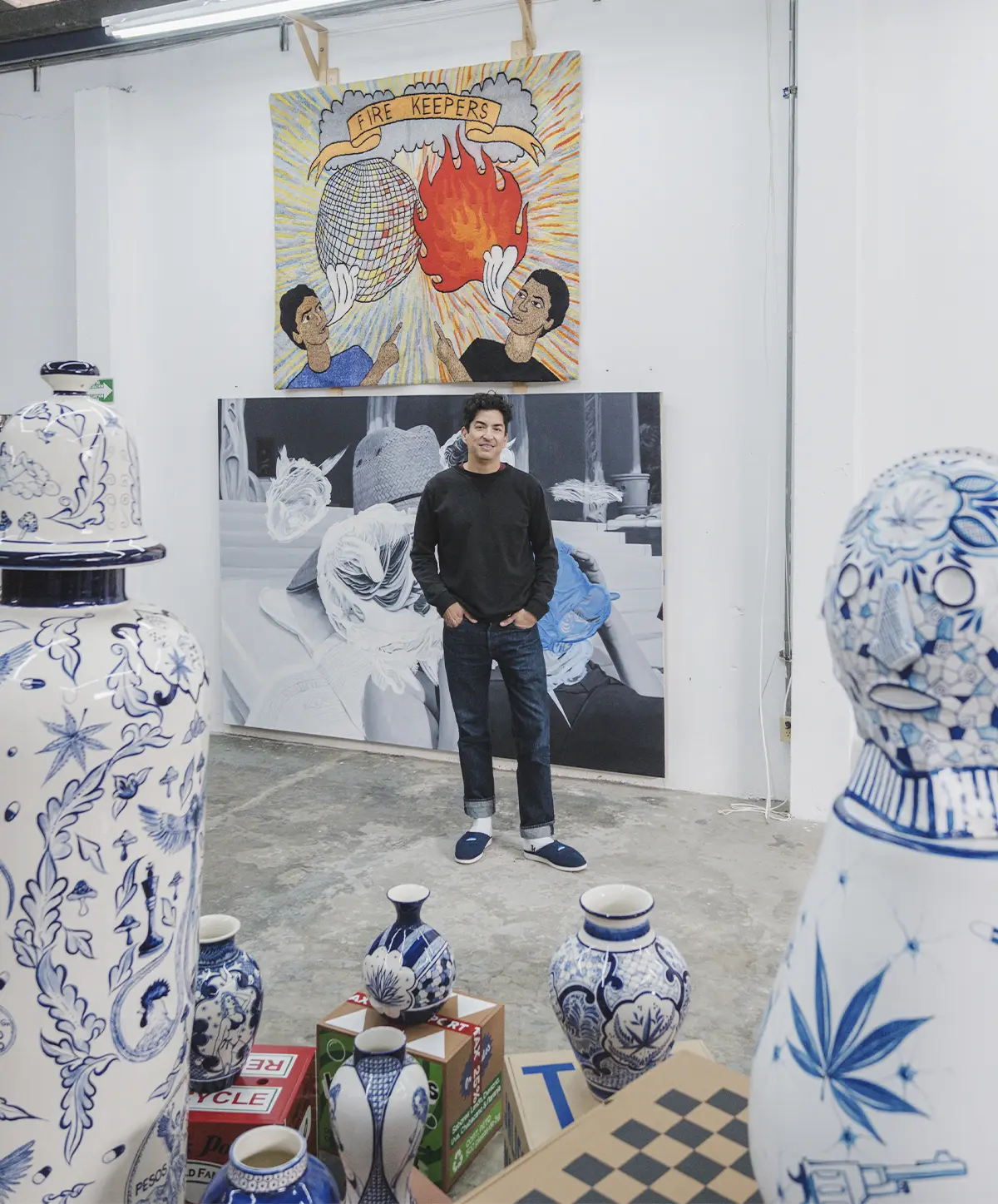

“I’m living proof that art can save you,” Eduardo tells me right off the bat. We’re in his studio in Guadalajara, and he’s just had some visitors as part of the city’s Art Week: “So many of my friends from where I grew up didn’t make it. They got involved in gangs, drugs, all sorts of things. I really do see that art helped me, supported me, and saved me from other paths—from many other paths,” he says.

Eduardo was born in Los Angeles in 1976 and grew up between the Californian metropolis—specifically the Boyle Heights neighborhood—and his parents’ hometown in Mexico: Mazatlán, Sinaloa.
From a young age, he had an affinity for and curiosity about art, which allowed him to develop a talent—and a life—beyond his immediate surroundings. “In Los Angeles, the music I grew up with was rap that told stories. There was the socio-political reality of what was being said and what you thought you wanted: gold, chains, luxury cars, women, selling drugs… it was part of a culture and a gateway to a lifestyle that felt attainable back then,” he recalls.
“And from there I would travel to visit my family in Sinaloa, in Mazatlán, where my cousins listened to corridos: two completely different styles, but ultimately they were about the same thing—the fast life, cars, mansions, selling drugs. It was a connection between two cultures sharing the same sentiment, albeit with different nuances.”
“They’d tell me, ‘Turn this off already; I don’t know what they’re talking about, but just turn it off.’ But in Mexico, everyone listened to corridos—from adults and the elderly to young people. And they can be more aggressive than gangsta rap, right? They say things that are more direct, more raw. I think corridos were based more on real stories, while gangsta rap was more made up, more fantasy: like, ‘I killed this guy,’ or ‘I don’t know what.’ So, between fantasy and reality, I started to grasp those differences that really left a mark on me. That’s when I made that connection, and from there the narrative, the stories, started to come out.

And from that convergence—that meeting of Los Angeles and Sinaloa—certain distinctive elements emerged: “I believe that ceramics are the hallmark of that. And as I evolved, the stories and vases began to tell more relevant stories focused on current events: issues of migration, how goods move between the United States and Mexico. These reflections appear in boxes, products, and in the vase as a container—almost like contraband—between the two countries.”
“These are global issues. The media and politicians in the United States often focus on the border and what’s happening here, but in reality, these are issues that occur all over the world. There’s a very natural, very genuine connection to the sociopolitical landscape and to the way people perceive work.”
For Eduardo Sarabia, the narrative that emerges from music is part of the roadmap he follows to bring his art to fruition. We visited his studio during the recent Art Week in Guadalajara, and the reception couldn’t have been better: rugs, cushions, a DJ, and a talk about his work. “My work has that historical aspect. Vases tell stories; they can be fragments or complete narratives. “When I’m painting, I almost always listen to music. I wake up and want to listen to jazz, classical music, or hip hop,” he tells me.

“Guadalajara has been key to my ability to work. Having a studio, support, and access to materials has been incredible. Culture, of course, ends up inspiring me, but the stories—my family—come from Mazatlán: the sea, the myths, the food, the music… it’s something truly rich. I usually like to open up the studio. It’s a really cool way to welcome visitors, work on the projects I’m doing, and make connections.”
Sarabia highlights a key element in his work: narrative. In his work, he doesn’t just seek to provoke, but to tell stories from the ground up. At a very young age, in the midst of the Cold War, he studied in Los Angeles and Mazatlán and also traveled to Russia. “I realized that those stories really had an impact on people,” he acknowledges. “I would go to museums and see masterpieces, but I didn’t know how to connect with them. These people didn’t look like me; I didn’t see scenes I was used to; that’s why I decided to recreate people who looked like me. I think it’s key to look within yourself and at what’s around you, and not look elsewhere.”
He recalls his time in the Soviet Union as a defining experience. He was 13 years old, and yes, he remembers it as a bleak period. They were at a camp on the outskirts of Leningrad, where they worked on a mural alongside Soviet children who would later travel throughout Europe. It was the end of the Cold War, and the atmosphere felt somewhat strange: the camp was next to a military base, and everything was strictly controlled. “We were kids from the United States; it was kind of a diplomatic thing,” he says.
However, that experience also revealed another side of the country. They visited museums and impressive palaces, and had access to places that weren’t necessarily open to the general public. That contrast—between the rigidity of the context and the cultural richness—left a lasting impression on him. He would have liked to see more, move about freely, ride the subway, and observe daily life, but the trip was carefully controlled.

“That trip changed my life,” he recalls. When he returned, he knew exactly what he wanted to do: if he could travel and see the world through art, he wanted to be an artist. His parents supported him, though not without some reservations: “Hey, you’d better study architecture—you’re going to starve to death.” But he had already made up his mind.
Over time, that fascination with architecture also found an echo. Later on, he had the opportunity to travel to Moscow, where he was once again confronted with that monumental scale and architectural language that had so impressed him as a young man. The artist has always insisted that his work reflect a genuine identity:
“In the end, I am the filter; everything passes through me, and what makes an impression on me remains in fragments. Suddenly, these translations begin to emerge in a more global context, yet with a strong sense of my culture and of what I know »—Eduardo Sarabia.
He draws on both the concept and the materials to shape his work: “Much of what Mexico has to offer me today—access to different materials, the crafts I love, the production of alcoholic beverages, ceramics, and natural-fiber textiles—I find incredibly interesting. I incorporate it, and it becomes a more open language for telling different stories.”
The ceramics, on the other hand, are a project she’s been working on for years. “I always think I’m making fewer and fewer of them, but they’ve served as a kind of sketchbook: I use them to draw how I feel, my ideas, my concepts, what I read in the news, politics. It never stops. I like to sketch them out and save them as if they were a diary.”

Last year, he launched a rug collaboration with a project called Mugal, which is produced in India, to showcase them in a different way. “I thought it would be interesting to create a listening room. The rugs, beyond simply being on display, serve a specific purpose: they absorb sound very well. He is now focused on a commission in Napa, at a vineyard called Bella Union in California, where he will create an installation and a series of pieces throughout 2026.
But for now, what concerns him most is the music: what will be played during his performance; a vintage Kraftwerk vinyl record tops the list. “I was able to bring in a hi-fi system to play records and create these sessions where people can come, put on some music, and listen. The idea was to create a space within the studio, almost like a secret room, to welcome people, chat, and tell stories. An intimate, almost secret space,” he concludes.
To keep exploring this thread, visit contemporary art from Latin America.