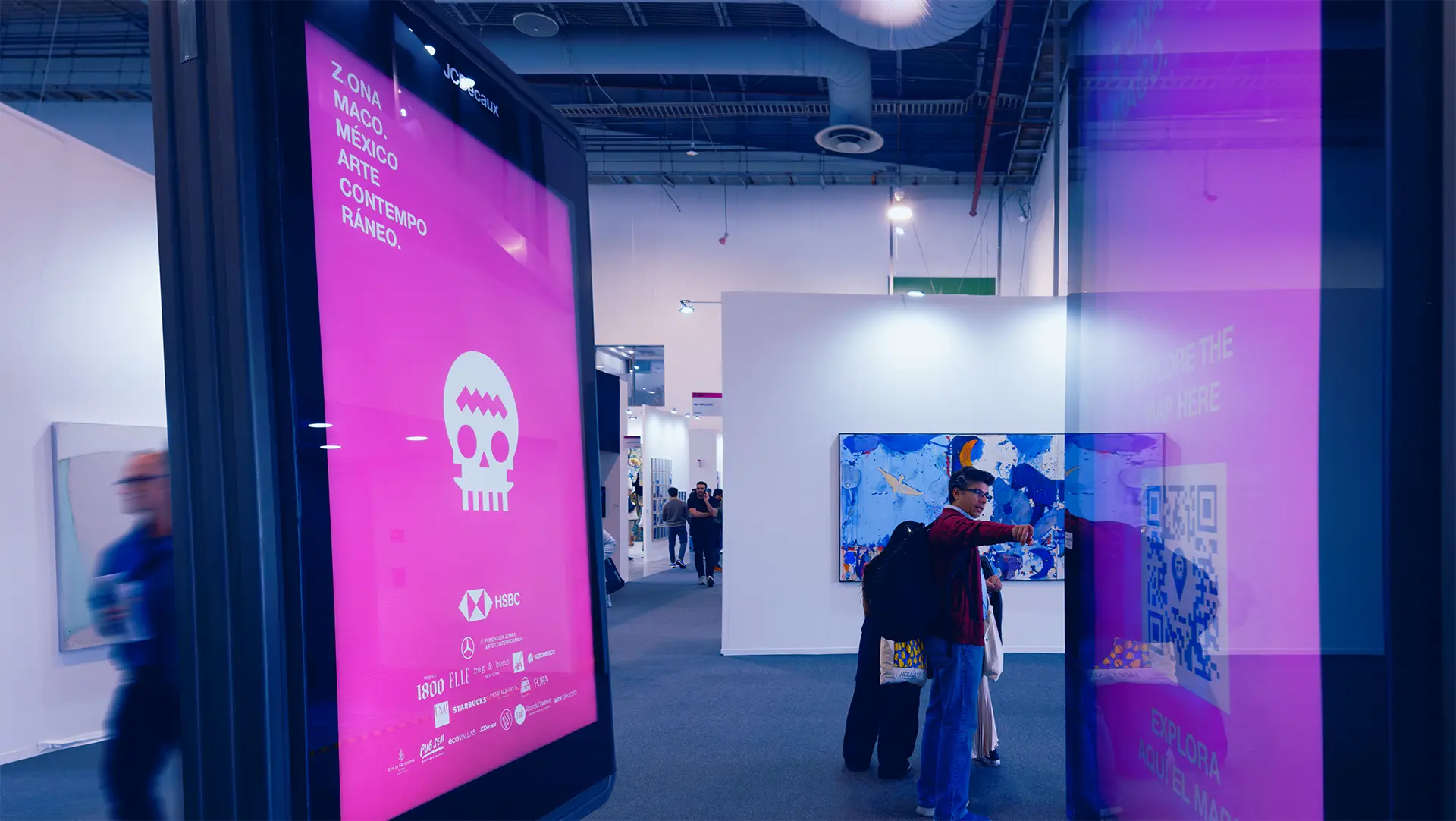

Hace tiempo que dejó de ser una simple una feria: hoy por hoy, se mantiene como el termómetro del poder cultural en América Latina. La 22ª edición de Zona Maco o ZⓈONAMACO 2026 Del 4 al 8 de febrero, el Centro Citibanamex de la CDMX volvió a convertirse en la capital del arte no solo en México, sino también brilló como el punto de encuentro más grande del arte en Latinoamérica.
Zona Maco 2026: mercado, presencia internacional y escena local
En un momento de creciente proyección internacional para el arte latinoamericano, la feria reunió a 228 galerías de 26 países y, según los organizadores, convocó a más de 82,000 asistentes entre coleccionistas, curadores, artistas, instituciones y público especializado que sabe que febrero es el mes más importante para el arte en la capital mexicana.

Con los años —a más de dos décadas desde su fundación— Zona Maco ha ido ampliando su alcance y, en ese proceso, ha desarrollado una especie de doble identidad. Por un lado, se trata de un evento cada vez más internacional; por el otro, sigue cumpliendo con claridad su meta original: ser la poderosa vitrina latinoamericana de las galerías que han marcado la escena de la Ciudad de México y de distintas ciudades del interior del país, así como de capitales latinas como Bogotá, Santiago de Chile y Buenos Aires.
Las galerías que conforman el círculo mexicano del arte regresan edición tras edición y vuelven a ocupar ese lugar central que suelen reclamar. Por ejemplo, la galería Travesía Cuatro, galería con presencia en Madrid, CDMX y Guadalajara, Jalisco, que presentó obras como Alien Queen (2019) de Manuela Solano; Exarchia (2024) de Mateo López; y Opal (2025) de Willa Wasserman, entre otras.

Proyectos Monclova presentó obras de varios de los artistas más reconocidos de su programa, como Yoshua Okón y Alejandra Venegas, mientras tendía un puente entre generaciones al incluir piezas geométricas en lana de Eduardo Terrazas y esculturas de su artista más joven, Josué Mejía.
Las galerías clave del circuito mexicano en Zona Maco 2026
Por su lado, la muy representativa kurimanzutto apostó por nombres como el del ex baterista original del grupo Fobia Gabriel Kuri, además de Abraham Cruz villegas y Minerva Cuevas, junto a la instalación de Carlos Amorales. OMR, otro nombre local de tradición, mostró desde gráficas de Jose Dávila hasta piezas de Gabriel Rico, reafirmando su lugar en el mapa actual.

Además, la creciente presencia de galerías internacionales mantuvo el pulso de diversidad y modernidad de la feria. Cerca de la mitad de los expositores en la sección contemporánea provienen de fuera de México.
Entre las propuestas destacadas, Pace Gallery participó con una cuidada selección de arte moderno y contemporáneo, que incluyó obras de Elmgreen & Dragset, Yto Barrada, Nigel Cooke y William Monk.
Las cifras de Zona Maco 2026
El ambiente, tanto en la zona VIP como en el área general, fue el habitual: carritos con bebidas circulando en los pasillos, conversaciones cruzadas en varios idiomas, ventas cerrándose, galeristas ocupados, moda y obras de distintos estilos para satisfacer a casi cualquier esteta y nuevo coleccionista.

Más allá de las cifras y las anécdotas logísticas, la edición 2026 confirmó algo que ya es parte de su ADN: Zona Maco funciona como termómetro del mercado, escaparate de poder local y plataforma internacional al mismo tiempo. Y como cada año, volvió a ser el eje de Art Week CDMX, detonando inauguraciones, exposiciones, intervenciones y fiestas en toda la ciudad, como Material, a la que también asistimos puntualmente.
El programa público —charlas, conversatorios y encuentros profesionales— amplió la experiencia. Quienes no llevaron su auto y lograron esquivar a los taxistas a la salida del recinto, conseguir un Uber o hacer que su chofer sorteara el tráfico de la capital mexicana, también vivieron un momento importante como fans, coleccionistas o curiosos del arte.
Las principales galerías que se presentaron en Zona Maco 2026
La edición reunió a una sólida selección de galerías internacionales en su Main Section, consolidando a la feria como un punto de encuentro clave entre América Latina, Europa, Asia y Estados Unidos.
Zona Maco 2026 y las galerías mexicanas y foráneas
Participaron espacios como Saenger Galería (CDMX), SGR Galería (Bogotá), Carl Kostyál (Londres / Estocolmo / Hong Kong), Madison Gallery (Solana Beach) y Mariane Ibrahim (Chicago / París / CDMX), junto a nombres fundamentales del circuito como Pace Gallery (Nueva York / Londres / Seúl / Ginebra / Hong Kong / Los Ángeles / Tokio / Berlín), Sean Kelly (Nueva York / Los Ángeles), Continua (San Gimignano / Pekín / Les Moulins / La Habana / São Paulo / París) y Galerie Nordenhake (Estocolmo / Berlín / CDMX).
La presencia mexicana fue especialmente notable con galerías como OMR, Labor, Arróniz, Galería Enrique Guerrero, Galería de Arte Mexicano (GAM), Galería Karen Huber y Galería Mascota, entre otras, dialogando con espacios de ciudades como Madrid, París, Londres, Berlín, Bogotá, Buenos Aires, Lima y Kioto.

Además, participaron galerías como Terreno Baldío Arte (CDMX), Galería Sorondo (Barcelona), Yusto / Giner (Madrid / Marbella), Arma Gallery (Madrid), Galería Artizar (Tenerife / Madrid), Galería Lume (São Paulo), Palo Gallery (Nueva York), Zielinsky (Barcelona / São Paulo) y Patricia Ready (Santiago de Chile), entre otras, reafirmando el interés por prácticas experimentales y narrativas críticas.
Zona Maco Arte Moderno
Por su parte, ZⓈONAMACO ARTE MODERNO integró galerías como Art of the World Gallery (Houston), Galería El Museo (Bogotá), Mark Hachem (París), Louis Stern Fine Arts (Los Ángeles), Durban Segnini (Miami) y Pablo Goebel Fine Arts (CDMX), además de espacios históricos de la escena mexicana como Galería de Arte Mexicano y Galería Enrique Guerrero.
La sección ZⓈONAMACO EJES reunió proyectos contemporáneos como Galería Ana Tejeda (CDMX), The Empty Circle (Nueva York), Herlitzka & Co. (Buenos Aires), Asya Geisberg Gallery (Nueva York), Galería Dix9 (París), Murmurs (Los Ángeles), YOD Gallery (Osaka / Kyoto / Tokio) y Henrique Faria (Nueva York), apostando por plataformas jóvenes y diálogos interregionales.

En ZⓈONAMACO FORMA destacaron propuestas vinculadas al diseño y la exploración material, como ADN Galería (CDMX / Mérida), Carpenters Workshop Gallery (Nueva York), Collectio (Santiago de Chile) y Rademakers Gallery (Ámsterdam).
ZⓈONAMACO DISEÑO reunió tanto estudios consolidados como instituciones académicas y proyectos independientes, entre ellos Studio Orfeo Quagliata, Breuer, Iker Ortiz, Odabashian, Carla Fernández – Casa de Moda, Centro Roberto Garza Sada (UDEM), Tec de Monterrey, Centro, Taller de la Tierra y Baron & Vicario, principalmente desde Ciudad de México, aunque con participación nacional e internacional.

En el circuito de galerías que aprovecharon la concentración de coleccionistas y visitantes internacionales durante la semana, destacó Galería Duque Arango con la propuesta Maestros y Nuevas Voces Latinoamericanas, una selección que articuló un diálogo interesante entre figuras reconocidas como Rufino Tamayo, Fernando Botero y Wifredo Lam, y nuevas generaciones representadas por artistas como Alejandra Aristizábal.
Zona emergente y Salón del Anticuario, dos categorías destacadas de Zona Maco 2026
La sección EMERGENTE presentó una amplia constelación de diseñadores y estudios jóvenes provenientes principalmente de Ciudad de México, Guadalajara, Puebla, Mérida y otras ciudades del país, consolidando una plataforma para nuevas generaciones.
Finalmente, ZⓈONAMACO SALÓN DEL ANTICUARIO contó con galerías como Daniel Liebsohn, Rodrigo Rivero Lake, Muzeion Gallery y Tom Swope Gallery, mientras que ZⓈONAMACO FOTO reunió espacios especializados como Momentum (Miami), Blanca Berlín (Madrid), Iconic Images Gallery (Londres), PDX Contemporary Art (Portland), Saenger Galería (CDMX) y Wizard Gallery (Milán), ampliando el espectro hacia la fotografía histórica y contemporánea.

Las “otras” ferías durante la Semana del Arte y la importancia de Zona Maco
Además de ZⓈONAMACO 2026, durante la primera semana de febrero en Ciudad de México —en el marco de la ya consolidada Semana del Arte— se llevaron a cabo diversas ferias que ampliaron y diversificaron el panorama artístico citadino. Entre las más relevantes destacó Feria Material, reconocida por su enfoque en galerías contemporáneas con una curaduría más arriesgada y experimental, privilegiando discursos críticos y propuestas frescas frente al modelo más institucional.
En paralelo, Salón ACME reafirmó su papel como una plataforma importante para el talento emergente. En una línea distinta, BADA México (Feria de Arte Directo de Artista) apostó por un modelo de venta directa artista–público, sin intermediación de galerías, acercando el coleccionismo a un público más amplio. Feria Territorio, realizada en Espacio CDMX, reunió propuestas de diseño, fotografía y arte-objeto, además de Material, que llevó a cabo su edición número 12.
En conjunto, estas propuestas consolidaron febrero como el momento más dinámico del año para el ecosistema artístico de la ciudad, generando una agenda en movimiento que activó galerías, estudios, , espacios independientes y encuentros sociales en múltiples puntos de la capital.
Zona Maco: Marcando pauta una vez más la Semana del Arte en México

Asimismo, la edición contó con la participación de galerías internacionales y latinoamericanas como SGR Galería (Bogotá), Livia Benavides (Lima), Alzueta Gallery (Barcelona), Cadogan Gallery (Londres / Milán), Ehrhardt Flórez (Madrid), Fernando Pradilla (Madrid),Galería La Caja Negra (Madrid), La Cometa (Bogotá), Zilberman (Estambul / Berlín), Arróniz, Galería Curro (Guadalajara), OMR, Albarrán Bourdais (Madrid) y Galería Mascota, entre otras. La lista completa, la puedes consultar aquí.
Sin embargo, más allá de esta diversidad y efervescencia, ZⓈONAMACO continúa siendo el eje indiscutible de la Semana del Arte en Ciudad de México. Es la feria más grande, la más institucionalizada y la que se desarrolla con mayor solidez organizativa, funcionando como el evento principal alrededor del cual orbitan las demás iniciativas —incluso aquellas que ya comienzan a adquirir un peso propio dentro del calendario cultural.
Este año, ZⓈONAMACO demostró estar más viva que nunca en términos comerciales: la alta concentración de visitantes confirmó que el entusiasmo por el arte permanece activo y que el mercado mantiene su dinamismo.
Zona Maco 2026: su convocatoria y su peso simbólico
Durante esos días, la ciudad parece girar en torno a la feria: inauguraciones de galerías, fiestas, recorridos de estudio y activaciones especiales se articulan estratégicamente para coincidir con la llegada de coleccionistas y profesionales provenientes de América Latina, Estados Unidos y Europa. Digno de reconocerse fue el enfoque en temas globales en gran parte de la curaduría, y las pláticas de los artistas ante un público que respondió con asistencia en los foros llevados a cabo.
Aunque persisten ciertas críticas —como la sensación de previsibilidad en algunas de sus propuestas y la ausencia reciente de gestos verdaderamente disruptivos—, su consolidación, capacidad de convocatoria y peso simbólico dentro del panorama artístico siguen siendo incuestionables.
To keep exploring this thread, visit contemporary artists and galleries; you can also continue through the art fair and biennial calendar.


