
You walk through the streets of Mexico City. Yes, you’re wearing sunglasses, but even so, the colors and designs on the billboards dazzle you. It’s impossible to avoid them. Finally, you surrender—resigned—to the sensory overload and the garishness.

After all, Estridentismo was a fundamentally urban avant-garde movement that celebrated the modernity of large cities, and its early manifestos and graphic works were widely disseminated in public spaces.
Just like posters—which are both reviled and celebrated—these colorful, baroque advertisements are part of the historical memory of city life.
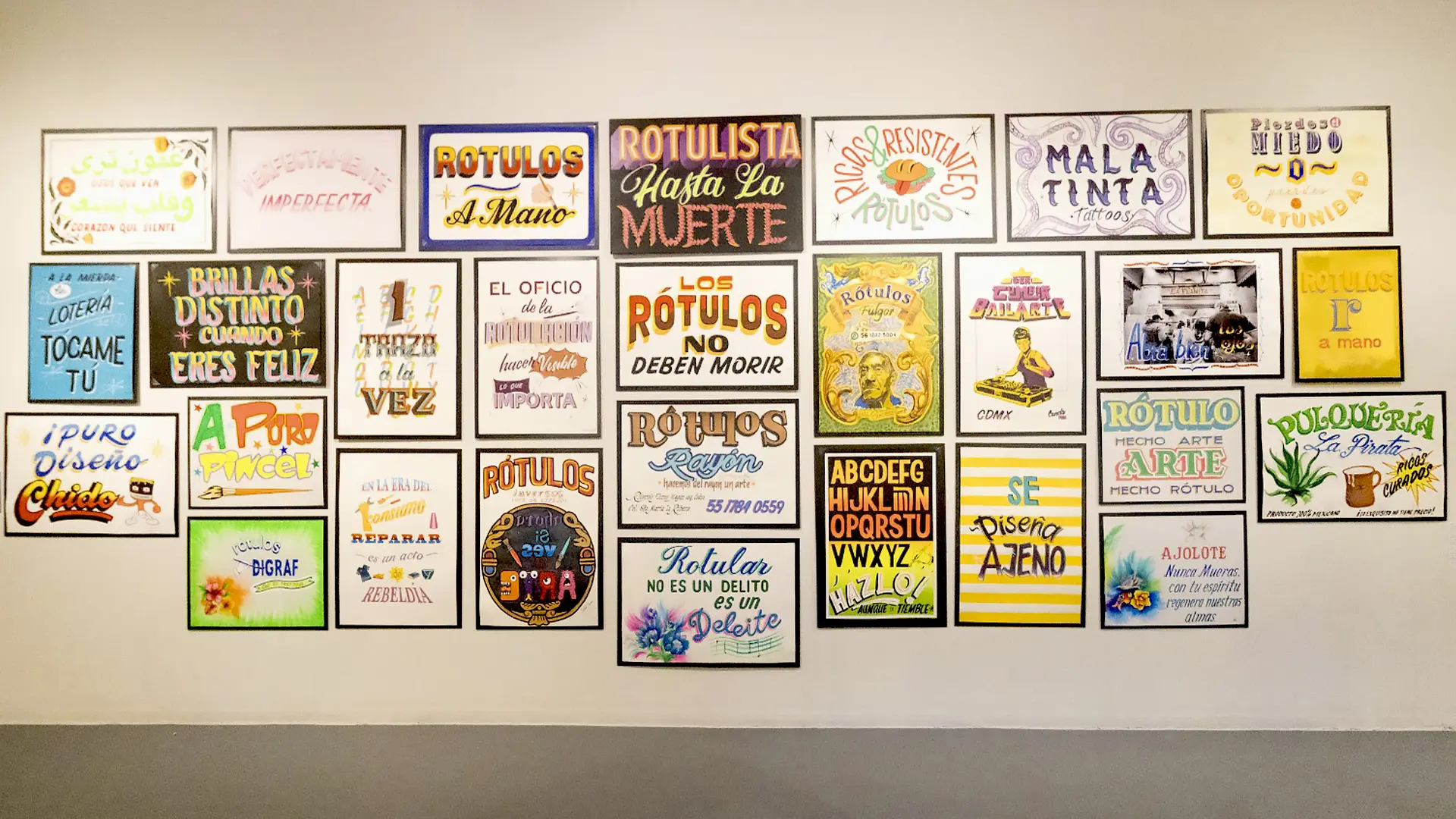
Today, rescued from the streets, building facades, and sidewalk stalls, and brought into the galleries of the José María Velasco Gallery, they take center stage in the exhibition *Signs Must Not Die*.
Signmaking as a craft, a language, and urban memory
The temporary exhibition at the José María Velasco Gallery in Mexico City—which opened last December and runs through April 6, 2026—brings together approximately one hundred works that explore signage as a craft, a visual language, and a form of urban memory in Mexico.
Signs Must Not Die pays a historical tribute to this urban language through a journey through urban graphics from the early 20th century to contemporary production.
The exhibition features photographs by Paulina Lavista, Yolanda Andrade, Tina Modotti, and other photographers and photojournalists who documented much of Mexico City’s billboards.
Signs Must Not Die: The Artists
Other photographers documenting the works on display include Graciela Iturbide, the Mayo Brothers, Nacho López, and Mariana Yampolsky. The exhibition features sign painting created using techniques ranging from brushwork to spray paint and airbrushing.
The exhibition is divided into five sections: Pulque, Photography, The Tepito Neighborhood, Signs in Tepito, and The New Sign Makers.
“Signs Must Not Die ” leaves no one indifferent. Critics of this kitsch aesthetic—which strays from both academic and experimental norms and is closer to popular culture—will see the exhibition as simply an extension of what can be seen on the streets of Mexico City.
“Signs aren’t usually photographed. These images from the 1930s capture the graphic design and typography so characteristic of that era. There are photographs of the Tepito neighborhood, of some movie theaters, of markets, and of all these spaces where signs are commonly found, such as pulquerías, which were the first places to open their doors to signs and advertising,” said Quetzalcóatl Molina, curator of the exhibition, who also designated the sign as Intangible Cultural Heritage of Mexico City.

For his part, León Cornejo, director of the José María Velasco Museum, said that the exhibition “reminds us of the vitality of artistic practices that engage deeply with identity, emotional memory, and public space.”
Popular aesthetics versus institutional visual order
At the end of the day, the motivations of the impromptu artists who create these advertisements are, for the most part, informative and decorative, aimed at fulfilling the practical function of catching the attention of diners and passersby, who become the unwitting audience of urban museums that never intended to be such.
On the other hand, there are those who champion urban graphic identity. These are artist collectives that believe signage constitutes a unique form of artistic expression that should be preserved.
Even cultural rights organizations and the Mexico City Human Rights Commission itself have issued recommendations calling for respect for these local cultural expressions.

For decades, hand-painted signs have been an integral part of Mexico City’s streetscape. However, in 2022, Sandra Cuevas, then mayor of the Cuauhtémoc district, ordered the removal of the colorful signs from street stalls, replacing them with uniform white paint and an institutional logo.
In response to the resulting protests, in 2024 the new administration led by Alessandra Rojo de la Vega reversed the decision, and the signs returned to public spaces, reviving a kitsch aesthetic that had been criticized for its alleged contribution to the visual clutter of the capital’s urban landscape.
The Importance of Signs: They Must Not Die Out in the Art World
With *Los rótulos no deben morir* (*Signs Must Not Die*), the institutional art world acknowledges the importance, within popular culture, of the posters and advertisements that fill the city. This, beyond hipster appropriations or reactionary denigration, reflects a reality that cannot be ignored.

Upon leaving the José María Velasco Gallery, the dark glasses no longer shield against the glare—or perhaps it no longer matters. Back on the street, the colors, the imperfect typography, and the exaggerated drawings cease to be mere noise and become a living memory. Perhaps oversaturation wasn’t the problem, but rather our inability to perceive it for what it is: a particular way of inhabiting the city.
To keep exploring this thread, visit our cultural perspectives section; you can also continue through concerts, exhibitions and festivals.