At the Salone del Mobile in Milan, Gucci presented “Gucci Memoria,” an installation that transforms the brand’s history into a spatial journey. Tapestries, architecture, and interactive elements come together to create a sequence that bridges the past and the present in one of the city’s most unique settings.
A brand that continues to create new contexts
For years now, a shift has been evident at the Salone del Mobile in Milan —one that no longer pertains solely to design but to the luxury industry as a whole. The object remains the centerpiece, though the focus has shifted toward the creation of experiences and a brand’s ability to generate contexts and narratives that unfold within a space and serve as a mnemonic device in an era dominated by the immediacy of social media. A clear example is the Gucci Memoria installation.
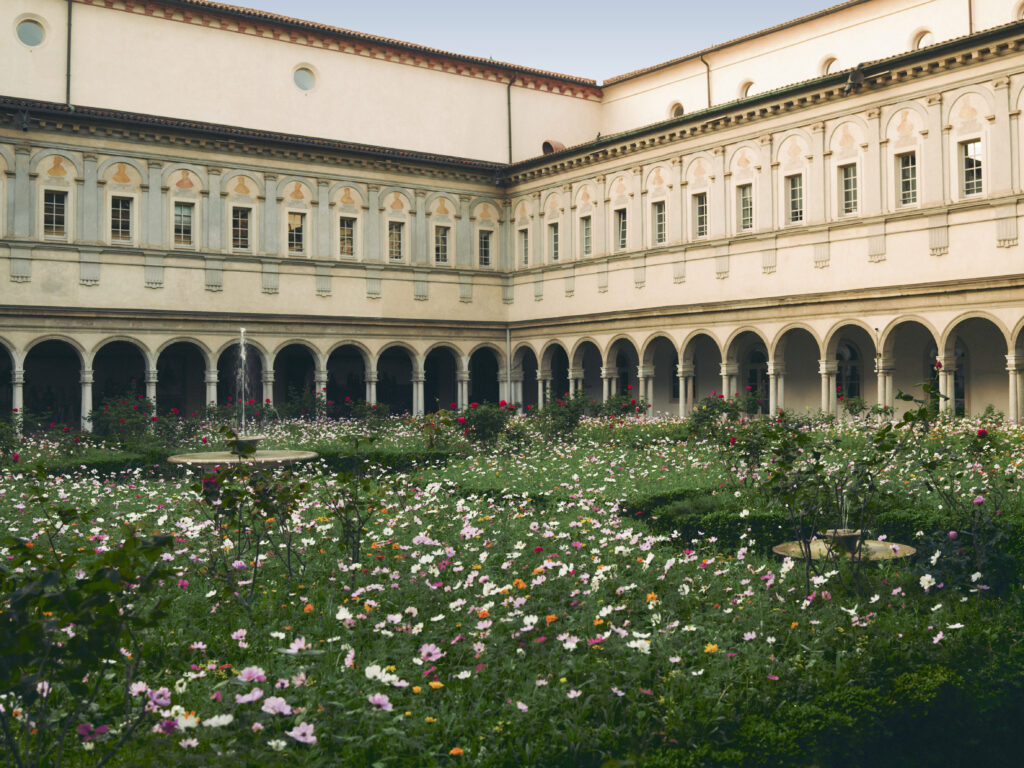
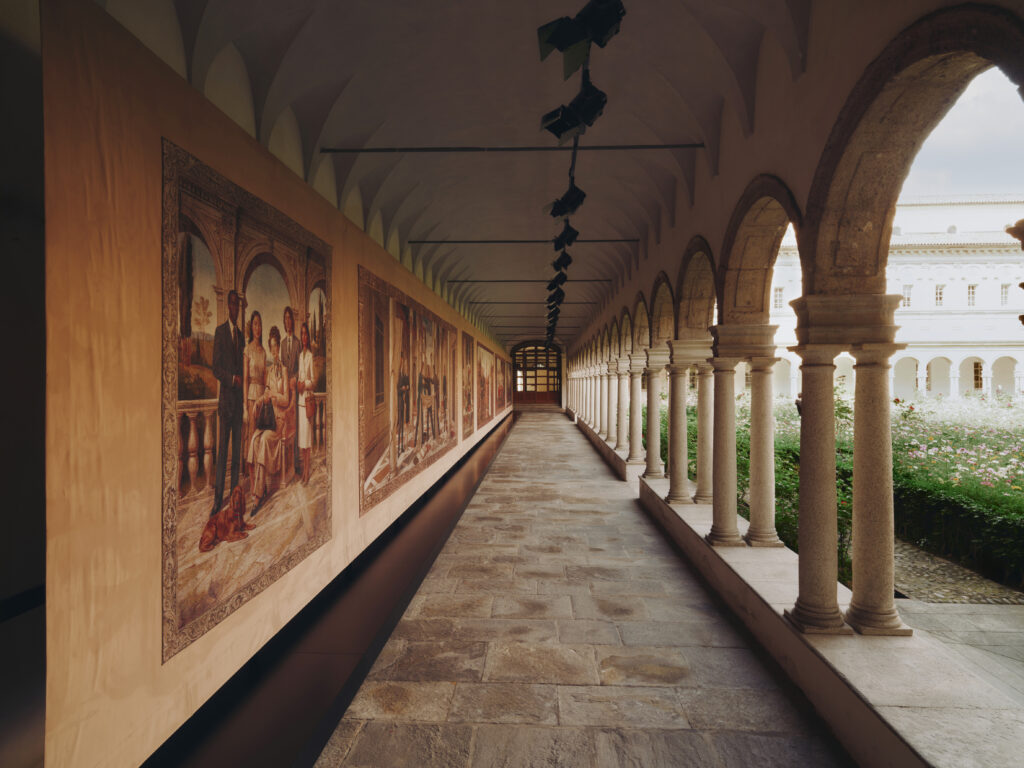
In Milan, during the 2026 Salone del Mobile, Gucci presented “Gucci Memoria” on the walls of the Basilica of San Simpliciano, a Romanesque church that still preserves elements dating back to the early Christian period. There, the brand organized an exhibition in which its history is brought to life through tapestries, architecture, and interactive elements that guide visitors through the space.
Monastic cloisters were traditionally organized around a central courtyard and have historically served as places of passage and contemplation. The repetition of their arcades creates a steady rhythm and fosters a continuous sense of space. That is why the exhibition route is designed without interruptions, unhurried yet with a sense of humor. Because if anything defines Gucci, it is cultural irony. One need only recall that Tom Ford dared to shave a G onto supermodel Karmen Kass’s pubic area to promote his Spring/Summer 2003 collection.
The Tapestry as a Form of Expression
In the stone interiors of the Middle Ages, tapestries helped regulate temperature, dampen sound, reduce humidity, and create a sense of intimacy within the cold stone walls. Over time, this practical function was complemented by a narrative dimension. The textile surfaces incorporated historical, religious, or mythological scenes. Furthermore, the ability to take them down and move them facilitated their circulation and allowed a single series to be adapted to different locations. This portable nature was particularly favored by European courts, such as the Spanish Habsburgs. If you are very curious about this textile art, we recommend visiting the exhibition Raphael: Sublime Poetry , which runs through June 28 at the Metropolitan Museum in New York. There, among the Madonnas, a series of tapestries based on cartoons by the master from Urbino has been installed; these were intended to decorate the walls of the Sistine Chapel and once belonged to the Spanish King Philip II.
The leather goods workshop where it all began
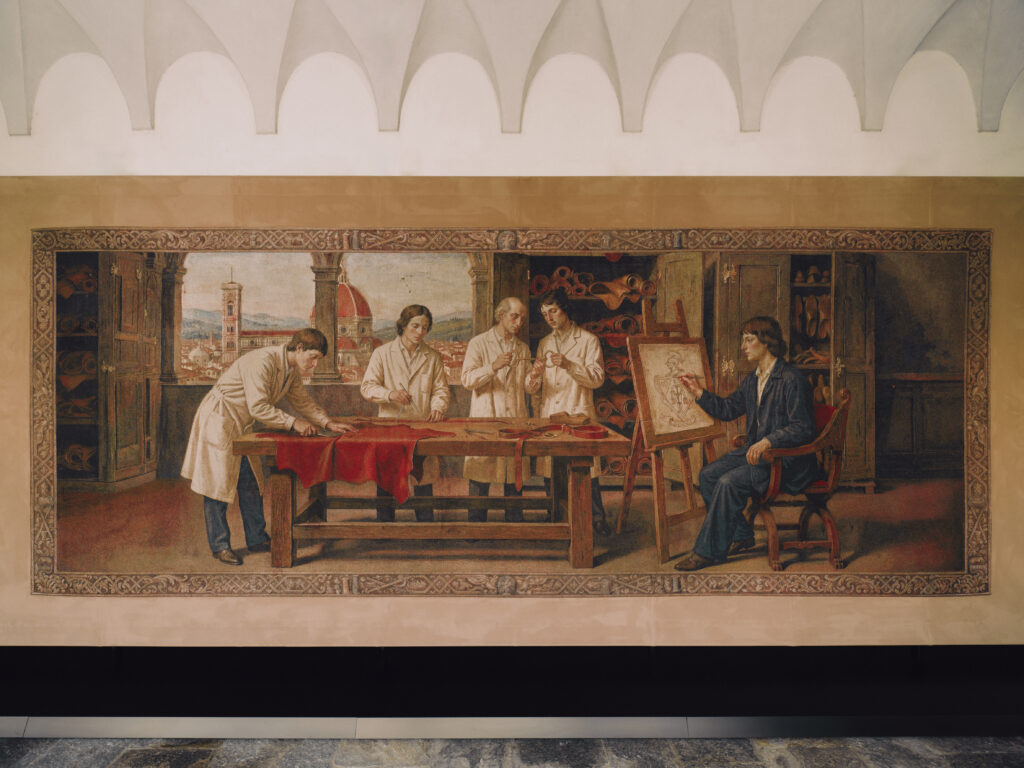
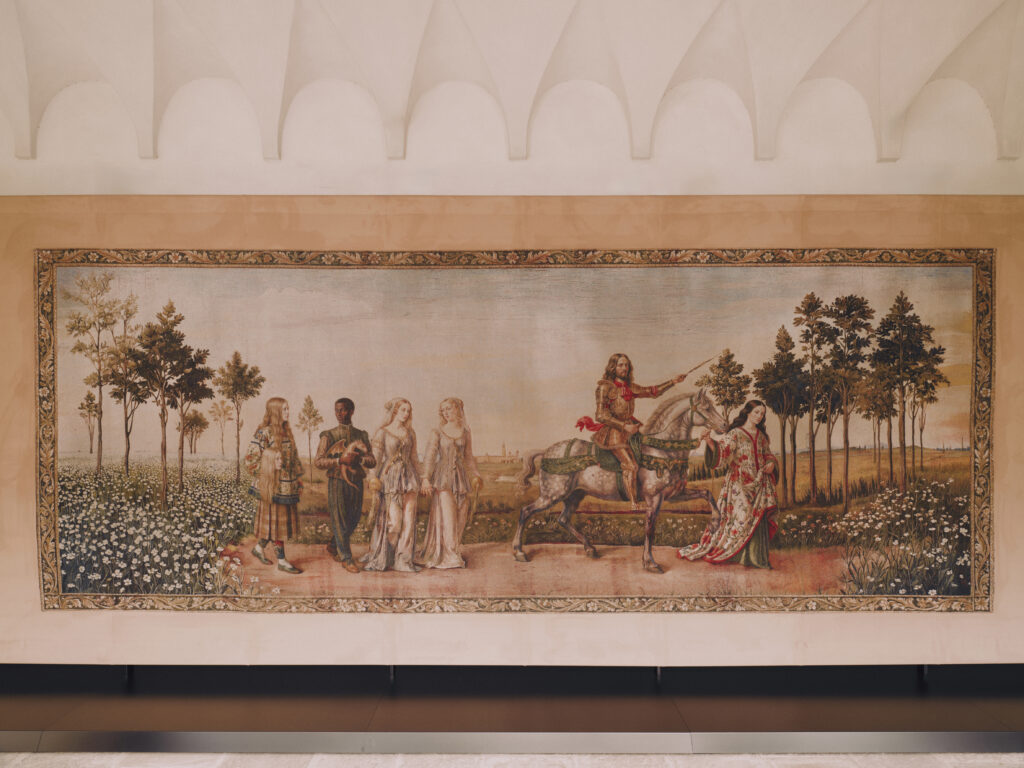
In “Gucci Memoria,” tapestry serves as a medium for a narrative that traces key moments in the house’s evolution. The exhibition is organized around twelve pieces that function as scenes, each of which is linked to a significant episode in its history.
The tour begins with a tribute to Guccio Gucci, who worked as a bellhop in the late 19th century at the Savoy Hotel in London. Perhaps it was his exposure to the luggage of an international clientele that influenced his decision to found a leather goods workshop in Florence in 1921, which marked the beginning of the brand. The narrative of the textiles traces the consolidation of that workshop, the development of its visual language based on leather craftsmanship, and its international expansion during the 20th century. During that period, pieces such as the 1947 Bamboo bag were designed, with materials that reflected the constraints of the postwar era. As well as the 1961 Gucci Jackie model, which the artisans created for the then First Lady.
The exhibition also highlighted the various creative directions the brand has taken. Tom Ford’s tenure, which repositioned the brand on a global scale. Or Frida Giannini’s, who revived archival elements such as the Flora motif, created in the 1960s for Grace Kelly. Not to mention Alessandro Michele, who revolutionized the legacy through an accumulation of contemporary references that defined the house’s identity. Until the arrival of Demna Gvasalia, who has introduced a new interpretation in which past and present coexist in an apparent hierarchy without conflict.
A cinematic sequence on canvas that tells the story of a house
The twelve tapestries function more as a cinematic sequence than as a homogeneous series. Each one introduces a distinct visual style, tailored to the historical moment it depicts. The first places Guccio Gucci at the Savoy in London. The scenes set in Florence introduce the workshop and the craftsmanship. As the narrative unfolds, the tapestries become more intricate, featuring scenes of travel and interiors.
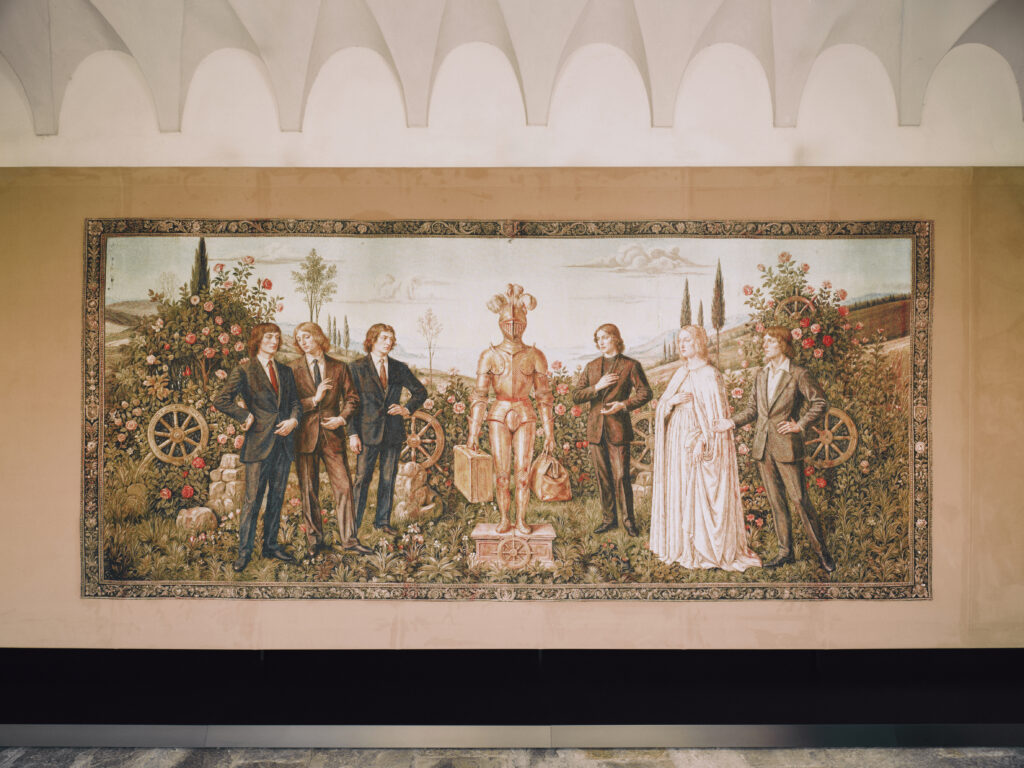
In the most recent collections, the design language has broadened, blending historical and contemporary references that reflect the brand’s diverse creative directions. Demna Gvasalia, a graduate of the Antwerp Academy of Fine Arts, has built a career centered on redefining the cultural codes of fashion. In Gucci Memoria, his focus is on the arrangement of elements within the space.
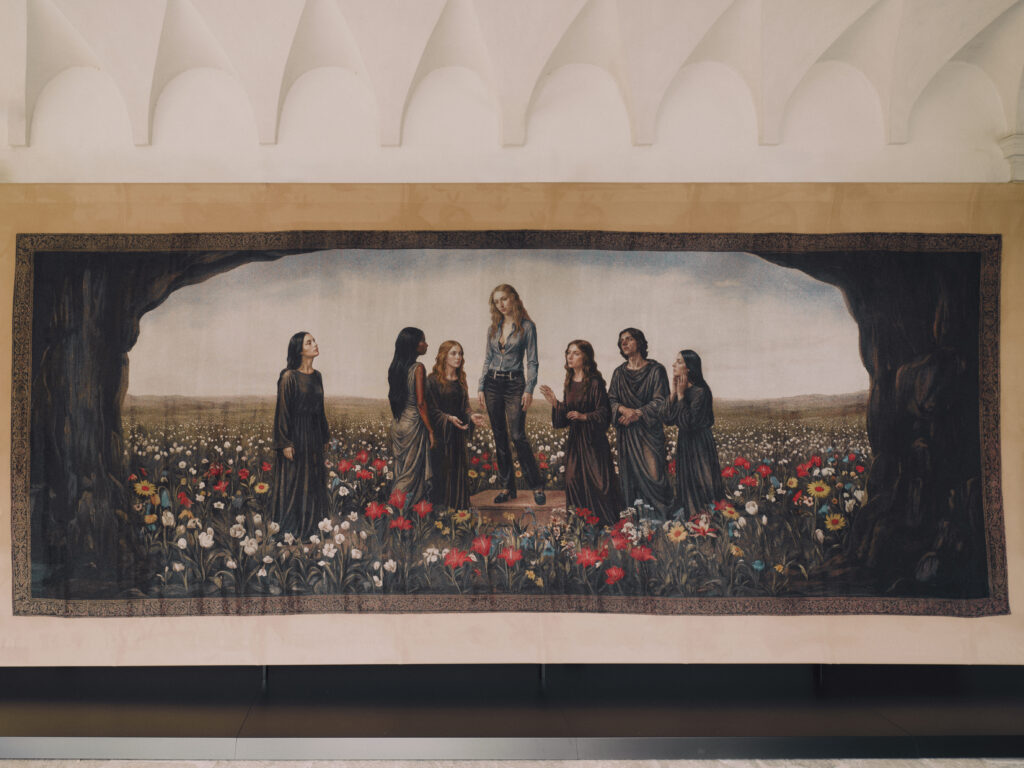
Alongside the tapestries, the exhibition features a botanical installation inspired by the Flora motif. In the inner cloister, a series of vending machines has been added to encourage audience participation. The exhibition comes to life at each stop, transforming the story into a shared experience.