Antonela Aiassa (b. 1988) is a young Argentine painter and sculptor. Her life and work are divided between two places: Buenos Aires, the city where she was born, and Barcelona.
Trained as a fashion designer, Aiassa has become a self-taught artist over the years. Her work, imbued with a hypnotic mystery, explores themes such as memory, loss, transformation, fragility, and time.
Where do memories really take root? In images, in the land we inhabit, or in our scars?
In 2026, Aiassa presented her work at this year’s Zona Maco, represented by Sorondo Projects, run by gallery owner Juliana Sorondo.
AW Magazine spoke with the young artist about her work, her career, and her poetic perspective.
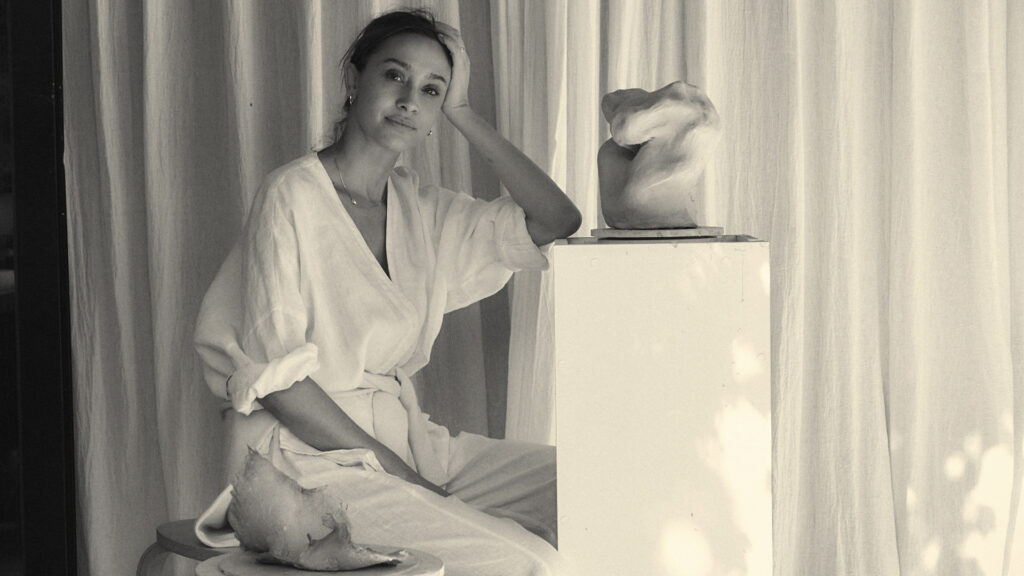
Antonela Aiassa: Creating and Observing from Both Sides of the Globe
Her work draws a delicate, not exactly straight line between memory, transformation, and the earth. Here, in this woman’s art, the land is an entity capable of remembrance.
The daily journey between Buenos Aires and Barcelona is not merely a matter of housing, but rather an integral part of its very essence. Each of these cities has a unique relationship with time. The Teatro Colón has stood in the City of Fury for over a century, having witnessed countless generations of Argentines come and go; the Llotja de Mar has stood in Barcelona for centuries, facing a sea that is never the same.
What does each city and each continent offer you as you create your work? What does one take away that another makes easier for you?
“Living between Buenos Aires and Barcelona keeps me
in a state of constant motion” — Antonela Aiassa
“Neither of them feels to me like a closed-off or definitive place. Buenos Aires connects me to something very deep—to a memory that is not just mental, but physical and emotional. It is a place where memory is alive, constantly changing, and where the traces are never erased or tidied away.”
Barcelona gave me distance. It allowed me to observe my own culture from the outside and understand that what seems stable is also in a state of constant transformation. It confronted me with the idea of form, of heritage, of structure, but also with the fragility of those ideas. One city gives me intensity and a sense of belonging; the other gives me perspective. My work emerges between the two, as a space where these tensions are not resolved, but coexist.”
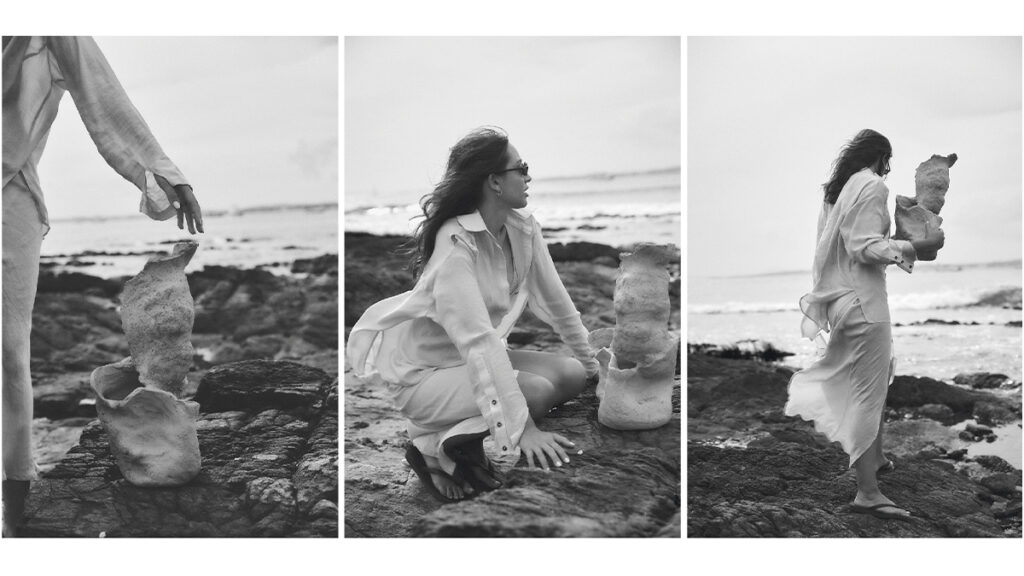
Aiassa views the land as a repository of memory and the earth as a living archive. And like all living things, the earth can also forget.
A Poetics of the Organic: Surrendering to Intuition
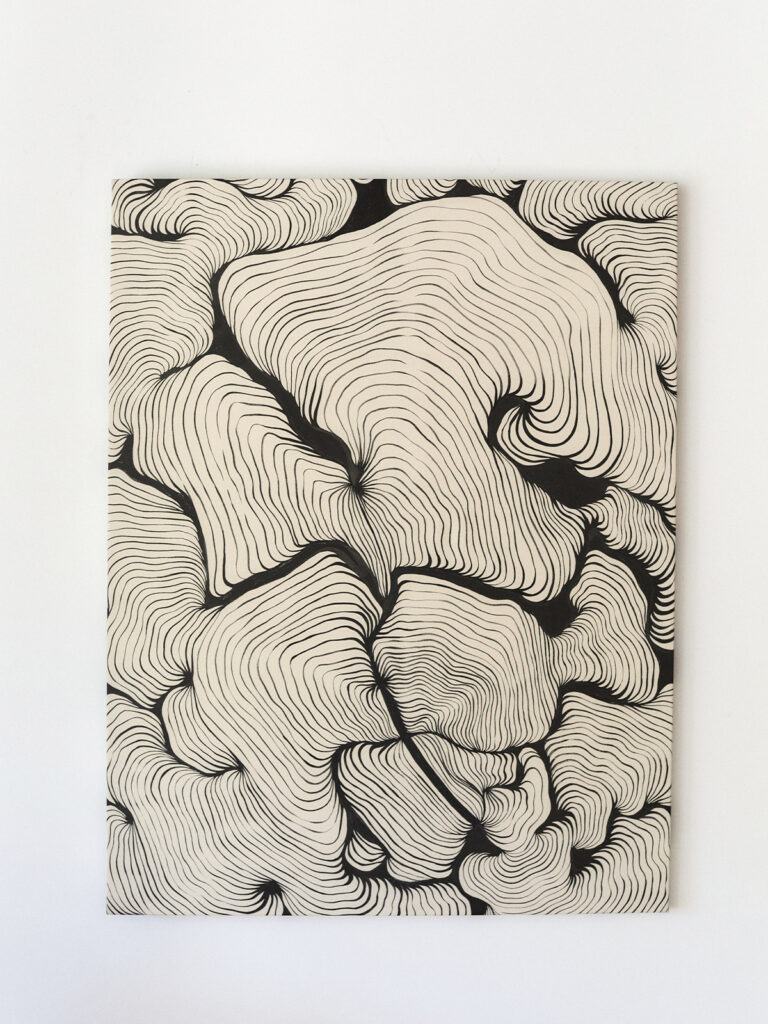
Nature lies at the core and heart of his work. If the ground beneath our feet is a living, mnemonic organ, the foliage and driftwood dictate the rhythm of the voice and the pulse. Aiassa’s visual work, almost always executed in monochromatic palettes, creates forms composed of lines and mysterious shapes.
When we look at a tree leaf, or throw a stone into the water, we witness shapes and echoes that seem to follow a secret yet living code. The same is true of Aiassa’s work, which begins with a general idea and, at a certain point, relinquishes control to intuition, to touch, to what lies beyond the realm of the intellect.
At what point does intuition take the creative lead? How do you know that your hunch is on the right track?
“Intuition comes when I stop trying to control the process.”
My work is largely rooted in research into materials and form, drawing from the archive, but there comes a point where the body and perception come into play— a more attentive listening to what the material suggests to me. It isn’t something sudden; it’s more of a gradual shift. I realize it when I begin to accompany the process, when I let gravity interfere and start to make decisions, when the material mutates in its form and the painting reaches points of tension and depth.
I work with materials that change, melt, and fail, and that forces me to accept error and transformation as part of the meaning.
“I feelthat this impulse is on the right track when the work is honest about its fragility, when it doesn’t seek to wrap up an idea or illustrate a concept” —Antonela Aiassa
“I know a piece is on the right track when I see and feel harmony, when a sense of freedom and balance emerges. At that point, I know the piece no longer needs me. It is finished and has a life of its own.”
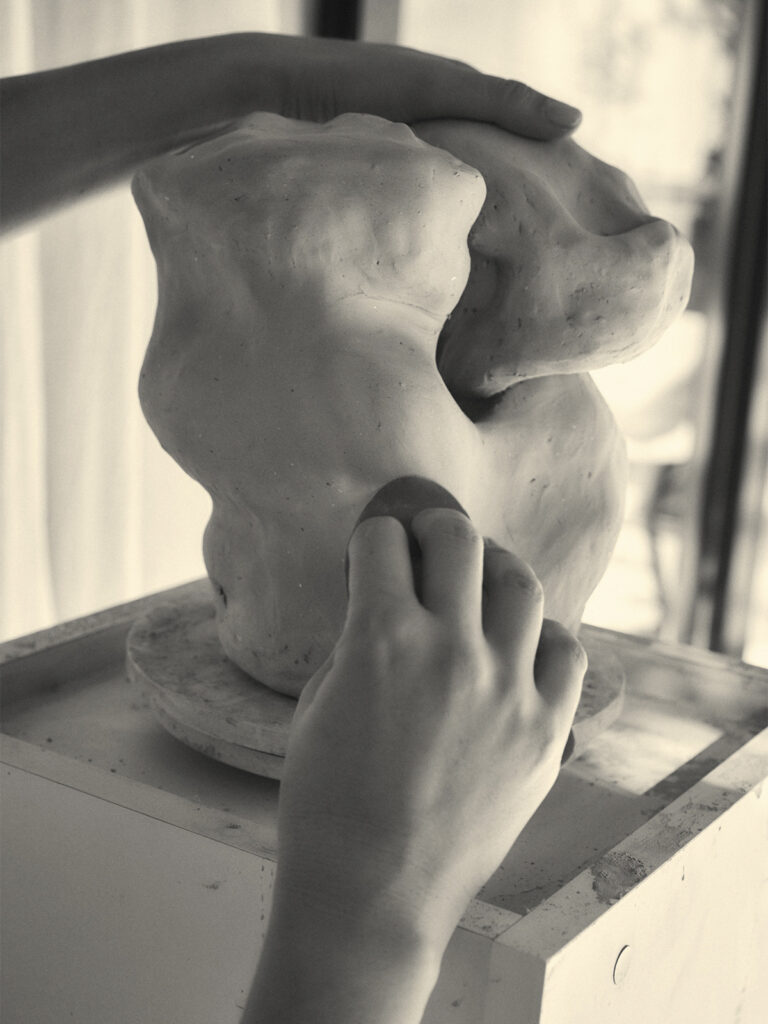
Antonela Aiassa creates work rooted in listening with the body, in making room for fragility, and in allowing natural gravity to follow its inevitable course. In this sense, what is memory—an attempt or an entity in a state of perpetual change?
Printing a photo by the sea
Her work moves between the archive and memory, but it does so in a very specific way. When we speak of preservation, we commonly think of technical media that retain images and words: paper, screens, magnetic tapes. Antonela Aiassa starts from a delicate yet powerful premise: the recording of a memory does not prevent its eventual fading.
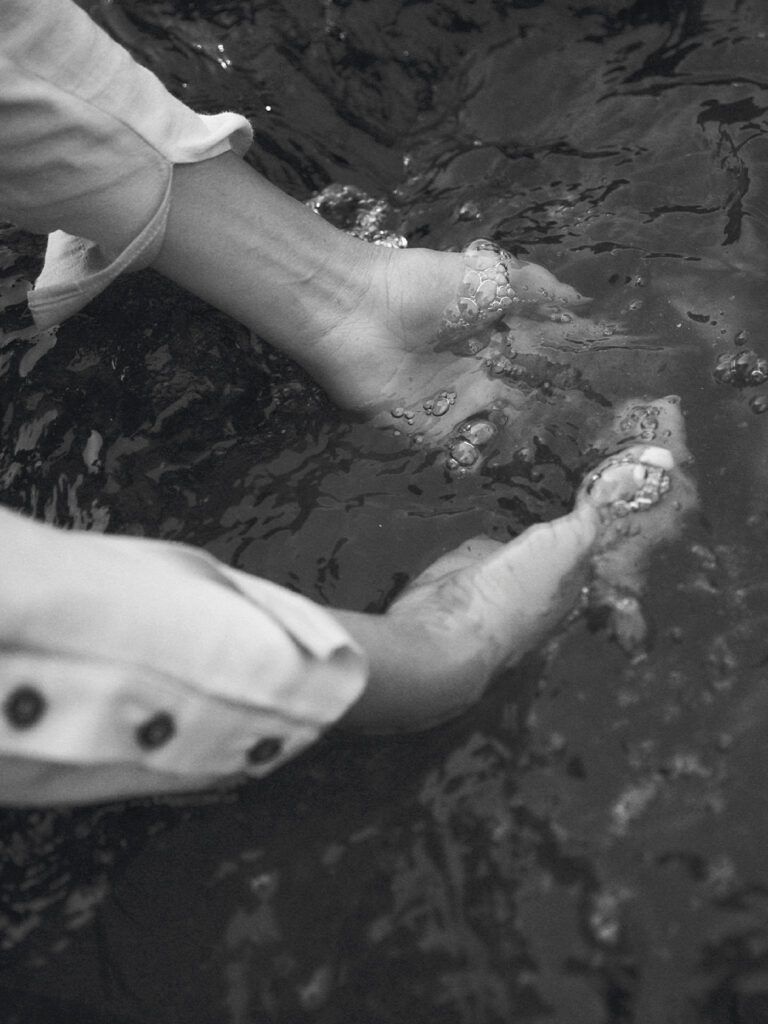
In “The Memory of the Earth,” water and earth—ever-changing—serve as the physical medium of memory. The act of remembrance is permeated by the fragility of the material. What is it like to work with these elements that are destined to change, to disappear?
“For me , memory isn’t about preserving, but about transforming. I’m interested in what moves, what erodes, what changes shape. That’s why I work with materials that don’t promise permanence. Ice, water, sand, earth, and natural pigments extracted from plants constantly remind me that nothing is fixed.”
Working this way means accepting that the work is not complete in the object itself. Memories aren’t captured in an image, but in an experience. “Something someone once saw and will never see again in the same way. What disappears isn’t completely erased; it transforms. Just as with ancestral knowledge, with culture, with the body. A trace always remains, even if it isn’t visible.”
His work, then, seems less like a reflection on memory and retention and more like an exploration of the effects of time on reality, on the ground, and on the gaze.
The weather: a block of ice is melting right before our eyes
“The Core of the Multifold” is an installation about change, material fragility, and the passage of time. A block of ice encases a core of reddish pigment. Aiassa extracted this pigment in collaboration with artisan Liliana Pastrana. The dye comes from Tafí del Valle, an ancestral territory in northwestern Argentina.
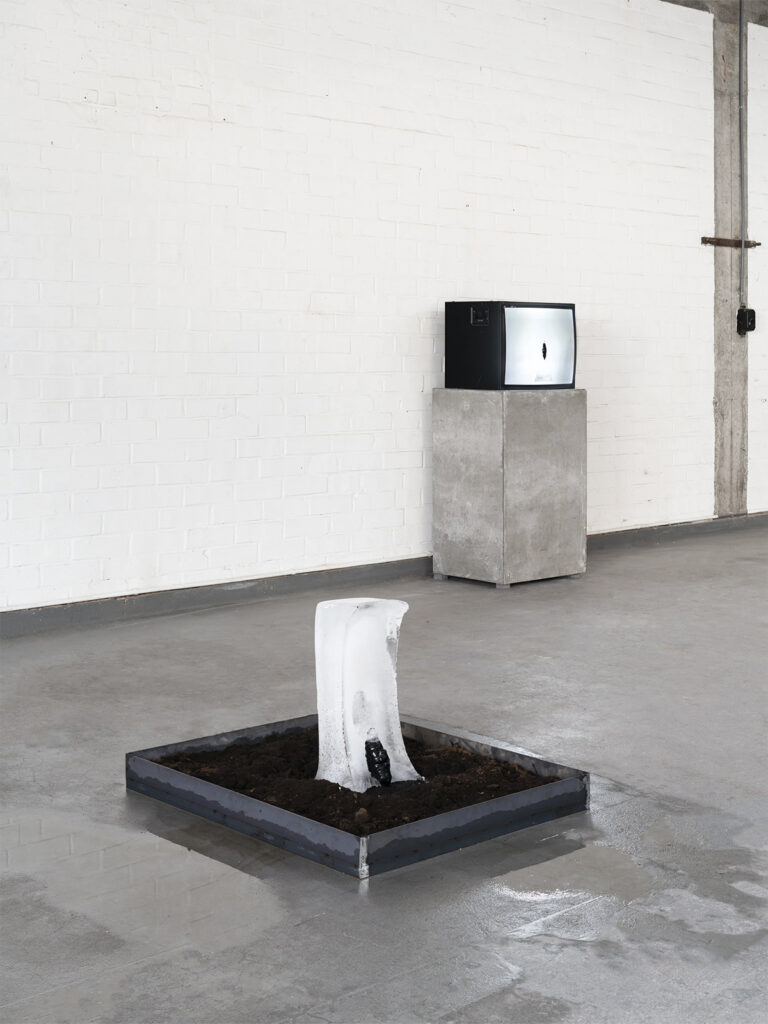
As time goes by, the ice melts and color gradually emerges from its icy container. A video documents the process. As the hours pass, the trail of color changes shape. The same is true of memory and recollection.
In “The Core of the Multiple,” you explore the mutable nature of memory. The pigment serves this purpose. The morning viewer saw a sequence that the afternoon visitor will never see. What does it mean, emotionally, to create a work whose materiality is lost in order for it to achieve its full existence?
“Creating a work that is fleeting means accepting time as an active part of the process. The work exists because it changes. We must let go of the idea of control and permanence. The work belongs to whoever is experiencing it at that moment, and each person who observes it inevitably sees something different.”
“Materiality fades away sothat the experience can truly exist. In that gesture, the work ceases to speak only of memory and begins to speak of the present, of attention, of what is happening right now. In the face of what is disappearing, the question is not what remains, but rather from where we are looking and what place we occupy in that process.”
Meet other contemporary artists in AW Magazine.