Hidden away in San Luis Potosí is an architectural destination that could be both a surrealist fantasy and a nightmare straight out of a Jorge Luis Borges story: the Edward James Sculpture Garden, also known as Las Pozas, in Xilitla.
Edward James Sculpture Garden in Xilitla: Located in the Huasteca Potosina region, this site is characterized by its beautiful and whimsical architecture, where unfinished staircases, Gothic arches, and impossible columns coexist with flora and water. Every year, thousands of visitors are drawn to this unique landscape.

Edward James: The Invention of an Impossible Paradise
Edward James was a poet, artist, and patron of the Surrealist movement, as well as one of its most radical proponents. As the heir to a vast fortune, he supported artists such as Salvador Dalí. He also cultivated a unique sensibility, marked by a rejection of instrumental reason and a persistent fascination with dreams and ruins.
In the late 1940s, he arrived in Mexico and, after traveling through the Huasteca Potosina region, found in Xilitla a place that spoke directly to his imagination. The climate, the lush vegetation, and the town’s isolation convinced him that there he could bring his life’s work to fruition: a personal Garden of Eden, untouched by any recognizable architectural tradition.

Construction of Las Pozas began in 1947, without definitive plans or a functional program. More than 150 local workers participated in a process guided by intuition and experimentation. After James’s death in 1984, the complex remained unfinished. It wasn’t until 1991 that it opened its doors to the public. Over time, it became one of the most unique architectural spaces in the country.
Xilitla: History, Jungle, and Territory
Xilitla is located in San Luis Potosí, in the heart of the Huasteca, a region characterized by high humidity, dense vegetation, and rugged terrain. On a national level, its remote location has contributed both to its historical isolation and to the preservation of its landscapes and traditions.
Before the arrival of the Spanish, the area was inhabited by Huastec peoples. During the colonial period, Xilitla gained strategic importance with the construction of the Augustinian convent in the 16th century, which is now one of the state’s most important historical ruins.
Nature has always been the defining feature of this place: constant rain, rivers, waterfalls, and a jungle that stretches out like the sea. This physical reality is the element with which the architecture of Las Pozas engages (and sometimes struggles).

Las Pozas: Architecture Without a Purpose
The Edward James Sculpture Garden spans more than 37 hectares, crisscrossed by a river and numerous waterfalls. The complex consists of dozens of concrete structures scattered throughout the jungle: pavilions, columns with floral capitals, arches, platforms, and staircases that seem to defy all logic of construction and function.
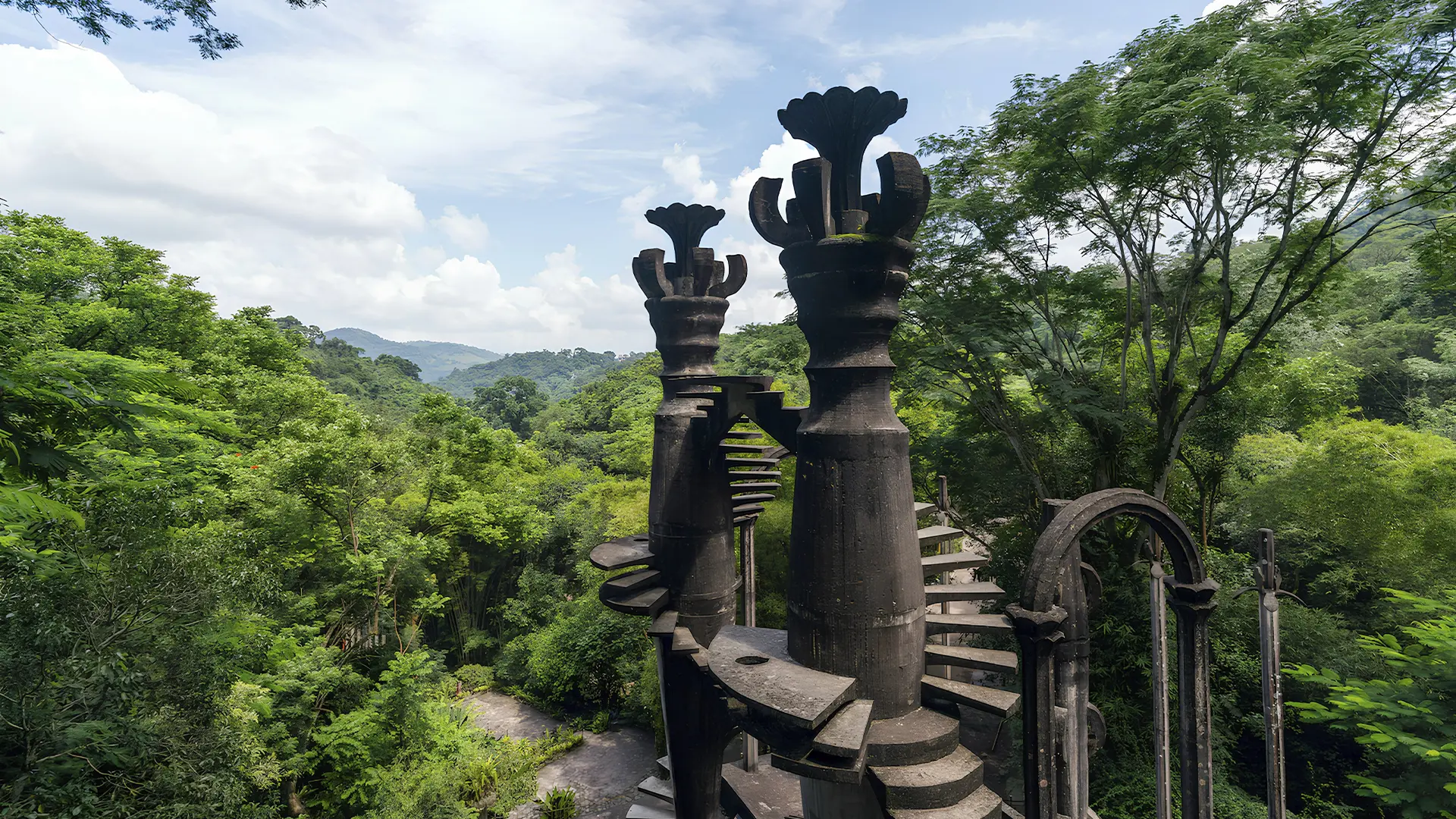
Rather than a garden, Las Pozas can be interpreted as a self-aware architectural manifesto. Here there is no program, no function, and no spatial hierarchy; dead-end corridors abound, as do doors leading to useless spaces and staircases that end abruptly in mid-air. The architecture does not seek to guide or protect, but rather to provoke an experience of wandering and discovery.
This feeling inevitably brings to mind The Immortal, by Jorge Luis Borges. The story features a city composed of useless and unbearable symmetries, inverted staircases that lead nowhere.
In Xilitla, as in the City of the Immortals, architecture abandons reason to become a vehicle for emotion and, at times, anguish.
So, who’s hungry?
After exploring Las Pozas and letting yourself be captivated by its surreal architecture, visitors can return to the town to round out the experience. Xilitla offers numerous restaurants serving Huasteca cuisine where you can sample traditional dishes such as zacahuil, a giant tamale stuffed with meat and cooked slowly, which restores a sense of grounding after the dreamlike experience of the garden.
Discover other architectural destinations in AW Magazine.
By: Armando Navarro
To keep exploring this thread, visit our architecture coverage.