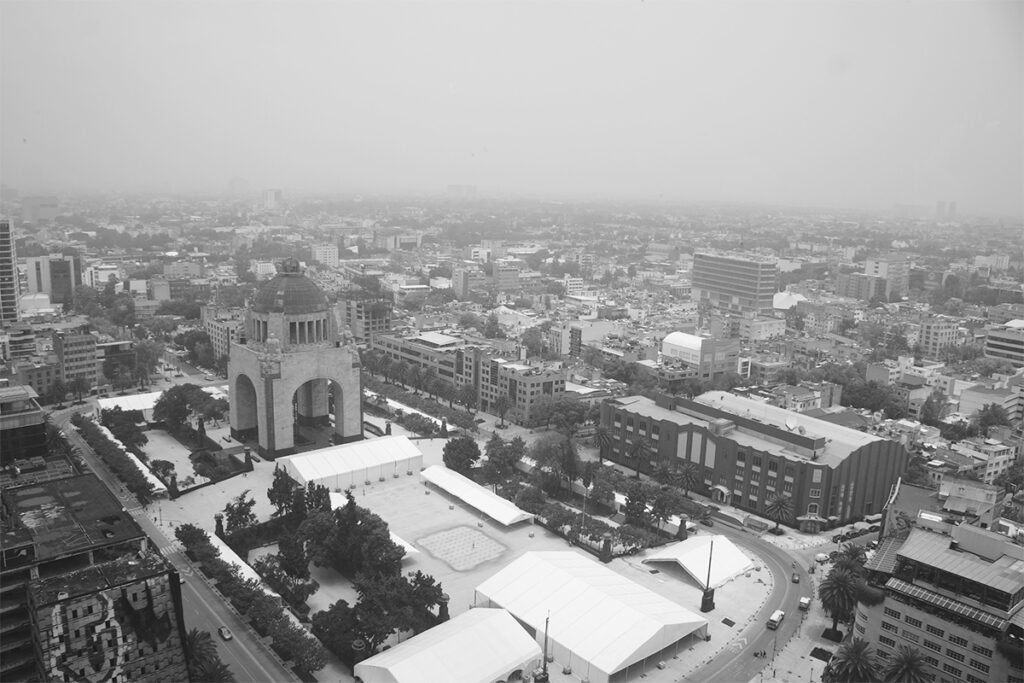
It is one of Mexico City’s most iconic landmarks and, at the same time, one of the hardest to categorize.
The Monument to the Revolution has been part of the collective imagination for nearly a century, but its origins are complex: it is not a completed work, but rather an unfinished project.
The monolith is a living ruin, the remnant of a colossal modernity that never came to fruition because the Mexican Revolution cut it short. The regime and the dominance of armed struggle came later. That new state adopted what was once a dream of grandeur and completely redefined it.
How can we understand the life of a monument that is, at once, a public space, an architectural relic, and a civic burial site?
From an impossible palace to a funerary monument
The origins of the Monument to the Revolution date back to the dawn of the 20th century. The regime of Porfirio Díaz had an ambitious plan to build the Federal Legislative Palace, a complex conceived as a colossal structure on an unprecedented scale. Following an international competition, the project was initially entrusted to the Italian architect Pietro Paolo Quaglia, but he died before construction began. Subsequently, the French architect Émile Bénard took over the project, seeking a European-inspired neoclassical design.
But then the Mexican Revolution broke out, and the building’s fate changed completely. Political instability and the fall of the Porfirian regime led to the permanent suspension of construction in 1912. For two decades, the steel skeleton remained exposed and abandoned. Bénard tried to salvage the project and build ties with the new government. However, the deaths of Álvaro Obregón and himself in the late 1920s put an end to that prospect.
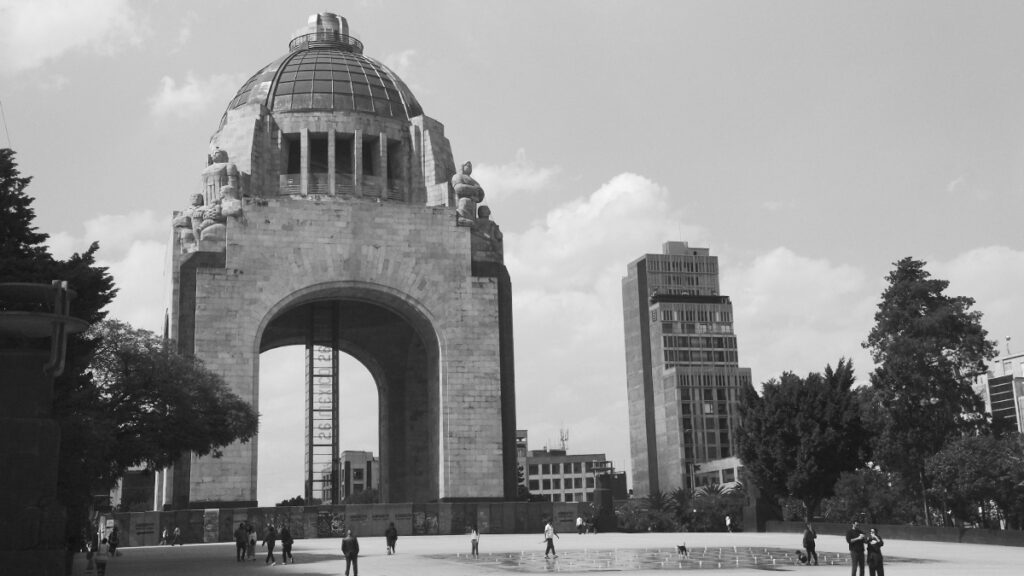
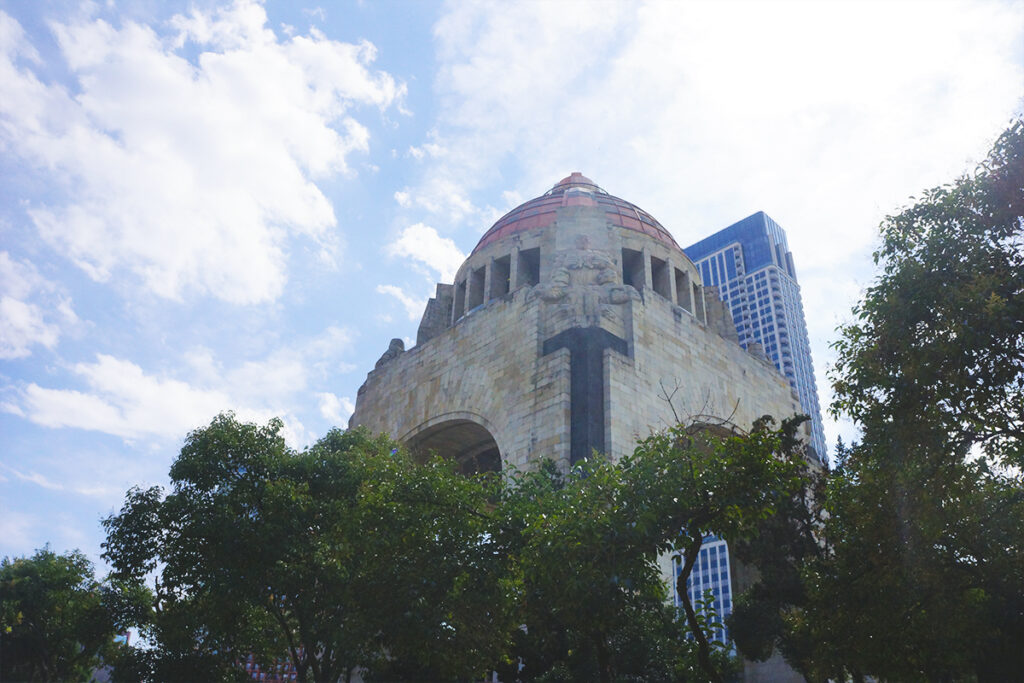
In 1933, architect Carlos Obregón Santacilia undertook the restoration of the unfinished structure. Díaz and Bénard’s vision would be reimagined with a new spatial and political meaning. The project, dedicated “to the Revolution of yesterday, today, tomorrow, and forever,” transformed the skeleton into a civic monument integrated with the plaza surrounding it. In 1936, the site began to be conceived as a civic mausoleum. There lie the remains of Venustiano Carranza, Francisco I. Madero, Plutarco Elías Calles, Francisco Villa, and Lázaro Cárdenas.
The Monument to the Revolution was completed in 1938, during the presidency of Lázaro Cárdenas. The year of his death, 1970, also marked a turning point in the monument’s functional decline: the observation deck was closed, and the complex lost part of its public purpose.
Four decades later, the political desire to make sense of the past was reignited. In 2009, to mark the bicentennial of independence and the centennial of the revolution, the Mexico City government undertook a comprehensive restoration of the monument and the Plaza de la República. The gesture was not only urban but also symbolic: a new attempt at reconciliation with that monumental graveyard inherited from an interrupted modernity.
The Architecture of Interruption
The original design for the Federal Legislative Palace was conceived as a colossal, almost implausible structure. With more than 14,000 square meters of floor space, a monumental dome, and a state-of-the-art steel framework, it was intended to be one of the largest legislative buildings in the world.
Many of its elements were never incorporated into the complex; instead, they were scattered throughout the city and integrated into other buildings and spaces. The sculpture “Youth and Maturity” is located at the entrance to the Palace of Fine Arts. The eagle that was to crown the central dome now sits atop the Monument to the Race. The metal lions that were to guard the main staircase now watch over the main entrance to the Chapultepec Forest. These remnants seem to tell us that the palace was blown to pieces before it was ever completed.
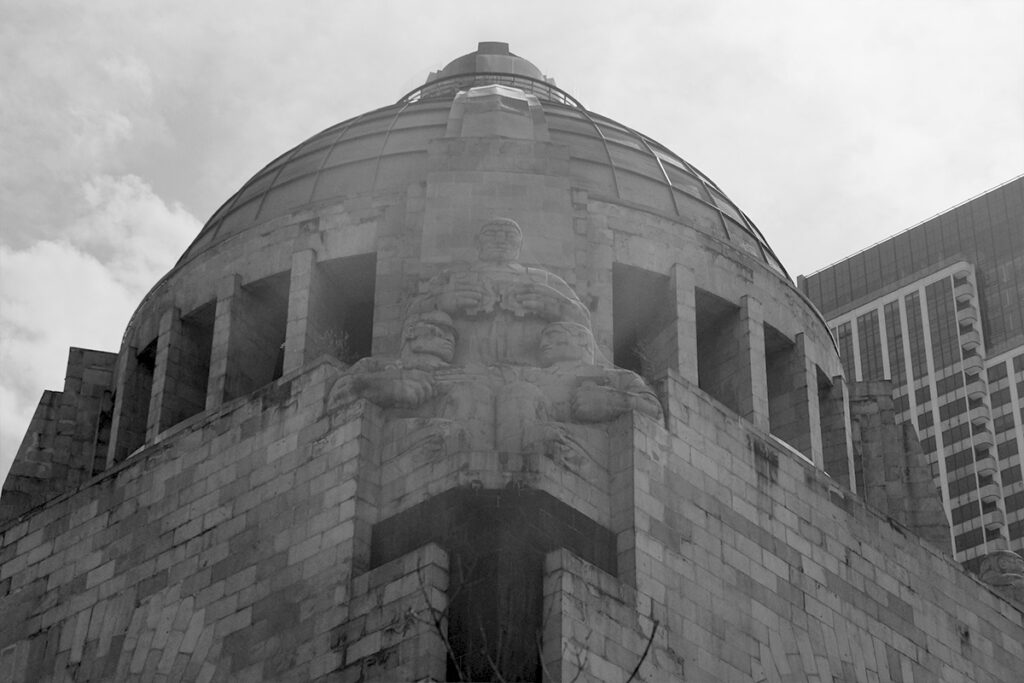
Carlos Obregón Santacilia’s intervention did not aim to complete the palace, but rather to give new meaning to the ruins. Building on the structure left by Bénard, the architect reinterpreted the complex with a restrained vision, reminiscent of Art Deco. He incorporated elements of pre-Hispanic architecture, creating a kind of totemic fusion. The black volcanic rock, Oliverio Martínez’s sculptures, and the volumetric composition transformed the metal framework into a monument of transition.
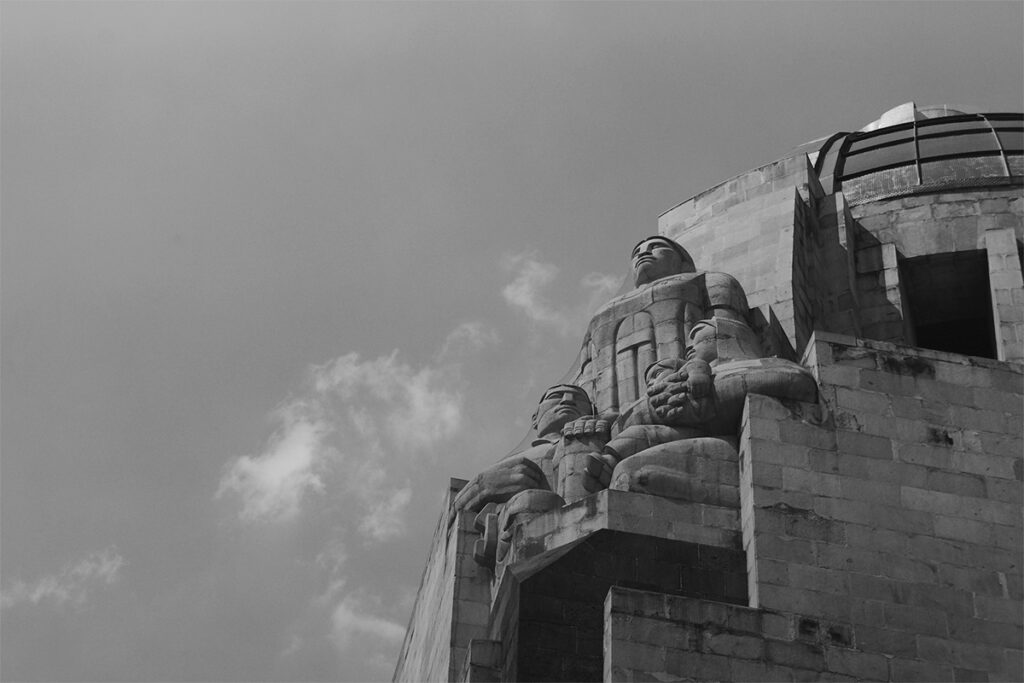
Today, the monument is experienced as a vertical sequence. Visitors pass through the remnants of the original project, ascend through the interior of the pillars, and emerge beneath the copper dome. The plaza, reconfigured as a public space, serves as a prelude to the tour.
Progress as a Phantom
The Monument to the Revolution embodies a paradox: an architectural structure designed to celebrate progress ended up becoming a relic of a deluded and shattered modernity. The Revolution did not destroy the project; it left it in limbo and then imbued it with memories, speeches, and human remains.
The ghost of progress haunts these ruins. The monolith stands as a graveyard of power.
Discover other iconic landmarks in AW Magazine.