
Hesner Sánchez: Architecture and Skateboarding Come Together. At the intersection of urban planning and skateboarding culture, Hesner Sánchez has created a body of work that does not merely decorate the city or appropriate space in the process, but rather seeks to transform it and push it toward new possibilities. With projects such as Nuevo Tenochtitlán, this Mexican architect and urban planner has carved out a place for himself within the cultural landscape—one where architecture engages with the city, but also reimagines it.
The work of this university professor—who was also featured in the latest edition of “70 Years x 70 Voices: IBERO Architecture” —spans the realms of public space and art, with a streetwise sensibility that cannot be acquired in an office.

An undercover agent from the skateboarding world in architecture
He admits that his entry into architecture was an almost romantic and idealistic move. Ever since he was a teenager, he’d been obsessed with the world of skateboarding, and “like an undercover agent”—he jokes… or maybe he meant it—he decided to study architecture with the goal of making the world more skateable.
“Muchof my interest continues to lie in visualizing urban traffic and the city as an obstacle for a skater”— Hesner Sánchez
After graduating from college, Hesner moved to Barcelona, one of the global epicenters of urban design. The city, shaped at its core by the plan of Ildefons Cerdà—one of the founders of modern urban planning—through to its current experiments in public spaces, was the international mecca of skateboarding in the early 2000s.
For an aspiring architect with a skater’s spirit, being in the land of Gaudí and Modernism was like living in an amusement park. That period solidified his view of the city as a living organism (one that didn’t mind people skating along its streets).
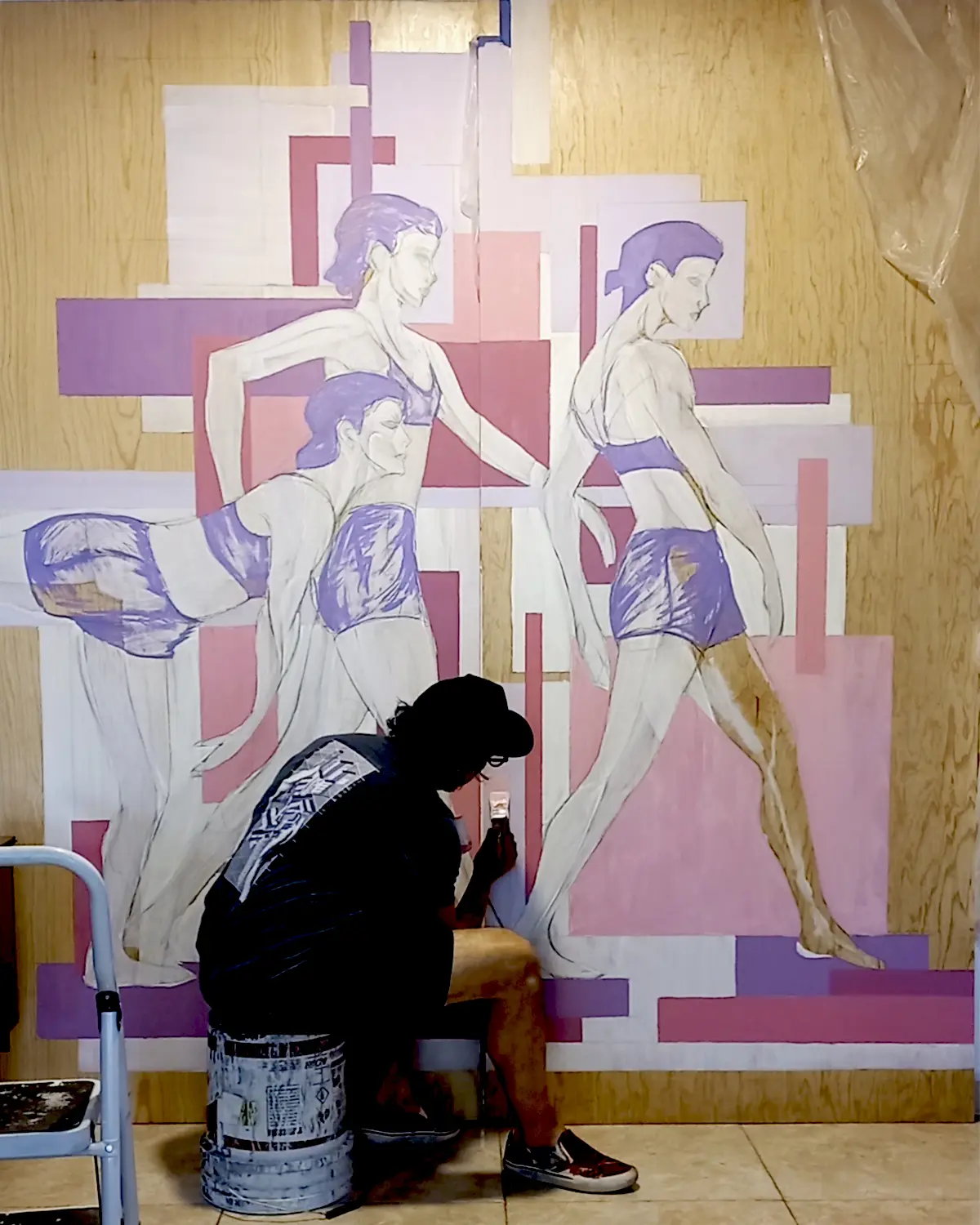
Upon returning to Mexico, he founded Territorios Taller de Arquitectura, a firm established with the aim of blending landscape architecture, public space, and urban exploration. One of his first projects, between 2016 and 2017, was a mural on a pedestrian bridge at the Central de Abastos in Mexico City, commissioned by the organization Central de Muros. Nuevo Tenochtitlán became one of his most significant engagements with public space. It was not just a painting; it was also a statement of principles.
New Tenochtitlán: Urban Futurism Through Muralism
“Since I’ve always been interested in the city and the region, I wanted the painting to reflect this vision from a futuristic perspective. That’s why the piece is called New Tenochtitlán,” he explains. The work blends images of Mexico City with echoes of the pre-Columbian past.
“It was my first mural, and it turned into a massive piece measuring 5 by 28 meters. To create it, I put together a crew of friends and people to help me paint; it was a very large space.” The goal, which UN-Habitat joined, was to finish in 30 days and stay true to the principles of sustainable urban development that have been so in vogue in recent years. The mission was accomplished by working nonstop from Monday to Sunday.
The mural, which still partially exists in Mexico City despite the weather and the passage of time, consists of a geometric mosaic depicting urban agglomerations deeply intertwined with their surroundings.“I often compare it to that pre-Hispanic territory where chinampas were built, and everything else was erected upon them. We had a much more harmonious territory: in the way we lived, in food production, in our relationship with the environment.” The reference is no coincidence: New Tenochtitlán functions as a speculative projection, a utopian? reminder that the city could be organized in a way that is more sensitive to the landscape that sustains it.
“The idea is to demonstrate the possibility of building more harmonious cities: more self-sufficient, with lower energy consumption, and a more balanced relationship with their surroundings,” he explains. The project, he says, also served as a starting point: an early statement of the direction he wanted his work in urban settings to take.
Transversal: Art, Architecture, and the City
Amid these projects, he founded Transversal Arte, Arquitectura y Ciudad, a personal and collaborative platform through which he manages all his endeavors: murals, tactical urbanism. Regarding Estudio Abierto, he explains that it involves literally opening up his studio so people can see his work. Usually at the beginning of the year, he turns it into a pop-up micro-gallery where he exhibits and sells his pieces.
Social Alchemy in Tlatelolco: Community, Art, and Urban Renewal

“Social Alchemy ” is the mural he created in Tlatelolco. The work was created in response to a call for proposals from the Social Prosecutor’s Office and as part of the 2021 Innovative and Participatory Housing Complex Restoration Program (RIPUH), whose goal was to restore, maintain, and improve the urban appearance of the common areas in Mexico City’s housing complexes.
Three locations were proposed for the project—Tlatelolco, Unidad Independencia, and Alianza Popular Revolucionaria. He chose Tlatelolco, “because I love Tlatelolco.”
Convincing the residents was the real challenge. The first three presentations were a failure; the residents felt there were “other needs” in the building that took priority over an art project. That is, until he met a neighborhood leader from the Los Bravos building in the Presidente López Mateos Urban Complex, who was willing to listen to his proposal and became his greatest ally. The mural took ten days to complete, and to this day, Alquimia Social (2022) remains virtually intact. “I see the tags below as unauthorized contributions,” he remarks resignedly about the signatures local graffiti artists have added to his work.
Now, Hesner is exploring how to bring that artistic and playful dimension to urban projects and skateboarding elements: a blend of sculpture, infrastructure, and landscape. “It’s a back-and-forth: from drawing to mural, from mural to architecture,” he sums up.

He admits that he hasn’t built any skateparks in Mexico City, though he has seen various facilities springing up there. His recent work has focused on suburban municipalities, where younger administrations seem more open to ideas that combine sports, public space, and sustainability. “When well-designed, these spaces can cater to people of all ages and address environmental issues, such as water harvesting,” he says.
Urban Projects and Vision for 2026
Looking ahead to 2026, Hesner remains tight-lipped. He is currently working on the design of a skate park and a BMX track. In Mexico, these types of urban sports are experiencing quiet but steady growth: the global BMX bike market alone grew to over $338 million in 2023 and is projected to see sustained annual growth through 2032. This boom is evident not only in parks and tracks but also in new ways of envisioning the city. And that is where Hesner Sánchez’s work becomes particularly relevant.
Hesner is also working on an Infonavit affordable housing project in the state of Hidalgo, where his main focus is on enhancing community and recreational areas.
Another potential project is a collaboration with the Álvaro Obregón district of Mexico City, focused on tactical urbanism and participatory murals. “These are acts of urban acupuncture,” he explains.
Urban acupuncture is an intervention strategy that proposes small, targeted actions to bring about significant improvements in an urban space.
“Do you remember that spot in La Condesa, where the little market on Michoacán Street is? At first there was just a lot of asphalt, but then they added paint markings and some street furniture, and that’s how they gradually carved out space for pedestrians. Urban acupuncture projects are initiatives to improve the city’s urban conditions through low-cost interventions,” explains Hesner. “Instead of massive construction projects, we focus on key points—a mural, street furniture, lighting, pedestrianization—that revitalize spaces. The structural and the pictorial go hand in hand.” For these projects, Hesner would handle the urban aspect; his friend, the Mexican-Swiss artist, muralist, and industrial designer Adriana Riolo, would lead the visual side.
These urban revitalization and “urban acupuncture” projects take on particular importance in areas such as the Álvaro Obregón district. In a district characterized by hills, narrow streets, and unused spaces, small, affordable interventions can completely transform the everyday experience. They improve mobility and safety, revitalize forgotten corners, and strengthen the community in areas where public infrastructure is often very limited.

Before ending the conversation, Hesner humorously recalls how his mother saw skateboarding as nothing more than a waste of time: “I tell her, ‘Look, Mom, who would have thought that all those years of wearing down the pavement would pay off? That scratching up walls would turn into something I could make a living from?’”
In Mexico, by 2026, skate-inspired urbanism has evolved from a marginal, street-level appropriation of public spaces into a contemporary strategy. Over the past decade, cultural and urban projects—from large parks like PARCUR Chapultepec to community-based initiatives that are both recreational and social—have legitimized skateboarding not only as a recreational activity but also as a tool for design, community building, and urban regeneration. “And we’ll see what comes next. We have to keep pushing,” concludes Hesner.
To keep exploring this thread, visit architecture in transit; you can also continue through where architecture meets art.