
Digital art and artificial intelligence as creators of aesthetic worlds define the practice of Felipe Sepúlveda, known as Alfacenttauri, a Chilean artist who views technology not only as a tool but also as an aesthetic and political field from which new forms of experience, meaning, and cultural circulation emerge.
His workshop is a computer, his studio an iPad, and Instagram his trusted gallery. Felipe Sepúlveda—known as Alfacenttauri—views technology not merely as a tool, but as an aesthetic and political field from which experience, meaning, and cultural circulation are generated. A prosthetic extension capable of articulating reality? Yes, but “alongside human will”—he clarifies, as if to make it clear that he is not a robot.
Alfacenttauri and technology conceived as an aesthetic field
The work of this young Chilean artist and researcher, who is based in Santiago and hails from Concepción—about 500 kilometers from the capital—spans various disciplines, though it is primarily organized around technology conceived as an aesthetic field. In this sense, the internet and artificial intelligence function as central territories of sensory experience, symbolic production, and cultural circulation.

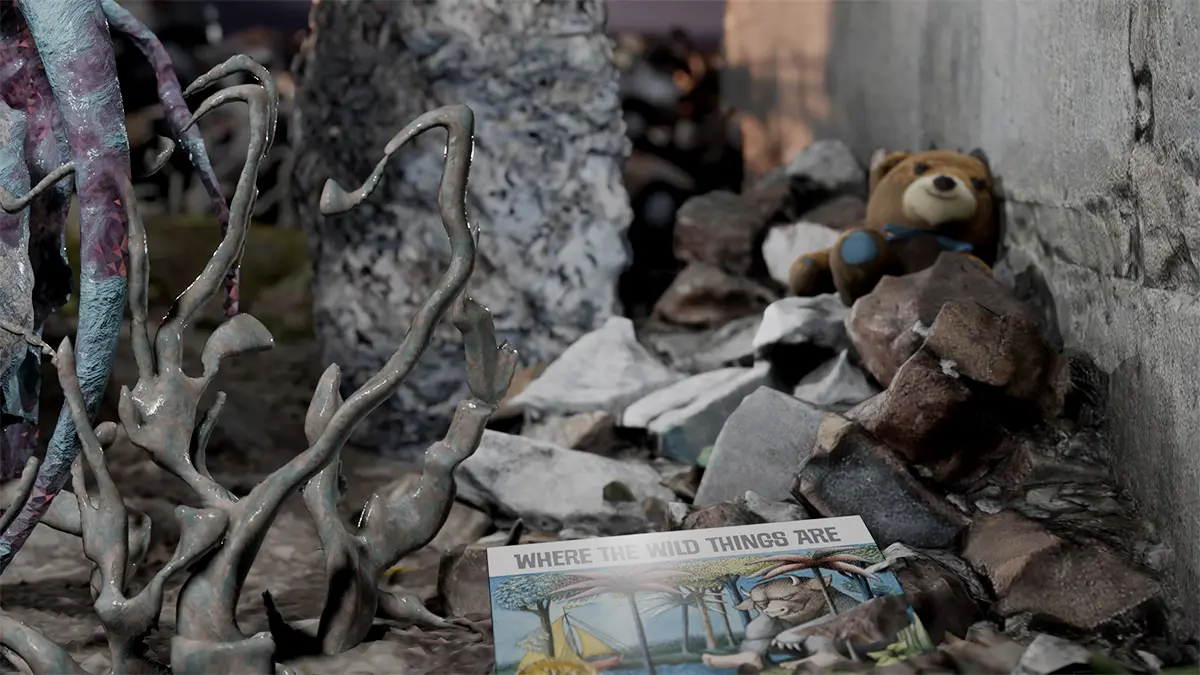
From the creation of digital ecosystems to the construction of fantastical works, Alfacenttauri employs computational processes and 3D tools not merely as technical elements, but as conceptual catalysts. His work offers a critical perspective on futures marked by crisis, while exploring new forms of coexistence between nature, technology, and worlds yet to be discovered.
Digital Art and Artificial Intelligence: The Beginnings of an Experimental Practice
“I started working with artificial intelligence when it was still a rudimentary and complex tool, even visually speaking. It wasn’t like today, where you chat with a bot, type a prompt, and get an image. You had to work at it, constantly interacting with different applications that, above all, generated errors and distortion,” he says. And therein lies part of the charm of his work.
During that period, programs like GauGAN—capable of transforming a simple sketch into an image—or StyleGAN—designed to generate realistic images from scratch—operated in an almost playful manner. The results were closer to experimentation than to automation. In 2019, that process still seemed like a kind of digital magic.
Based on that experience, his work began to shift toward a more experimental approach to digital art,“with the explicit goal of developing a unique, multidimensional aesthetic,” he says.

Maximalism as a political and aesthetic stance
To reinforce that identity, the artist—who recently turned 25—chose maximalism. “In the moment we’re living in now, as we leave the post-pandemic era behind, maximalism responds to a need. I’m interested in this aesthetic oversaturation where every form is crafted in detail and every work contains multiple layers of information, open to interpretation from different angles.”
In one of his most iconic works, a hybrid organism—half insect, half architecture—unfolds against a background saturated with acid greens and metallic blues. The surfaces appear damp, almost organic, as if they were in a state of constant mutation.
There is no single focal point: the viewer’s gaze is compelled to move across the image in multiple directions, confronted by an overwhelming accumulation of details.
Alfacenttauri and Artificial Nature
Although nature plays a central role in his imagination, his range of references draws on a personal archive that includes archaeological artifacts, landscapes, pre-Hispanic art, video games, and digital visual culture.
In a digital ecosystem already marked by visual overproduction and the attention economy, one might wonder whether maximalism functions as a form of critical resistance or whether it runs the risk of blending in with the logic of saturation that the system itself imposes.
From an early age, his relationship with the internet—through platforms such as Tumblr, Pinterest, and DeviantArt—has been instrumental in developing a sensibility focused on the observation, collection, and sharing of digital photographs.
His artistic work is particularly notable for pieces related to the world of insects and nature, approached from a personal perspective.
“Theuniverse I have created functions almost like an archive, an anthropological record of my life, of my urgent need to imagine a way out that channels my anxiety and emotional pressure”—Alfacenttauri
It is no coincidence that her influences include—alongside musical and visual references such as Björk—names like Ursula K. Le Guin, Jeff VanderMeer, and Octavia Butler, whose literary works critically explore society, politics, identity, and ecology.
Although the internet is his primary medium, his work has transcended the digital realm and the borders of Chile. He has exhibited at the Public Works Administration gallery, located in Times Square, New York.
Art and AI in Public Spaces
In 2023, he created visual artwork for the fashion show In My Memory by designer Mima Zamall, presented at Viste la Calle, and created the artwork for the CI x HKCR launch. Additionally, she designed the digital flyer for the Favela Clash event, bridging the gaps between digital art, fashion, and urban culture.
That same year and in the years that followed, her work began to occupy public spaces in a more direct way. She participated in *Cosmogonía*, an exhibition held in Santiago, Chile, and curated by M21, and was featured in *Pupila Dilatada*, an exhibition held at the Museum of Modern Art in Rio de Janeiro, Brazil.

In 2024, his work was featured at the MMMAD Urban Digital Art Festival in Madrid, alongside the Creative Campus at the European University, and he participated in *Mundos (Im)posibles*, a project presented at Tangent Projects in Barcelona and curated by Felipe Román.
The Ethical Debate on AI in Art
Recently, the artist launched the Centtauri Institute, a curatorial and research platform through which he interviews artists, curators, and creatives aligned with his project. Regarding the debate on the application of artificial intelligence to art, he concludes that there is a debate underway.
“We need to discuss ethical boundaries, but without human intervention, that technology loses an essential dimension of artistic practice: the ability to experiment, transform, and innovate.”
In this regard, Nayat Sánchez-Pi, director of Inria Chile—the National Institute for Research in Computer Science and Control—writes in the article “Artificial Intelligence and Art: A New Creative Renaissance?”, published in 2024: “Artificial intelligence is not only transforming the way artists create, but it also opens the door to new, as yet unknown artistic movements, constantly redefining what we understand by art in each era.”
Centtauri Institute: Chile and AI in Art
In addition to continuing to develop the Centtauri Institute, he plans to exhibit his new works more selectively in 2026, prioritizing dialogue with curators with whom he already has established relationships. Rather than participating in residencies or group exhibitions, his focus is on consolidating his own project.
With that in mind, he is working to establish an independent space in Chile, funded through cultural grants and external financing. “At this point, it’s not so much about participating as it is about building a space of our own for creative work.”
To keep exploring this thread, visit contemporary art from Latin America.