About six kilometers south of Tepoztlán, Morelos, lies a place that seems frozen in time; nestled amid the mist of the Sierra del Tepozteco mountains is Huehuecóyotl.
It is the first ecovillage established in Latin America, and today—nearly 35 years after its founding—it remains an idyllic retreat from the hustle and bustle—and information overload—of the big city. It’s also a place to experience life surrounded by nature. Why spend seven years in Tibet when you can also find inner peace in Huehuecóyotl over a weekend?

Huehuecóyotl means “old coyote” in Nahuatl, but it is also the name given to the Mexica deity of—among other things—art and pleasure: none other than the (not-so-holy) patron of uninhibited sexuality.
The story begins in 1982 when a group of artists, activists, and environmentalists settled in the region, seeking a sustainable lifestyle based on permaculture, a term coined by Australian biologists and ecologists Bill Mollison and David Holmgren in the late 1970s, which is the discipline that designs and plans human settlements in such a way as to enable the creation of a permanently sustainable culture.
“To this day, we uphold permaculture as an ideological principle, above all because it allows us to view nature in a holistic way,” says Andrés King Cobos, one of the founders of Huehuecóyotl. For him, this practice is, in a way, a branch of architecture in which resources are not wasted; they are used rationally, based on the harmony of nature.
“The concept behind an ecovillage is that it’s something sustainable, that it doesn’t require so much effort to build and live in—it’s almost like you’re surfing, floating within that world you’re creating” —Andrés King Cobos, founder of Huehuecóyotl.
Accommodations in Huehuecóyotl: How does it work?
The village has a shared dormitory-style hostel where guests can reserve one of the fourteen bunk beds. There are no traditional bathrooms—only outhouses. In addition, one of the thirteen houses in the community is usually available for short-term rent. All at affordable prices—between 400 and 500 pesos per person. You must deal directly with the community: no Airbnb.
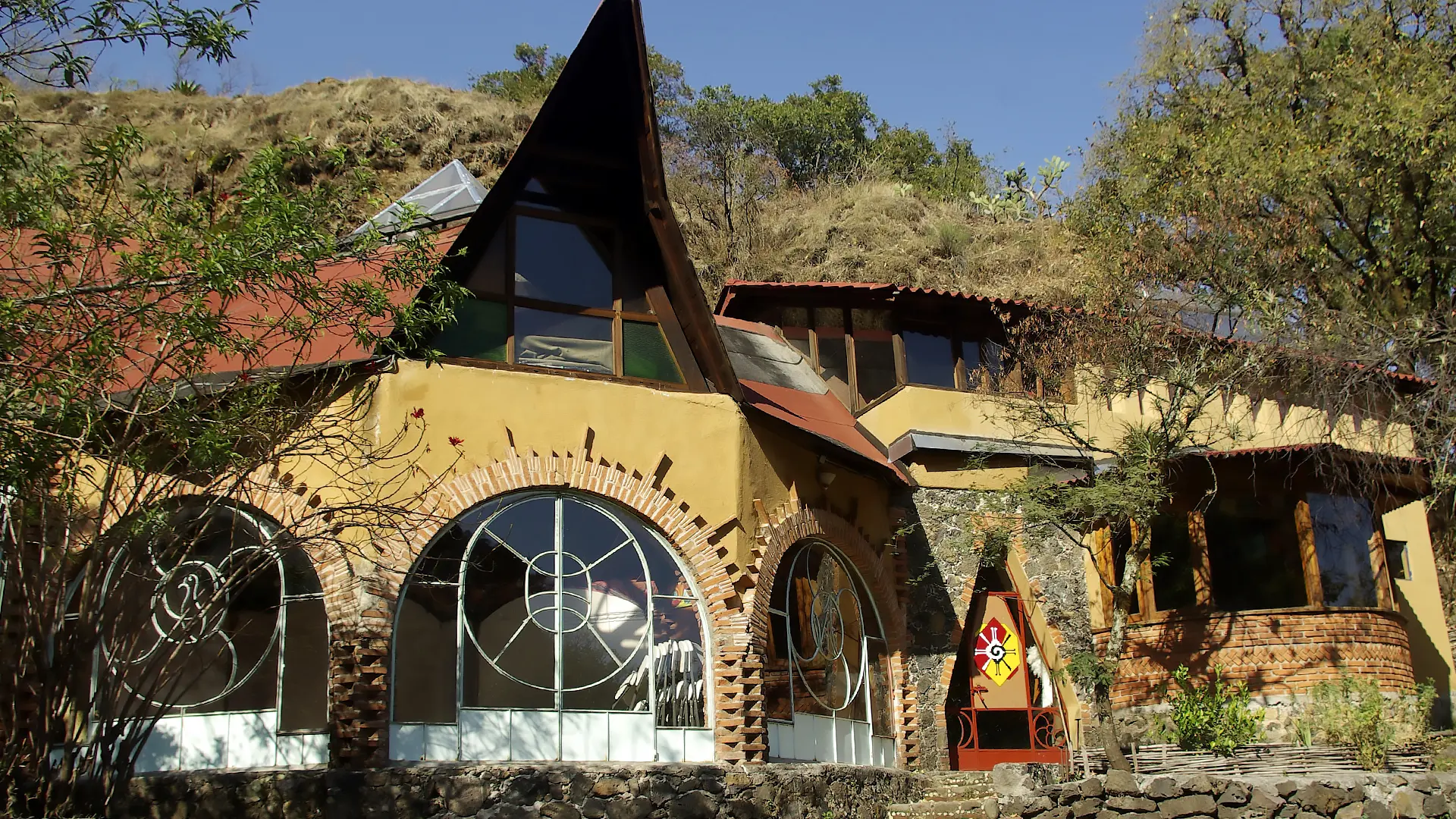
About 25 people live permanently in Huehuecóyotl , including Mexicans, Americans, Swiss, Scandinavians, and Spaniards; many of them are now naturalized citizens. The original residents brought their own building traditions with them. “With the help of an eco-architect, I built my own house,” reveals King Cobos.

These colorful homes are made from recyclable and sustainable materials, such as straw bales, tires, and bottles of all kinds, but they also make use of local materials and techniques such as bajareque—an ancient construction method common along the coasts of Central and South America—which uses a bamboo or wood framework and is supplemented with a mixture of mud, soil, and settled plant waste.
Camping in an ecovillage
If travelers prefer a more direct connection with nature, camping spots can also be reserved. The site is open to the general public, but the owners don’t particularly like feeling overwhelmed: “In fact, we don’t want too many people here, because it would completely ruin our peace and quiet,” warns King Cobos. “I could tell you there are rules, but we’re an anarchist community. So, instead of ‘order,’ we prefer to call it respect.”

Andrés, now in his late 70s, was an activist in the 1968 student movement and left Mexico after the Tlatelolco massacre. For more than a decade, he traveled to over thirty countries with the group that would later found the ecovillage. “I am proud to have belonged to that generation that was a watershed moment,” he recalls, referring to the countercultural and artistic movements—such as the Situationist International—that influenced him.
Over time, he says, he came to understand that “anarchy begins with art,” a conviction that guides his life, which is dedicated to poetry, aesthetics, and ecology. One of his books, *Árbol del precipicio* (Ed. Ambos Mundos, 2024), recounts in verse much of the local cosmogony of Huehuecóyotl.
What to do in Huehuecóyotl?
A visit to Huehuecóyotl also offers the chance to experience a Lakota-style temazcal—similar to those of the Great Plains tribes in the U.S.—or a Mexica-style one, focused on healing and Mesoamerican tradition.
In addition, the site features two small, more traditional inns—with full amenities—a circus tent, and an outdoor theater. During certain seasons, these spaces often host workshops, courses, and retreats on organic gardening, solar energy, green building, holistic health, spirituality, theater, and community development.

“Much of what we offer is about creating a space where people can interact with the residents, take an interest in a different way of life, walk around the area, and experience daily life,” the founder explains. For the time being, guided tours of the surrounding forest are restricted due to recent fires.
A place in Mexico where you can experience true sustainability
“Another restriction is that tourism involving the use of mushrooms or medicinal substances is not permitted. For that, we recommend you go to Real de Catorce or the Amazon; Huehuecóyotl is a rather artificial place for that.”
Ultimately, what this place offers isn’t just a trip, but a respite: a reminder that the world can operate by different rules and at a different pace. Sustainability isn’t an abstract concept, but a way of living in the present, and becoming part of the Huehuecóyotl community for a few days—the best time for a getaway is from October to April, when there’s little chance of rain—is an experience you won’t find in the private pool at The Royal Dubai.
Discover more weekend getaways in AW Magazine
To keep exploring this thread, visit our purposeful travel section; you can also continue through cultural weekend getaways.