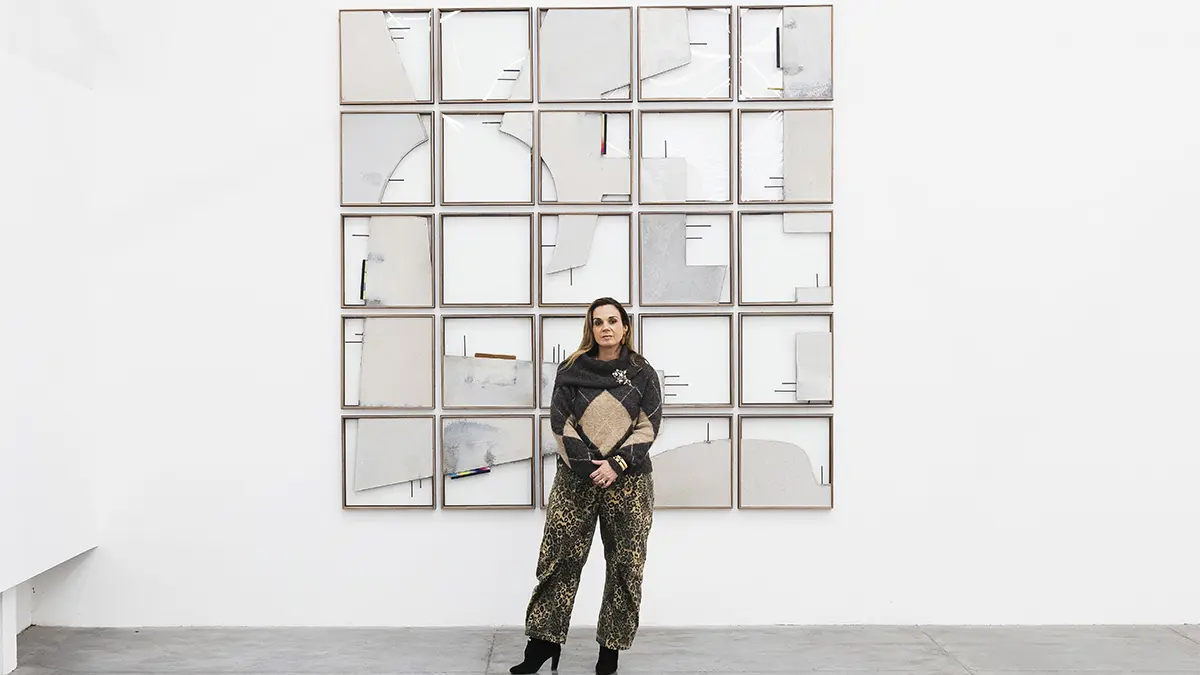
Jimena de Tezanos is not a traditional rebel, paradoxical as that may sound. However, the name of the space that bears that adjective (and which she founded herself), Galería Rebelde, is a clear statement of intent.
The Other Side of Art in Guatemala
Following the 2023 elections, Guatemala experienced what some call a “second democratic spring.” It is within this current political and social context that Jimena says one of her goals is to show the world the other side of art in Guatemala.
“Yes, a different face from the one it has traditionally had—one marked by precariousness, limited voice, and very little representation. My mission is to represent the region and the country,” he says.
We spoke with her during her recent visit to ART WKND GDL, for a brief moment—she was in high demand—against the very fitting backdrop of the gallery’s artworks and walls Tiro al Blanco. “We’re doing really well here,” she tells me. Meanwhile, she asks someone from her team—who was insisting they had to move on—to wait for her while we talk.
Jimena de Tezanos, a compulsive collector
For more than two decades, Jimena has remained at the forefront of the contemporary art scene from her home in Guatemala. Born in Montevideo, Uruguay, but Guatemalan at heart and in every sense of the word, Jimena describes herself as a compulsive and lifelong collector who has always championed the collecting of art and design in that region of Central America.

“I founded a design studio 22 years ago in Guatemala, where I worked extensively on a collaboration between designers and artists who created crafts from a contemporary perspective. It was a hybrid between a commercial space and a conceptual space, with the revenue supporting artistic production. After running it for over twenty years, I closed it and in 2019 I opened the Rebel Gallery”.
The aim of this new space was to create an exhibition venue in Guatemala that would foster cultural exchange between artists from abroad and Guatemalan and Central American creators. It also sought to transform the local art scene and develop exhibition projects capable of establishing themselves within the international art collecting and acquisition circuit.
The world’s view of Guatemalan art
As her interest in the art world grew, Jimena discovered the lack of support and resources plaguing Guatemala’s art scene: “The School of Fine Arts has been neglected; we don’t have a contemporary art museum; there are only two or three institutions that, with tremendous effort, keep the art system going.”
““Throughout my years of collecting, ever since I was 20, I’ve realized that there’s a huge disconnect between how the world and people outside Guatemala see the country and what it’s really like, both in terms of the art scene and the richness of itsculture”— Jimena de Tezanos

And it is precisely to serve as a driving force for the local art scene and a showcase for artists that Galería Rebelde was founded : “There is a great diversity in the artistic language and production in Guatemala because we have artists from different indigenous communities,” he says.
“Artists who are no longer indigenous and who have different perspectives, much younger artists who didn’t even experience the armed conflicts or guerrilla warfare and who are more tied to other perspectives, since they don’t have that memory—they lived a different life, in a different era.”
And while contemporary art often celebrates the idea of starting from scratch, when it comes to historical memory, is it really a good idea to put the past behind us?, we asked him.
“Did you know that artists are currently returning to textile traditions?” asks Jimena. “They’re going back to the tradition of woodworking and that great quest. I think stepping away from technology in their production is a good thing; artists are starting to paint again, they’re starting to work with ceramics.”

What is the CARA art network?
Recently, the gallery owner founded Central American Art Network (CARA), a network founded by art professionals and local institutions. Together, these individuals foster synergies to promote the region’s artistic initiatives—from Guatemala to Panama—around the world, particularly in Mexico, the United States, and South America.
Among CARA’s plans is to organize an exhibition in November 2026, in the style of a major art fair and featuring four different curators. This upcoming event will showcase Central American art, featuring the work of Central American artists who have had to leave the region and are now practicing their craft from other countries.
“And, of course, Guatemalan artists,” he concludes. He takes a sip of his coffee and glances back at the pieces surrounding us, as if to say goodbye.
To keep exploring this thread, visit contemporary artists and galleries.