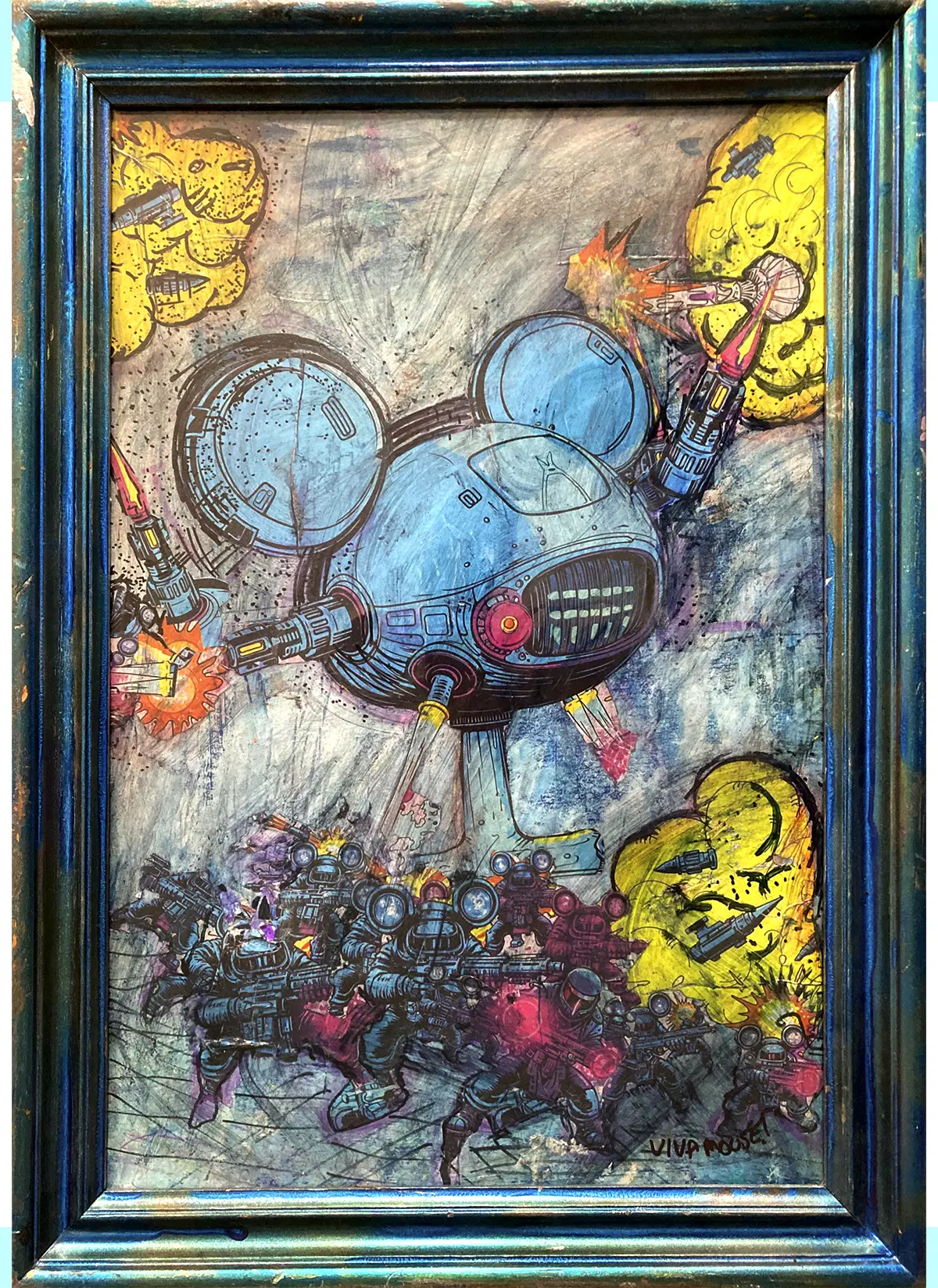

“No matter who holds power in the land of Viva Maus!, they can change their presidents, they can change their rhetoric, but their logic remains intact—they are belligerent.” The above is part of the manifesto Viva Maus!, a collective whose members do not show their faces, call themselves “mice,” and display a number as a form of identification.

When you visit their website, the first thing that catches your eye is that they have a love-hate relationship with Mickey Mouse, a long-standing symbol of pop culture’s dominance. However, the Guerrero-based visual artist Pavel Aguario doesn’t hide his hand after throwing the stone: he is the creator of this initiative, whose members are mainly students from the visual arts workshop he directs.
Where does *Viva Maus!* begin? It can be read as a deconstruction, but also as a tribute
The last thing I want to do is make excuses, although if that helps people understand my work, then so be it. But Long live Maus! is not a celebration; on the contrary, it is a critique.
And how do the students taking a painting workshop get involved? Do they actually realize that they are participating in a critique or a systematic experiment?
Yeah, well, there are three of us “mice”: Mouse 1, Mouse 2, and Mouse 3. Mouse 2 is the one who understands the concepts best—even better than I do. Mouse 2, who’s a teenager, really gets the idea. Some of their parents are also part of the club and are behind the masks. We’re all in Mexico City, except for a couple who are in the United States.

Regarding the censorship you’ve faced, where did it occur and why?
The first one—and the one that hurt the most—was at the Museum of Contemporary Art at the Autonomous University of Guerrero. We had the entire concept of the exhibition all figured out, but shortly before the opening, they told us we couldn’t exhibit there. And we were really frustrated. Then came the YouTube takedown; we never knew why or who complained, but at the university, we know it was the president.
And what was the reason for that? Maybe the president never got to go to Disneyland, right?
Well, I don’t know. We were told the order came from above, and the only person above us is the president; or the cultural affairs department, but we had a very good relationship with them, so it must have come from him.
Can I buy physical and digital copies of *Viva Maus*?
Yes, and we have a wide selection of physical artworks, ranging from very large pieces to very small ones, as well as modified works and more…
Which do you value more, a digital work or a physical one?
Well, the artist creates both types of work with the same passion, the same intention, and devotes the same amount of time to them. But on the physical side, there are also curators and intermediaries, and although what matters most is the final piece, I might prefer the tangible ones because more people are involved. But I also greatly value digital art.

What influences—and what anti-influences—do you have? What do you avoid when creating these pieces?
Well, to start with, we have Maushaus, which is the “mouse” version of the Bauhaus. Our influences are quite varied. Basically, graffiti—now that Banksy’s been unmasked—was one of our influences.
Do you think it’s him?
I hope it isn’t him. But to answer your question, contemporary art from the 20th century and the early 2000s is also a point of reference, especially the kind that critiques imperialism. That is our main task. Someone once asked me if the art of Viva Maus! was against Donald Trump.
Isn’t that right?
No, this is not a criticism of all governments and global imperialism.
You’re changing a symbol, but at one point Disney itself used Donald Duck in war cartoons for propaganda purposes against Nazism…
I mean, Disney is an icon, isn’t it? It can be representative of both sides.
Originally subversive cartoonists like Matt Groening are fans of Mickey Mouse
He worked with Fox for many years and has now sold *The Simpsons* to Disney. Actually, when we create our work, it’s not directed against people or characters. The system is Fox, it’s Disney, it’s Matt Groening. I mean, everyone is acting in favor of the system, which is the one that wins in the end. And those of us left out are everyone else.

How experimental is *Viva Maus!* within the realm of contemporary art?
We think we’re pushing the system to its limits, but we’re not subversives or anything like that—we’re just presenting a very small dilemma. We’re neither subversives nor guerrillas.
“I don’t know if we’re contemporary art. I don’t think our art is that pretentious.”
Is there also some self-criticism in*Viva Maus*?
Yes, absolutely. The critique is also internal. It’s not just about pointing out “they’re the bad guys,” but about recognizing that we, too, have allowed ourselves to be colonized in every way: through language, methods, and perspectives. It’s a self-critique of accepting a subordinate position within that logic. For example, superheroes almost always come from the United States and are the ones who “save us.” So we question that too: no one is going to come save us. That idea is part of the dominant logic, and we want to challenge it.
We ended the conversation thinking that perhaps many of the graphic icons of the future will be altered versions of Mickey Mouse, like the ones proposed by Viva Maus!, because the traditional ones are already (literally) a thing of the past.
To keep exploring this thread, visit contemporary artists and galleries.