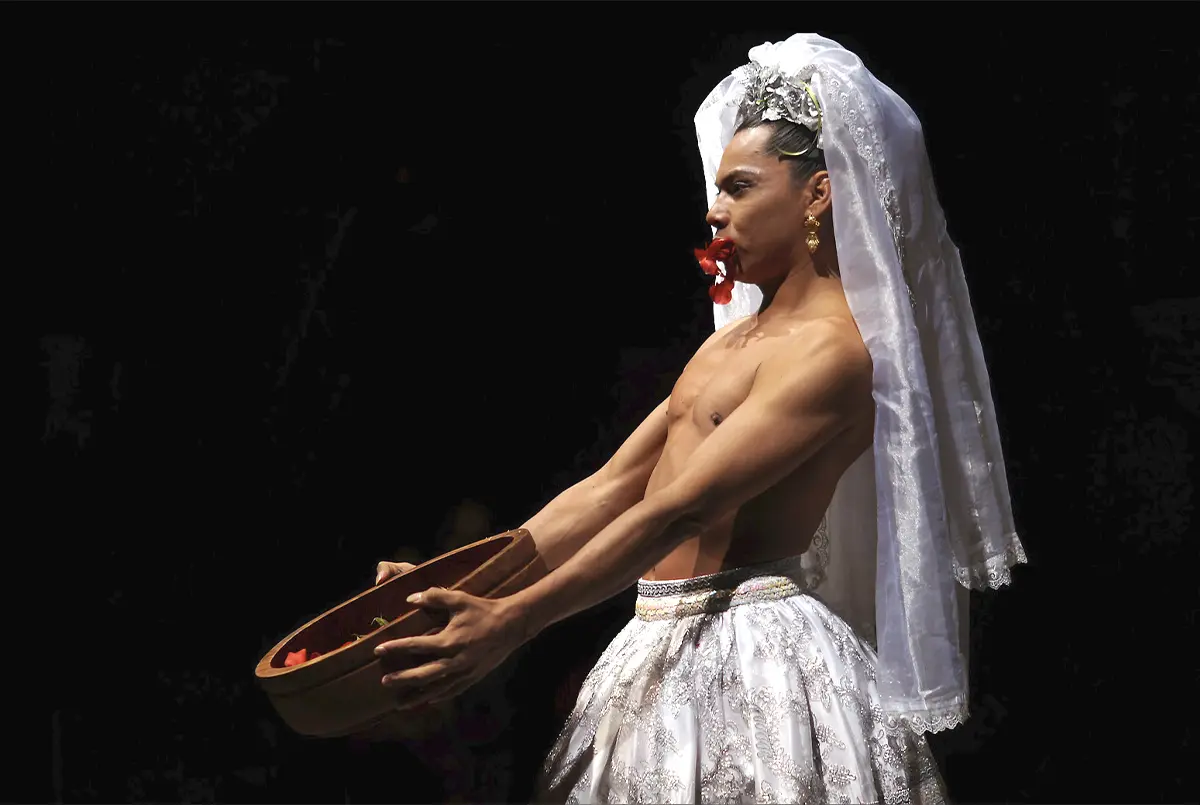

Budaya is a project that emerged between Guanajuato and Durango, Mexico. We never would have imagined it, since those regions aren’t traditionally known as hotbeds of electronic music. But fortunately, the hybrid didn’t turn out to be a mummy dancing the pasito duranguense. The result is a duo with an interesting track record that, under the Arts & Crafts México, remains at the forefront of dance music made on this side of the planet Earth.

Maya Piña and Tulio Almara make up this duo. For their latest release, they’ve teamed up with Wet Baes, a Mexican producer and musician who collaborated with them on the single “Querer (sin querer tener).” The track is part of their upcoming album, which also features artists like Ely Guerra. We spoke with them for AW Magazine.
“To Love (Without Wanting to Possess)” stems from a reflection on love and the way we understand it within a culture that has historically associated it with possession, drama, and dependence. “Yes, the inspiration came from both friendship and romantic love, and how we perceive them based on the value we place on the possessions or relationships we engage with, ” explains Maya.
For her, the problem lies in the fact that the collective imagination—fueled by Mexican soap operas and Hollywood—has reduced love to a narrative of possession. This narrative overlooks the possibility of appreciating love through freedom, the mind, and one’s own space. In that sense, the song proposes a different idea: to love without possessing.

Emotional maturity and possessive love
“I think the key concept is ‘emotional maturity’—seeing everything through the lens of non-possessive love. It’s a song that doesn’t say ‘I love you, I hate you, or let’s dance,’ but rather has a slightly more mystical message. All of this, without it turning into a tongue-twister or something that requires a lot of depth to understand,” says Wet Baes.
In recent years, following the various waves of deconstruction that have marked the start of the decade, the notion of possessive love has begun to change—fortunately. For Budaya, this change has not been entirely organic. “It should be natural,” they reflect, “but we have lost sight of what is essential; everything is mediated by capitalism, even the way we love.”
Maya’s reference to the German psychologist Erich Fromm —who defined love not as a fleeting feeling or a spontaneous emotion, but as an art that requires knowledge, effort, and discipline—is no coincidence. The song engages with that tradition, which views affection as a practice rather than a possession.

Latin influences in electronic music
“When we first started out, we felt there weren’t many role models in Latin America for electronic music, but today we definitely feel part of an ecosystem of projects like Buscabulla from Puerto Rico or Rubio (from Chile), and of course Wet Baes and many other Mexican artists, but I feel that it has managed to permeate the scene and that there are many projects that have understood how to showcase their Latin identity and the beautiful Spanish language in more avant-garde genres.”
The video was directed by Yussel Estrada, who was in charge of cinematography and color grading, while Maya, along with a group of friends, handled the art direction, costumes, and overall aesthetic. The location, Agrio Club, provided an atmosphere that reinforced the project’s artistic vision.

Warning: If you suffer from severe obsessive-compulsive disorder (OCD), this video may trigger anxiety—the peeling walls, for example.
““The intention was to embrace the visualizer format—effective in the digital age—without sacrificing complexity or ‘compromising’ creativity for the sake of merefunctionality”— Budaya
The conversation between Budaya and his guest inevitably turns to technology and its impact on music. For Wet Baes himself, the 1980s and 1990s marked a turning point: they were the first generations to experience the democratization of technology and the tangible promise of the future.
How sound evolved and “the worst thing that could have happened to music”
“I think those were the generations that genuinely experienced, for the first time, the democratization of technology and a real sense of what the future held. I think they really got into discovering and transforming how sound evolved—which, for many purists, was the worst thing that could have happened to music, right? That everything shifted from bands to people doing things on computers.”
Budaya will be performing in Mexico City on a date yet to be announced in April, coinciding with the release of this new collaborative album. In the meantime, the duo and their current collaborator invite us to reflect on love from the dance floor.
And yes, as I was saying “Dancing with tears in my eyes”, the classic single by the British band Ultravox: it’s okay to dance with tears in your eyes if it’s for a good reason, but also to learn to let go. After all, “contemplation” is what the group promised from its very name: Budaya, a word linked to the concept of akal budi (mind/intellect) or kebudayaan (culture) in Indonesian philosophy.
To keep exploring this thread, visit music, film and cultural stories.