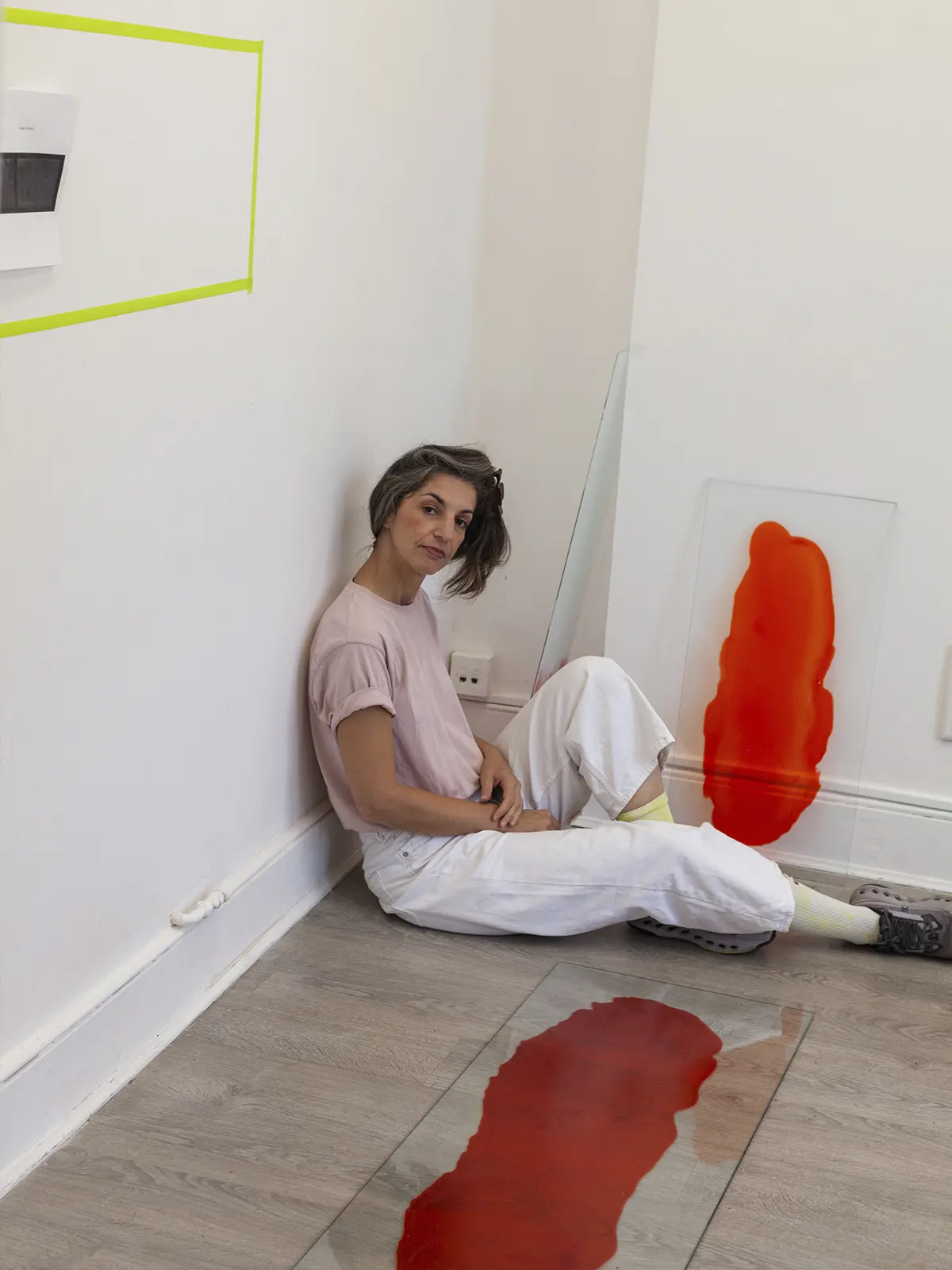

At the entrance to the Zapopan Art Museum (MAZ), located in downtown Zapopan, stands a large-scale two-part work that resembles a sort of “black hole.” I soon learn that the piece is made up of multiple individual parts produced at the legendary Cerámica Suro, in Guadalajara, Jalisco. “It was first installed in Mérida, and this is the second time it has been mounted,” explains Alejandra Laviada. “It represents the interior and the exterior. The idea of time is more universal, cosmological,” she adds.

The Concept of Time in the Work of Alejandra Laviada
“Science and quantum physics talk about time in a way that differs from our human perception—this idea that there is a past, present, and future,” he tells me earnestly.
Isn’t there any? “I ask him as we walk through the museum’s hallways looking for a place to talk.”
“No. There are theories that suggest time consists of a series of events occurring simultaneously across multiple dimensions—not in a linear fashion, but rather in a circular one. That’s the starting point for these two pieces,” he says.
“That whole idea resonates with me in so many ways—like the movie *Everything Everywhere All at Once*. Oh, that movie—when I saw it, I thought, ‘That’s exactly like how I’ve been reading a lot of science books that say time also has multiple dimensions.’”

The ladder caused the house to collapse
Finally, we found an empty office where we could talk, and Alejandra Laviada got right to the point: her current exhibition, titled *La escalera hizo caer la casa*(The Staircase Brought the House Crashing Down), which is on view at the same MAZ and curated by Viviana Kuri Haddad and Maya Renée Escárcega.
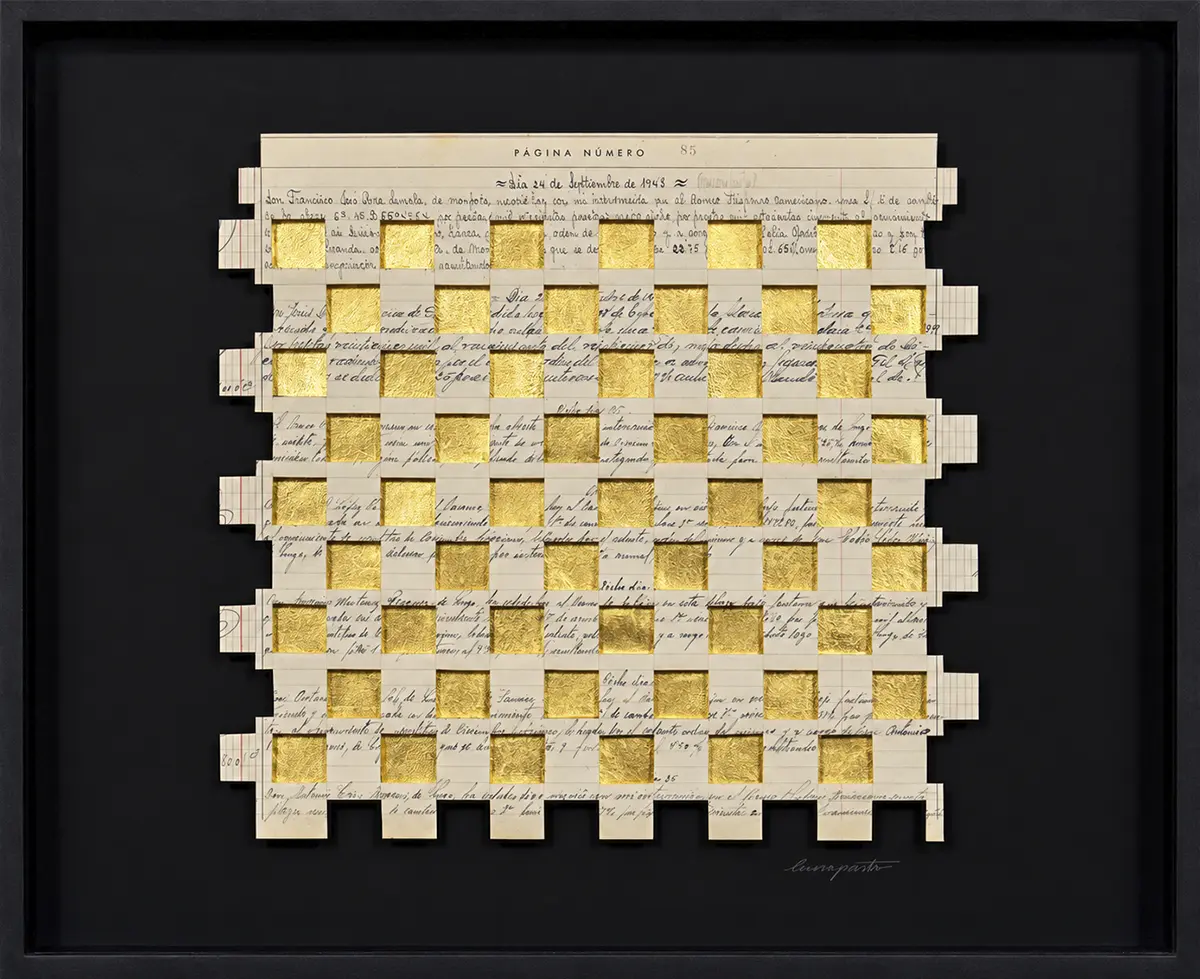
The work—whose title sounds very Cortázar-esque to me, though I’ll soon discover it has nothing to do with him—explores the concept that “every structure is born as a ruin,” while also questioning the transience of domestic spaces by using objects salvaged from demolitions to create sculptures that establish a unique dialogue with photography.
“That idea that spaces have almost a life of their own has always interested me. One of the artists who has influenced me the most is Robert Smithson, from the 1960s and 1970s.” For Alejandra, Smithson is not just a historical reference but a way of thinking; she is especially interested in his writings, particularly those that emerged from his travels to Mexico.

“He died very young, but he left behind a great many writings… and there’s one called *Ruins in Reverse*, in which he talks a lot about entropy.” That text serves as a starting point for observing the immediate context.
“I’m really struck by how new buildings in Mexico create a certain ambiguity. For example, when someone builds a house and leaves the rebar in place for a second floor that may never be built…”, that suspended state, where structures seem to be under construction and finished at the same time, is another of the themes that influenced *The Staircase Brought the House Down*.
“So you don’t know if it’s under construction or if it’s already finished.” That ambiguity isn’t resolved; rather, it’s part of the everyday landscape that Alejandra observes, as if every building already bore the marks of its own wear and tear.
“And the moment a building is completed, it begins to fall into ruin.” Alejandra is interested in understanding these processes as part of broader cycles of transformation.
““Change is the only constant, but our human nature tries to resist it. It’s like fighting against something that inevitably decays, transforms…”— Alejandra Laviada
The exhibition features sculptures made from objects salvaged from abandoned homes that are about to be demolished or completely renovated. The interview continues, and with that context in mind, the conversation becomes more direct.

So, your art is about what obsesses you—in a good way—what makes you think, right? The things you get really absorbed in. Is that where it comes from?
Exactly. And well, the interior space is different because I feel like this idea of time is more on a human scale than a domestic one. It’s very personal. So, there are all these theories, and then there’s also how we experience time, how we perceive it in our daily lives; in the end, it’s a matter of perception.
So is that where the title comes from—from those theories?
No, it comes from a book written by a French author named Georges Perec, called *Species of Spaces*. He was a cross between a writer, a poet, and an artist.
Moving from photography to sculpture is a shift from two dimensions to three, isn’t it? I mean, why did you make that decision? .
Well, I first explored painting, then photography. I found my medium in photography for a long time, but my photographic process was to think of it as a blank canvas and build something.

But you had nothing to complain about when it came to the photography, did you? It wasn’t like it held you back or anything.
I felt there was more I could say by taking it a step further. And I’m not closed-minded: I believe photography is just one medium in my work, but it’s not the only one.
In April 2026, you’ll be taking part in an exhibition at the Jumex Museum centered on soccer…
Yes, Guillermo Santamarina is curating it, and it’s called ” Soccer and Art.”
Do you like soccer?
I love soccer. Plus, my grandfather was a professional soccer player in the 1930s. His name was Carlos Laviada. He played for Club España, which no longer exists, for Asturias, for Real Oviedo, and in Madrid. Apparently, he was the first foreign player at Real Oviedo. So, he was a big deal. I never met him—he died a year before I was born—but I found his collection several years ago—photos, newspapers, magazines—and I started digitizing everything to figure out what to do with it.
The exhibition by the artist, who is based in Paris but originally from Mexico City—“I have a foot in both places,” she explains”—whose work has been shown at the Jumex Museum, the Museum of Fine Arts, Houston, and the Centro de la Imagen in Mexico—as well as in several private collections—will be on view at the MAZ through June 14, 2026, in the museum’s Lola Álvarez Gallery.
Taken as a whole, Alejandra Laviada ’s work not only challenges the way we inhabit space, but also the way we understand time and the transformation of everyday life.
To keep exploring this thread, visit our contemporary art coverage.