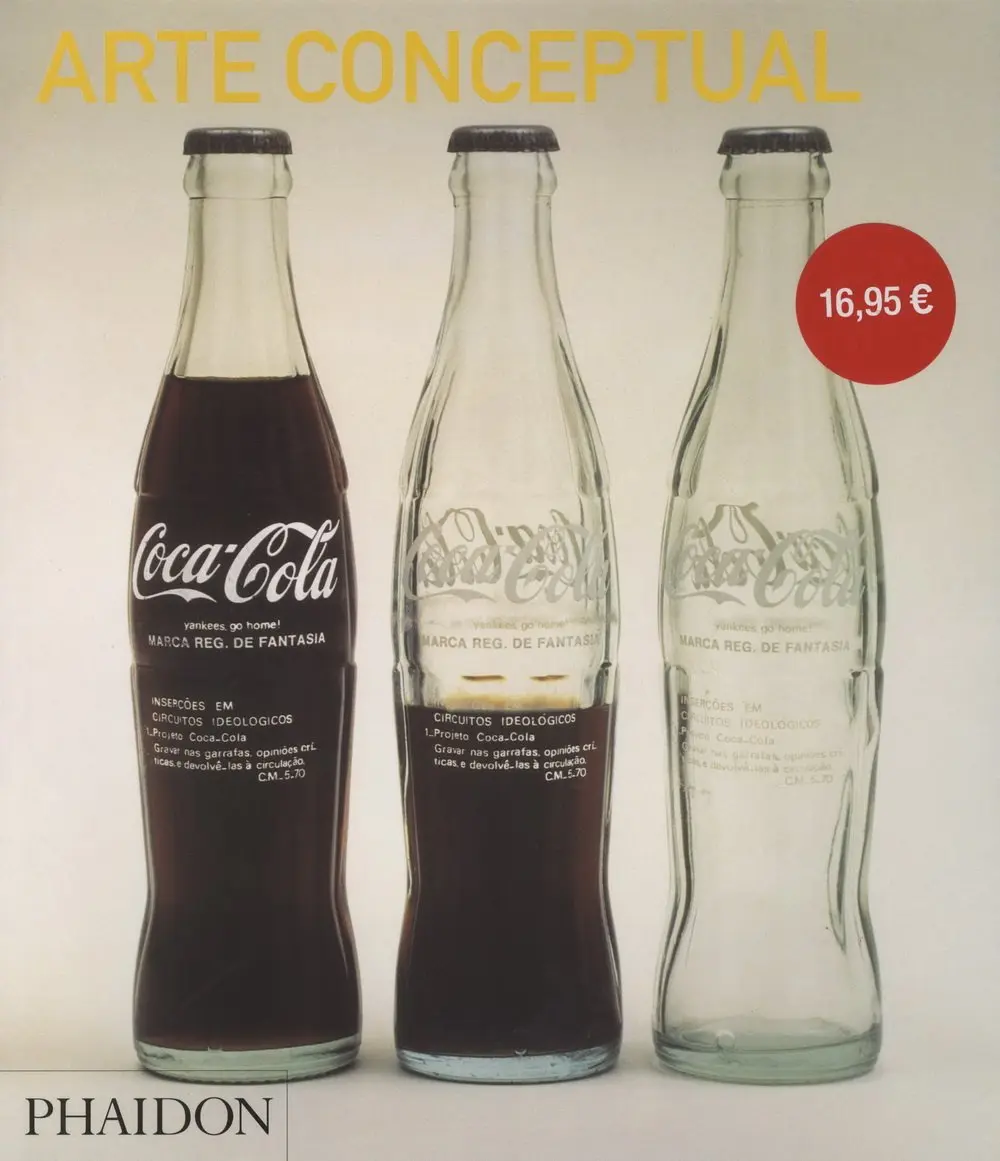

The story goes that Cildo Meireles and Andy Warhol once walked into a bar. Meireles was holding a bottle of Coca-Cola with the message: “Yankees go home.” It is said that Warhol was outraged and almost hit him because those products were iconic and sacred within the liturgy of pop culture.
Of course, the story isn’t true—we can’t imagine Warhol hitting anyone—but it helps us understand something key: that in the 1970s, there were those who turned consumption into art… and those who turned it into criticism.

Meireles: A Provocative Career
Both perspectives are valid. The fact is that the Brazilian conceptual artist Cildo Meireles (born in 1948 and still active) has, throughout his consistently provocative career, addressed issues such as the military dictatorship in his country. And, of course, Latin America’s economic dependence on the global market. A nationalist? Perhaps, but not in the fascist sense of the word—quite the opposite.
The artist was awarded the Velázquez Prize for Plastic Arts, awarded by the Spanish Ministry of Culture, which, in a way, clashed with his anti-capitalist stance. However, to his credit, he himself had mentioned his aversion to art when it became a propaganda tool.
Well, a couple of nostalgic, out-of-touch hippies might well have been disappointed. But for Meireles, the recognition was well-deserved.
“In my exhibitions, I have always tried to avoid being overly didactic. Because I know that within art, within the field of art, works must engage with the history of the art object. And work within that evolution,” he told the South American digital magazine Antishock in 2013 .

What was the Coca-Cola Project?
The series of works we are referring to—which is quite extensive, but this is his most memorable piece— Projeto Coca-Cola—was conceptually subversive. The artist decided to engrave critical messages on the returnable glass Coca-Cola bottles that were in style at the time.
And then he would put them back on the market. It’s hard to imagine the surprise of anyone who came across phrases questioning militarization and the influence of capitalism. If this had happened today, Donald Trump would probably have labeled him a terrorist.
The truth is that, in a way, this provocation did make clear the intention to reimagine certain untouchable symbols and give them a new meaning. In other words, “the medium was the message.” And the fact is that, in addition to the bottles—which might have outraged the seemingly frivolous Warhol (though he would most likely have loved them)—in his role as an obsessive chronicler of his country’s culture, Meireles also dared to literally intervene with money.
In Inserções em Circuitos Ideológicos the artist stamped or altered real banknotes with political messages or changes to their value. His goal: to have art circulate within the economic system, infiltrating everyday life and leaving some housewife perplexed as to why a zero-value bill had ended up in her hands.

According to the artist, the goal of his works—which span installations, sculptures, and conceptual art—was to “jolt” the consumer audience, creating works that were not merely individual objects, but rather a strategy that came to life outside conventional art spaces.
The above, in a sort of “ready-made”— that is, taking ready-made or everyday objects and turning them into works of art through the artist’s selection and the new context in which they are presented—…in reverse.
Another of his works, *Cruzeiro Zero*, is an exact replica of a cruzeiro bill—the currency of the time in Brazil—which, paradoxically, is worthless. Instead of the usual historical and heroic figures, the artist replaces those faces with the image of a local indigenous person and that of a patient in a psychiatric hospital.
The piece offers a direct critique: it addresses hyperinflation and the devaluation of the cruzeiro, but it goes further. It questions what we mean by “value”—both in money and in art—and highlights Brazil’s marginalization within the international art world.
Cildo Meireles Today
The artist continues to exhibit his work in museums and galleries around the world, and has had recent and ongoing exhibitions in Europe (Paris, Brussels, etc.) between 2025 and 2026. Many of the current exhibitions are retrospectives or projects that revisit key works from his career, such as the aforementioned interventions.

Yes, he continues to question the values of identity, culture, and money, but today in a less confrontational way, in installations such as *Babel* or *Desvio para o Vermelho*. All of this takes on a more experimental tone and appeals to personal perception. We don’t know if he still drinks Coca-Cola, if he ever did, or if he just used the bottles as materials in his studio.
Rather than creating objects, Meireles disrupted the circuits through which those objects acquire meaning, and made us see that even the most mundane things can be subverted. And that everything can be used as an ideological weapon.
To keep exploring this thread, visit contemporary Latin American art.