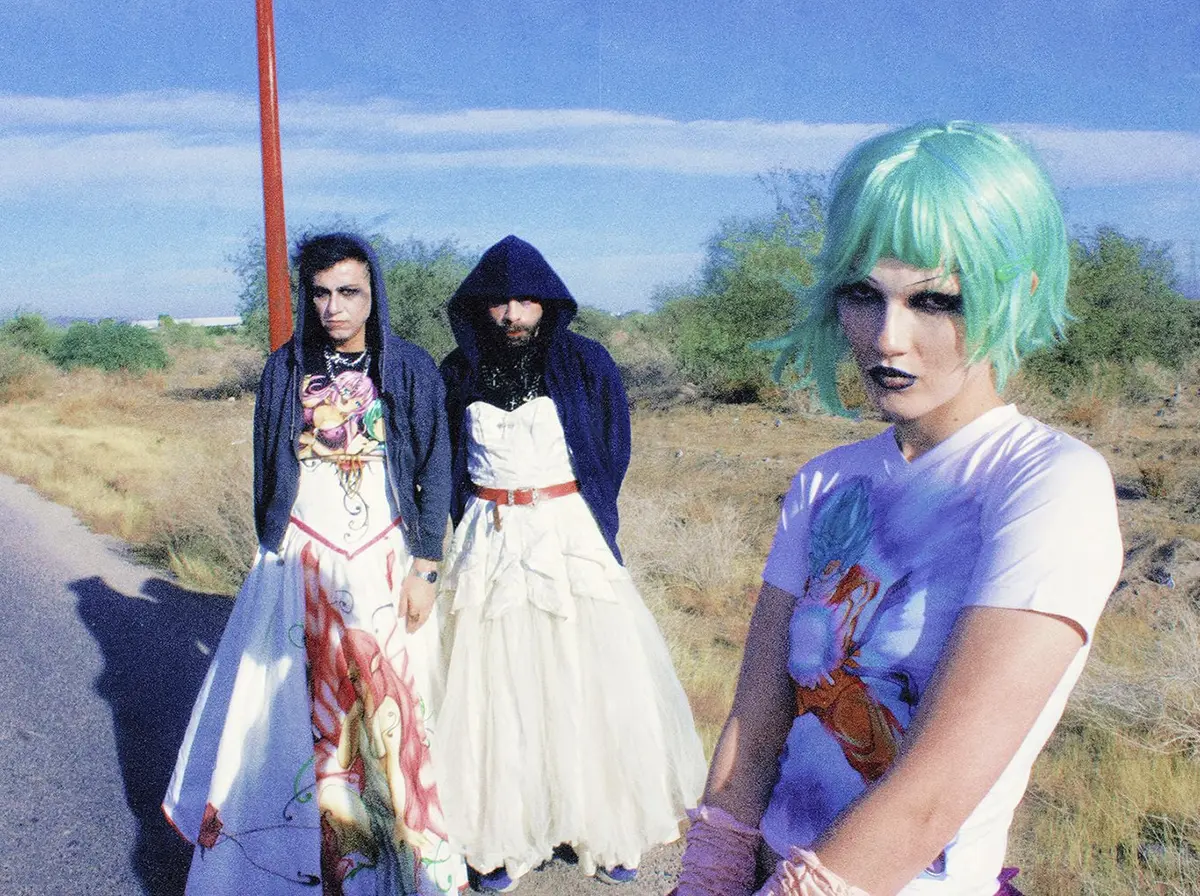
I’ll admit it: Meth Math used to scare me. After catching a glimpse of their photos on social media, reading that their style was occult neo-perreo, and watching their videos full of references to Gen Z mythology, vaporwave, electro-pop, and their twisted samples of quinceañera tunes, they terrified me more than the possibility of running into the gothic cholos from Prayers on a lonely early morning in an unfinished neighborhood in some border town.
After contacting To Robles, one of the founders of Meth Math, for this interview and learning that, in addition to being a musician, he was a high school math teacher—hence the band’s name: a play on words between the subject and amphetamines—the mystery lost some of its intensity. Plus, I found out that To had been part of Milkmoon, a band I’d crossed paths with years ago on the electro-clash scene and on MySpace; with those references, I relaxed.
From “Perreando y llorando” to making a name for herself in the Mexican electronic music scene
After all, it turns out Meth Math wasn’t actually a cult in the Sonoran desert that held nightly perreo rituals where they sacrificed cats. Or so I think. What remained undeniable (and still is) is that it’s one of the most interesting projects on the Mexican electronic music scene. The trio, originally from Hermosillo, Sonora, consists of To Robles (Bonsai Babes), Angie Ballesteros, and Efrén Coronado (error.error). You can accuse the group of anything—even of being Satanists or cyber-nihilists—but not of lacking originality.
“No, to be honest, I’ve never actually cast spells,” To reassures me. “All of this comes from the references in Meth Math, from culture, from movies,” he explains. “I’ve always liked those slightly dark things, like Marilyn Manson, Nine Inch Nails, or Portishead, which had that melancholic, atonal, and dissonant quality.”

The band, which released its debut album in 2024, started out as something spontaneous, almost overnight. “It just happened when the three of us got together to play; we started doing weird electronic covers of Britney Spears and Sonic Youth.”
The History of Meth Math
It all started when Angie, who is from Sonora—but has been living in Mexico City for years—was bored during a visit to Hermosillo and posted about it on her Facebook status. Then, error.error invited her to make music. To joined the fledgling project. That’s how their first song came about: “Perreando y llorando.” Later, someone played the songs for the label In Real Life Music in Los Angeles, California, a label that signed them and with which they are still signed.
“The ‘neo-perreo’ label was coined by Tomasa del Real,” To acknowledges, “but once we met her, she told us to use it, and even though we’re not just that and our songs incorporate other styles, we don’t mind being classified that way.”
More than just a label, the neo-perreo in Meth Math serves as a strategy for merging seemingly conflicting territories: taking a genre historically dismissed by the alternative scene and turning it into an aesthetic laboratory.
A die-hard Cocteau Twins fan would hardly have a reggaeton song in their record collection—or on their playlist. And yet, the trio boasts influences ranging from the dream-pop of the aforementioned Scottish band to Mecano and the Spanish artist Soto Asa. The latter claims he makes reggaeton of the future; Asimov and Bradbury surely never imagined that by the year 3000, everyone would speak like a Puerto Rican.
““Back then, those of us who listened to alternative music were embarrassed to listen to reggaeton, which isn’t the case now; things used to be more pretentious—we were afraid of tropical music and turned our backs on Latin rhythms. Now, what’s frowned upon is dismissing anygenre”— To Robles
And I agree with him: years ago, no alternative band would have written a song called “Bad Rabbit” that included lines like: “You don’t know how I feel, you’re on my mind every time I wake up, your name in the wind…”. It would have been like, say, Fobia dedicating a song to Chayanne. It’s no wonder that Meth have also been labeled “a nightmare version of Latin club music.”
That rejection and disdain for cultural snobbery reveals that the Meth Math generation seems to have understood that the future of Latin electro-pop isn’t about purism. On the contrary, the more it gets dirty as it wades through the swamp, the better.
Who is Angie Ballesteros?
But while To is the group’s existentialist and, alongside error.error, its sound craftsman, it would be a real mistake not to mention that Angie Ballesteros—the mysterious singer (though perhaps if I’d spoken with her, she’d be a little less mysterious)—is the one who brings that visual and fashion element to the table. Her fashion retail projects, such as Baby Angel and Antes de Cristo —a designer clothing store in Mexico City—speak volumes about this.

“Angie is very visually oriented; she grew up surrounded by art,” she says. Her mother is a painter, and her sister is a writer, watercolorist, and documentary filmmaker: Fernanda Ballesteros. In addition, Angie (who sometimes goes by the name Ángel) directs and comes up with the ideas for Meth Math’s videos.
Despite their arty and experimental roots, the band also seeks to find its way toward simple, straightforward pop. But there’s a catch: their tastes aren’t exactly conventional. “Every time we’ve tried to create a sound that’s a little more straightforward and decided to experiment with pop in its purest form, it never works out; darkness and strangeness emerge. We like it to be clear that it’s pop, but at the same time not entirely digestible: we want it to be experimental, appropriate, and colorful.”
Meth Math and the convergence of urban music, electro-pop, and digital tools
Their music features elements of urban music, cutting-edge electro-pop, and hyper-pop. The vocoder is a staple in their tracks, as are glitch and classic perreo beats—sounds we can now hear just as easily at a street party in a Latin American suburb as at an exclusive nightclub in Europe.
Yes, even though Meth Math has that catchy pop and electronic sound, their friends often tell them that their songs always end up having a dark side. “Even when they want to make something cheerful, they always end up making something dark, they tell me,” To reveals. “But what I see is that there’s beauty in a cold, dark place too, isn’t there?”
For To—who, in addition to AutoTune, considers the smartphone to be this generation’s key musical instrument—the group’s influences are varied and timeless, ranging from The Knife, Enya, and Autechre to Gloria Trevi and Belinda. In some of their songs, such as “Chairo,” there are nods—presumably ironic, and To chooses not to clear up the ambiguity—to Aleks Syntek.
Meth Math isn’t just playing at being a digital nightmare: he’s brought his danceable darkness to stages where perreo coexists with contemporary art. They’ve played at the Knockdown Center and the Boiler Room booth in New York, at the Echoplex in Los Angeles, at Corsica Studios in London, and at Paradiso in Amsterdam; they’ve also performed at festivals like Ceremonia and Mutek MX, and even Les Nuits Sonores in France. That’s no small feat for a project that was born, literally, from a Facebook post.

Meth Math: AI that raps with superhuman flow
In 2026, the trio plans to release a new album tentatively titled *Tranqui*. The album will be released on vinyl, like their previous works. The interview ends, and the idea that Meth Math are part of a collective that reimagines urban music and blends it with the campest elements of the ’80s and the experimental spirit of a dream band for the curators of the Mutek Festival remains . Those legends I made up in my mind no longer seem so strange to me.
I still ask To why Angie sometimes signs her name as “Ángel,” and it’s simply because her real name is Angélica—there are no Illuminati implications involved. It seems Angie actually exists and isn’t an AI model who moves to the meta-human flow of Maschinenmensch, the robot from the movie Metropolis. Or well… maybe that’s what they wanted me to think. After all, maybe Meth Math isn’t a nightmare, but the inescapable soundtrack of a generation that no longer distinguishes between the club, the algorithm, and the museum.
To keep exploring this thread, visit music, film and cultural stories.