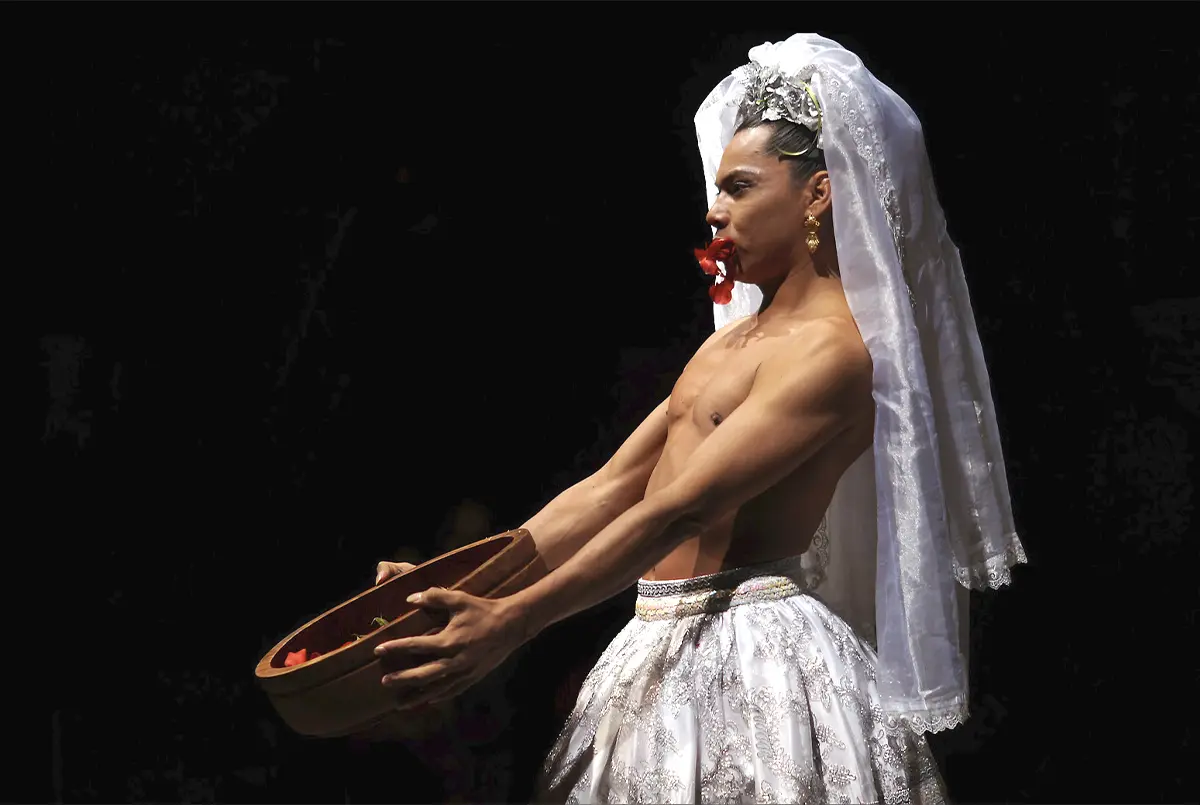

On February 27,Oaxacan producerMiroslav Ü performed in Mexico City as part of RAÍCES: Deep Roots Sound That Unites, an electronic music event that blends techno, house, and references to memory.

Miroslav Ü and the People of the Clouds
Miroslav Ü and Electronic Oaxaca: “In this region, we sometimes forget that we were Zapotecs, and that inspired me to give the concept an identity,” says Miroslav Ü, the name behind the mask that brings to life a project that fuses house music and cutting-edge electronic music with traditional sounds.
Binnizá is the name the Zapotec people use to refer to themselves, and it means “people of the clouds”; hence, Miroslav Ü’s musical style is described as an “alebrije of the clouds.”
Miroslav Ü draws on the languages of pre-Hispanic Mexico to forge a link between ancestral worldviews and the avant-garde. We spoke with the young producer and DJ, who released his new album *OLLIN* —which means “movement” and “vital energy” in Nahuatl—in January 2026.
Miroslav Ü and his pre-Hispanic references
“Miroslav Ü was born in 2022 with Oaxaca in mind first, not electronic music,” he explains.
The project has been presented at venues such as the Mezcal Fair at the Oaxaca Cultural and Convention Center; the Tsasná Festival and Chiibal Sound Fest; in addition, the artist gave a masterclass on pre-Hispanic electronic music at Anáhuac University in the same region and was the opening act for Paul Van Dyk’s concert in May 2025.
His work clearly draws on the past. “Long before the last Zapotec ruler in Oaxaca—Moctezuma II’s nephew—there was already a conception of art in which dance, song, and celebration were part of everyday life,” explains the 26-year-old artist, whose real name is Uriel Mendoza.

“That’s why the preservation of the language is so strong, and why it has been able to survive through syncretism. Although the Isthmus of Tehuantepe faces problems of violence, the people remain very resilient,” he says.
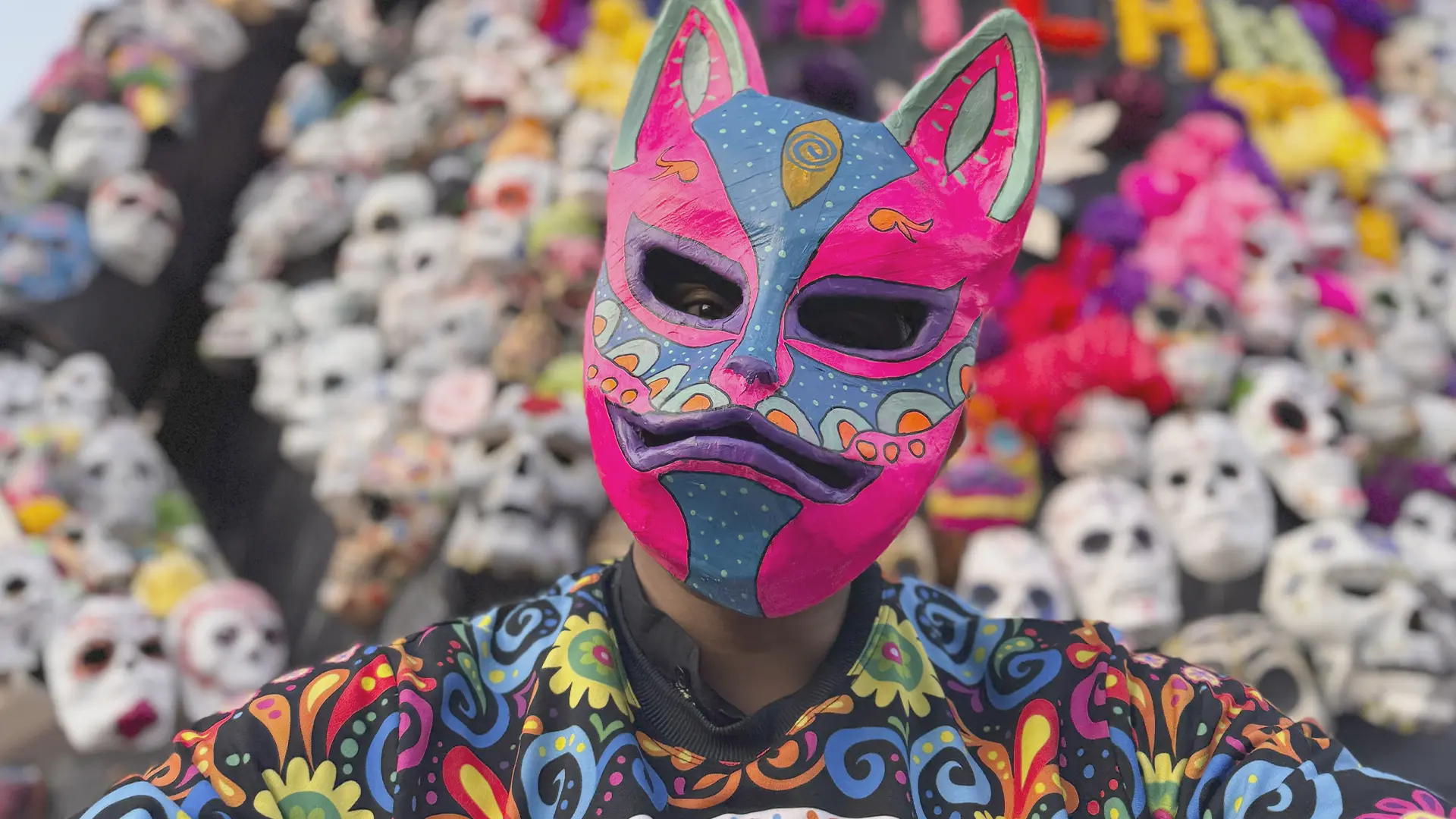
Miroslav Ü ’s masks —designed by local artisans such as Mario Olivera—are key elements. Beyond their aesthetic appeal, they serve as a bridge between his Mesoamerican heritage and the contemporary experience of the club and electronic music festivals. The artist never takes the stage without them, and few people know what he looks like.
Territory and Identity
Although his new album includes a tribute to Quintana Roo and Felipe Carrillo Puerto—a historic figure who championed the Maya people—the project remains rooted in Oaxaca and in that frontier where identity, memory, and the present converge.
The artist grew up in a community called Santo Domingo Tehuantepec, one of the most important cultural hubs on the Isthmus, where it is still common to see local women walking through the streets chatting in Zapotec or Spanish and, from time to time, Miroslav Ü wearing his ancestral mask, his laptop, and his MIDI controllers, blending in with the local magic.
“It’s one of the most open-minded cultures in the region. It’s a warm and welcoming place,” he says. It’s no coincidence that his stage name comes from his favorite soccer player: the Slovakian Miroslav Klose.
What does pre-Hispanic music sound like if there are no recordings?
In the absence of direct, authentic sound recordings, Miroslav Ü clarifies that his starting point is not to imagine “what the past might have sounded like,” but rather to learn from living references. “There may be no recordings or data in the modern sense, but these practices exist because grandparents and creators have sustained them through oral transmission,” he explains, defending his position without arrogance, but with confidence.
“Mexico has an abundance of wood and traditional instruments, as well as cultures that have preserved their musical traditions since the colonial era; this heritage remains present, though it is not always visible to the industry or institutional archives,” he says.
Oaxaca is also home to pitu nisiada, a form of music played on a reed flute with minimal instrumentation: a leather drum, deer antlers, a turtle shell, and a three-hole flute. “Without complex structures or melodic virtuosity; it is direct music, tied to everyday life,” he notes. Miroslav Ü’s project is built upon these findings, not as an archaeological reconstruction, but as a contemporary interpretation using electronic tools and a danceable beat.
Language, Civil War, and the Living Archive
In 2026, the artist began to outline a clear strategy: to construct a sonic narrative rooted in indigenous languages that engages with the present. In several tracks, the first part is sung or recited in Zapotec or Nahuatl; the second is translated into Spanish to forge a connection with contemporary listeners.
Some of his works revolve around what he calls “the soul of war”—a reinterpretation of Huitzilopochtli stripped of its warlike connotations, not as violence, but as a force for transformation. “There are many versions of what is said about these deities,” he explains. “I focus on what builds.”

And yes, his view is somewhat romanticized, but he stands by it. “There are many historians who say that human sacrifices took place, and others who say they didn’t; I can’t tell you whether they did or not, but what I do know is that every offering was made as a sacrifice and pre-Hispanic music was used to give thanks,” he says. “It’s no use knowing a lot about history if you don’t live it; that’s the big mistake made by the vast majority of Mexicans,” he notes.
From the community to the festivals: Miroslav Ü and electronic music in Oaxaca
Internationally, at festivals like Tomorrowland —where internationally renowned DJs such as Angemi and Austin Kramer have shown support for the project—it is seen as an evolution of electronic music. Within Mexico, however, it is often seen as a break with tradition. “We are questioning which traditions are valid and reviving languages that have been neglected for a long time,” he says.
“What could be better than taking global electronic music and reimagining it our way?” — Miroslav Ü
Electronic music —associated with foreign, American, and European culture—thus becomes a transformative tool.
Undoubtedly, this is a move worthy of a master of Patolli, the pre-Hispanic board game comparable to chess: bringing the past to life from memory and rewriting indigenous culture in the contemporary world. And that is precisely where the core value of his project lies.
To keep exploring this thread, visit Latin American culture.